Companies that have handed out Copilot licenses want to confirm with numbers whether they are actually being used. If the usage dashboard shows many people who are not using it, that can lead to a decision to cut licenses. But if those numbers are not people who are not using it, but rather people who are "not classified because of how counting works" or people "whose telemetry is not arriving because they use an older IDE," the decision will be wrong.
Between November 4 and 6, 2026, the description of Copilot usage metrics was updated three times in GitHub's documentation repository (github/docs). The changes were also announced in the GitHub Changelog on November 5 and 6. In this article, based on the source text we checked on November 7, 2026, and the live pages and announcements we cross-checked on November 11, we sort out what changed and how to read the numbers before using them to review licenses. Note that an update on November 9 reorganized the page structure, and items such as the table of minimum versions moved to the "Coverage and requirements for Copilot usage metrics" page.
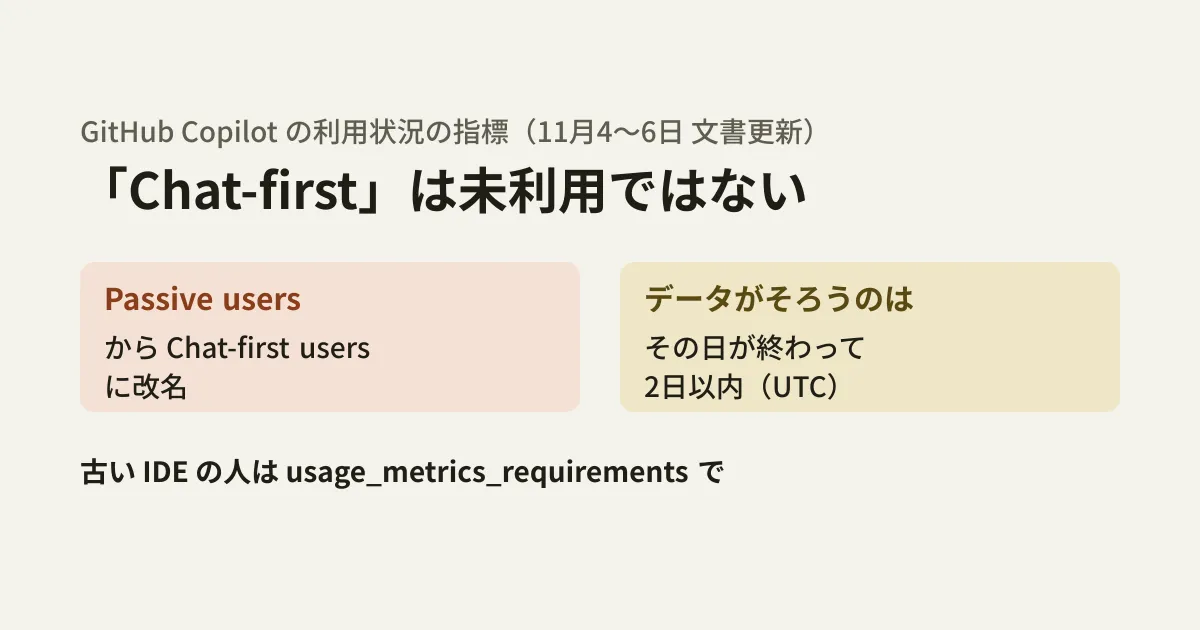
"Passive users" becomes "Chat-first users"
With the November 6 update and the GitHub Changelog announcement, "Passive users" on the impact dashboard was renamed "Chat-first users." In the API, it still corresponds to the No Cohort value. According to the announcement, only the name changed; the number of people in the category did not.
The new definition in the source text is as follows.
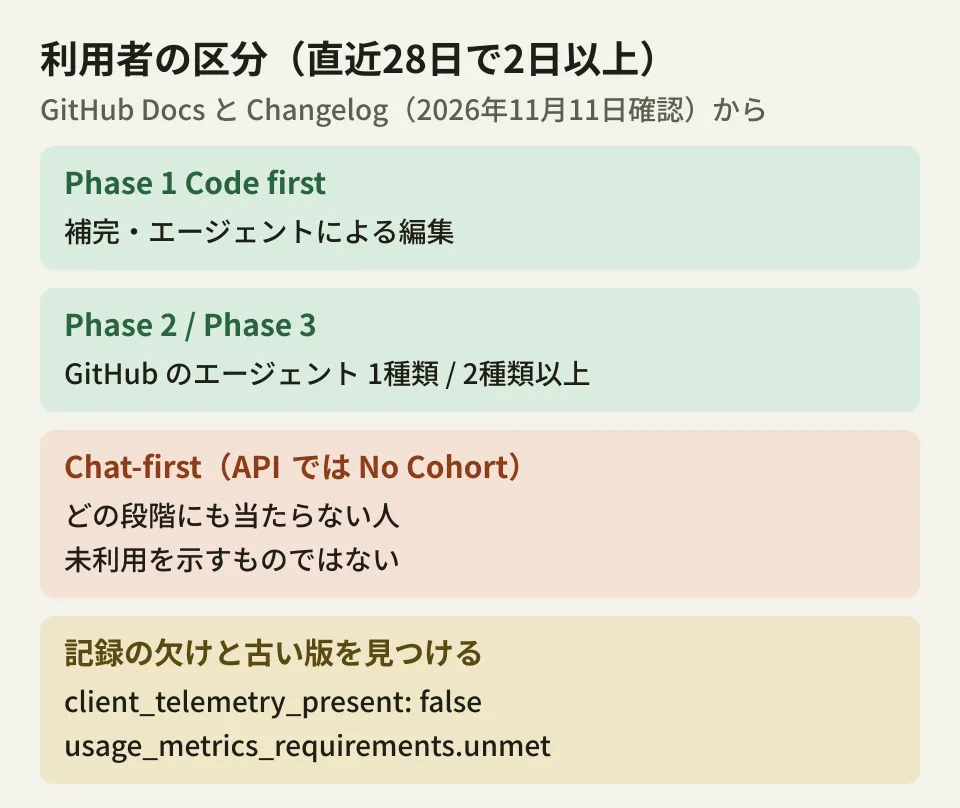
Someone who uses Copilot but has not used qualifying features on two or more days in the last 28 days. For example, someone who asks questions in Copilot Chat or agent mode but has not applied code changes.
The source text repeatedly states that this category "does not indicate non-use." The API description also says that people in this category may use Copilot daily and consume usage allowances.
How phases are divided
The meaning of Chat-first becomes clearer when placed alongside the other categories. The source text divides users into the following phases based on which features they used.
- Phase 1 (Code first): Used code completion or direct file edits by the agent (agent edits). Using Chat or agent mode alone does not qualify if no completions or edits result
- Phase 2 (Agent first): Used one type of agent feature on GitHub (the cloud agent, code review, Copilot CLI, and so on)
- Phase 3 (Multi-agent): Used two or more types of agent features on GitHub, or used the GitHub Copilot app
Each phase requires using that phase's features on two or more days in the last 28 days. The documentation says phases are recalculated every day from the last 28 days of records, so a user's phase can change as older days drop out of the window, even if their usage has not changed.
The November 6 update added Copilot Chat (chat) and the VS Code Agents window (vscode_agent) to the per-feature user counts (copilot_feature_engagement), bringing the total to nine features. However, these two are used only for usage totals, not for determining phases. This is why people who mainly use Chat fall into Chat-first. According to the announcement, the Chat count includes agent mode usage, so people who made agent edits are also counted under Chat. These two appear only in the 28-day enterprise and organization reports; reports for periods before the change contain only the original seven features.
Data is complete after two days
The November 4 update standardized the guideline for data delays. The previous page said data could be "delayed by up to three days" and "finalized within three days," but the new source text reads as follows.
Data for a given day becomes available within two days (UTC) after that day ends.
Even if the numbers for the most recent days look low, they may still be processing. The source text recommends waiting until the processing period is over before investigating gaps. It also says that if you exported NDJSON files that include days still being processed, you should export them again after the period has passed.
In Japan time, the UTC date boundary falls at 9:00 a.m. If you check last week's numbers at the start of the week, you will need to wait until the weekend's data is complete before looking.
Fields for finding missing telemetry and older IDEs
These fields were announced in the GitHub Changelog on November 5 and added to the documentation on November 6. The following two fields were added to individual user records.
client_telemetry_present: Whether telemetry from the user's client (such as an IDE) arrived that day.falseindicates that the server recorded usage but telemetry from the client did not arriveusage_metrics_requirements: Whether the IDE and extension versions the user last used meet the minimum versions. Values aremet(meets),unmet(does not meet), andunknown(unknown)
Aggregate records also gained missing_client_telemetry_user_count and below_usage_metrics_minimum_user_count as daily user counts. Because both are daily counts, a note says not to add them up across days. Since one person can be counted in both, you also cannot add the two counts together. A day with no value (null) means "no data," not 0. Days before these fields were added have no values.
According to the Changelog, people whose client telemetry does not arrive are still counted as users. However, lines of code and breakdowns by feature and model are missing. Causes listed include old editors or extensions, disabled IDE telemetry (sending of usage data), and blocking by proxies or firewalls. It also says telemetry may not arrive from users behind a proxy even if they meet the version requirements.
The minimum versions are shown in a table on the "Coverage and requirements for Copilot usage metrics" page. For example, VS Code requires version 1.107.1 or later of the editor and version 0.35.3 or later of the Copilot Chat extension. With older versions, the telemetry needed for the metrics may not be sent, or usage may be counted as usage of a different IDE. Counting agent usage additionally requires VS Code 1.139.0 or later; the page says usage of the Agents window in 1.134 to 1.138 is missing from the metrics and cannot be backfilled later.
Before using them to review licenses (editorial suggestion)
From here on is the editorial team's suggestion based on the source text. We did not verify it against the dashboard or API numbers of an actual organization.
Do not treat Chat-first as "non-use." When choosing candidates for license removal, look for people who are truly not using Copilot through measures such as daily active users (DAU), not whether they are Chat-first.
Fix missing telemetry first. Ask people whose usage_metrics_requirements is unmet to update their IDEs and extensions first. The source text also recommends enforcing minimum versions through device management tools. For people with many days where client_telemetry_present is false, check IDE telemetry settings and proxies in addition to versions.
Do not use the last two days for decisions. Close weekly and monthly reports at the last day whose processing has finished.
Do not take comparison figures as proof of results as they are. The dashboard's "adoption multiplier" compares the number of pull requests created by people in Phases 1 to 3 with those created by Chat-first people. The source text cautions that the two groups differ in team composition and task difficulty, so the figure does not necessarily reflect the effect of Copilot itself.
As of November 7, the old name "Phase 0-1 Passive and Code First Users" remained in the "Potential return on investment" section of the same page, but the November 9 update corrected it to "chat-first and code-first users (Phases 0-1)." If older materials or internal reports say "Passive," read it as the same category as Chat-first.
For managing costs based on Copilot usage, see also our article on Copilot usage-based billing and our article on Copilot Fusion.
Scope of verification
On November 7, 2026, we reviewed the diffs of commits 8d0d83c (November 4, 2026, setting the data delay guideline to two days), ce25bc8 (November 6, renaming Passive users to Chat-first users and adding chat and vscode_agent), and 087ba79 (November 6, fields for client telemetry and minimum versions) in GitHub's documentation repository (github/docs), along with the source text on main for "GitHub Copilot usage metrics," "Interpreting usage and adoption metrics for GitHub Copilot," and "Data available in Copilot usage metrics" (document research). On November 11, 2026, we checked the live pages after the November 9 reorganization (commit 12939dd) and the GitHub Changelog announcements (November 5 and 6). We have not checked an actual organization's dashboard, API, or NDJSON output.
GleamHub accepts consultations on development, AI, and automation, including introducing AI development tools such as Copilot and designing how to measure their impact. Since the numbers to watch depend on your setup, please reach out via our contact form.
References
- GitHub Docs — GitHub Copilot usage metrics
- GitHub Docs — Interpreting usage and adoption metrics for GitHub Copilot
- GitHub Docs — Data available in Copilot usage metrics
- GitHub Docs — Coverage and requirements for Copilot usage metrics
- GitHub Changelog — Copilot impact dashboard adds chat and VS Code agent usage (November 6, 2026)
- GitHub Changelog — Usage metrics API flags telemetry and version gaps (November 5, 2026)
- github/docs — commit ce25bc8
- github/docs — commit 087ba79
- github/docs — commit 8d0d83c