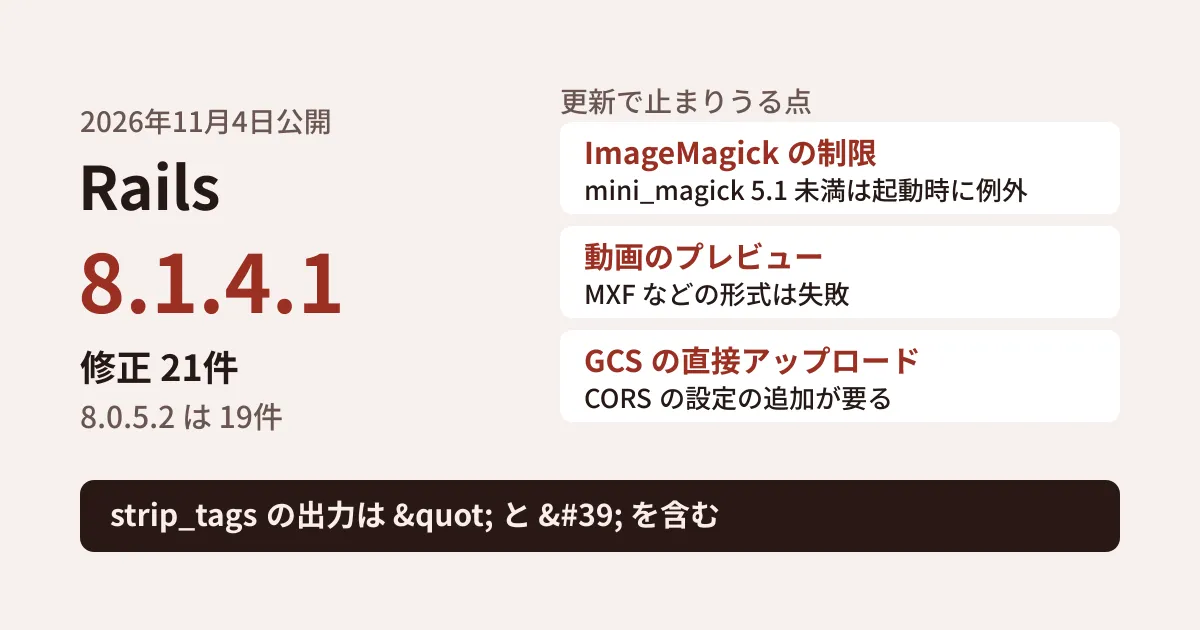
A security release only bumps the last digit of the version, but upgrading to Rails 8.1.4.1 without checking could break your app. This is because the CHANGELOG describes, as part of the fixes, conditions under which an exception is raised at boot and conditions under which uploads from the browser fail.
Rails released 8.1.4.1 and 8.0.5.2 on November 4, 2026 (they were published to RubyGems and announced on the official blog on November 4; the CHANGELOG headings are dated November 3). In this article, based on each component’s CHANGELOG, the official blog announcement, GitHub security advisories and the contents of the gems fetched from RubyGems, we lay out the behavior changes after updating and where to check before you upgrade.
Released versions and number of fixes
The 8.1.4.1 section of the CHANGELOG lists 21 GitHub security advisory numbers (GHSA). The breakdown is 7 for Active Storage, 7 for Action Pack, 4 for Action View (including raising the required version of rails-html-sanitizer), 2 for Active Support and 1 for Action Mailbox, while Active Record, Action Mailer, Railties and others say “No changes.” The official blog announcement also mentions “21 security issues.” The most severe is arbitrary file read and write during image analysis in Active Storage, rated Critical (GHSA-f3w6-w445-fwh9).
The 8.0.5.2 section has 19 entries. It does not include two fixes found in 8.1.4.1: detecting mismatches between Forwarded and X-Forwarded-For (GHSA-2gff-2mmg-m73p), and the handling of SafeBuffer in MessagePack (GHSA-2w9f-fxwj-w2qf). No fixed release was issued for the 7.2 series this time. The September 24 announcement of 7.2.4 said it was the last release of the 7.2 series and that future security fixes would be released only for the 8.0 and 8.1 series. This announcement also says “Security support for the 8.0 series ends on November 7, 2026.” and the maintenance policy page likewise lists security fixes for the 8.0 series until November 7, 2026, and for the 8.1 series until October 10, 2027. For apps on the 8.0 series, we recommend upgrading to 8.0.5.2 and also planning a move to the 8.1 series (editorial suggestion).
Behavior changes after updating
Active Storage restricts ImageMagick processing (GHSA-f3w6-w445-fwh9)
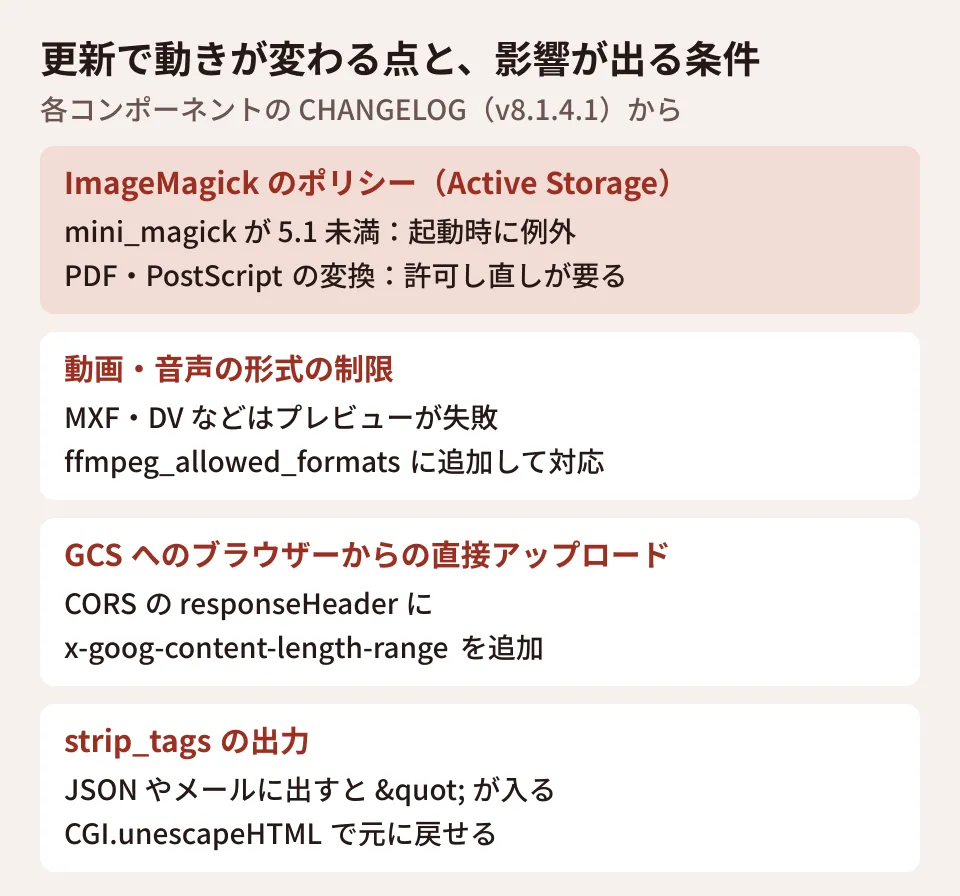
Active Storage in 8.1.4.1 bundles an ImageMagick security policy (policy.xml) and applies it to every ImageMagick process that MiniMagick launches. According to the CHANGELOG, the policy denies reading other files referenced inside an image, fetching external resources over URLs or HTTP, and passing data to Ghostscript (PS, EPS, PDF and so on). As it says, “The policy applies to every ImageMagick command MiniMagick runs, not only Active Storage’s.” so it also affects processing that uses MiniMagick outside Active Storage.
The CHANGELOG says the following apps “must act.”
- Apps whose variant processor is
:mini_magick. Unless mini_magick is 5.1 or later, “it raises at boot,” meaning an exception is raised at startup. - Apps that render PostScript or PDF with ImageMagick. You need to re-allow the
gsdelegate and the formats you use in the server-sidepolicy.xml. - Apps that replace
MiniMagick.cli_envafter boot, clear the environment withMiniMagick.cli_prefix, use a customMiniMagick::Shell, or use GraphicsMagick. Because the bundled policy does not reach them, you need to write the same rules in ImageMagick’s system policy.
For all other apps, the CHANGELOG says the app “needs no change.” The 8.1.4.1 gem we fetched contains lib/active_storage/image_magick/policy.xml (8.1.4 does not), as well as the error message shown when mini_magick is too old: “requires mini_magick 5.1 or later.”
Video and audio previews fail for some formats (GHSA-3f4q-8x5m-76v8)
The formats passed to ffmpeg and ffprobe are now limited to the list in config.active_storage.ffmpeg_allowed_formats. The gem’s default is mov matroska avi mpeg mpegts flv asf ogg mp3 wav flac aac aiff caf. The CHANGELOG says formats such as MXF, DV, AC3, WavPack, AU, W64 and raw H.264 or MPEG-1/2 video “now fail to preview.” Apps that accept footage from professional cameras (such as MXF) need to add those formats to the list.
Direct uploads from the browser to GCS require a CORS setting (GHSA-hfr4-8rjc-97m2)
For direct uploads to Google Cloud Storage, signed URLs now require the x-goog-content-length-range header. Because the browser sends this header, the CHANGELOG says “direct uploads from the browser fail” unless it is included in responseHeader in the bucket’s CORS configuration. Note that you need to change the configuration on the Google Cloud side, not your app’s code.
" and ' appear in the output of strip_tags (GHSA-rq8q-p985-fjq7)
strip_tags now also replaces " and ' in its output with character references. When displayed as HTML, nothing looks different. The CHANGELOG says that when the output is used outside HTML, such as in text templates or JSON, what used to be " and ' becomes " and '. For example, apps that strip tags from body text and put it into an email subject or an API response will see different output. To restore the previous output, pass it through CGI.unescapeHTML.
Requests with two conflicting forwarded headers are rejected (GHSA-2gff-2mmg-m73p, 8.1 series only)
When ip_spoofing_check is enabled (the default), requests that carry both Forwarded and X-Forwarded-For with conflicting client IP addresses now raise ActionDispatch::RemoteIp::IpSpoofAttackError. In setups that stack a CDN and a load balancer, each adding a different header, it is a good idea to check the error logs after updating.
There is also a fix that changes how Vary is set (GHSA-r9jg-fmfx-2gv6). For the relationship between Vary and shared caches, our article on Django 6.1.3, where we reproduced a separate Django fix related to Vary, is a useful reference.
In addition, apps that receive email from Mailgun through Action Mailbox now reject messages whose timestamp is more than two minutes ahead of the local clock (GHSA-5957-c7qm-m469). If the server’s clock is off, receiving mail may be affected, so also check time synchronization (this impact is the editorial team’s interpretation).
What to check before upgrading, in order (editorial suggestion)
- Check the mini_magick version. Use
bundle exec gem list mini_magickorGemfile.lockto confirm it is 5.1 or later. If it is older, upgrade it togem "mini_magick", "~> 5.1"together with Rails. - List the formats you handle with ImageMagick. Search the places that use
variantorMiniMagick::Imageto find out whether you generate PDF thumbnails or convert PostScript with ImageMagick. If so, you need to allow them in the server’spolicy.xml. - Check the video and audio formats you accept. If you show previews, check whether the formats you actually accept are in the default list.
- Check whether you use direct uploads to GCS. If
config/storage.ymlisservice: GCSand your forms usedirect_upload: true, addx-goog-content-length-rangeto the bucket’s CORS configuration first. - Find where the output of
strip_tagsis used. Usegrep -rn "strip_tags" app/to check for places that output it outside HTML, such as email, JSON or CSV. - Run boot and key operations in a test environment. Go through boot, image upload and conversion, video previews and direct uploads once in the same configuration as production before releasing to production.
These commands are general-purpose, and we did not run them against a real app when writing this article. If you are also checking fixes to Ruby itself, see our article on the regular expression fixes in Ruby 4.0.9 and other versions.
Scope of verification
On November 15, 2026, we reviewed the CHANGELOG of each component at the v8.1.4.1 and v8.0.5.2 tags of rails/rails, and the RubyGems publication dates (desk research). We also fetched actionview and activestorage 8.1.4 and 8.1.4.1 from RubyGems and compared the bundled files (policy.xml, error messages and the default format list) and the gemspec dependencies. On November 20, 2026, we reviewed the official Rails blog announcements (8.1.4.1 and 8.0.5.2, and 7.2.4), the maintenance policy page and the 21 entries in the GitHub security advisory database, and corrected the count. We did not boot a Rails app, run any methods, or verify behavior with ImageMagick, ffmpeg, GCS or Mailgun.
GleamHub’s development consulting covers updating business apps built with Rails and planning the checks before an update. What to check depends on how your app is built, so please reach out through our contact form.
References
- Ruby on Rails — Rails Versions 8.0.5.2 and 8.1.4.1 have been released!
- Ruby on Rails — Rails Version 7.2.4 has been released!
- Ruby on Rails — Maintenance policy
- GitHub Advisory Database — GHSA-f3w6-w445-fwh9
- rails/rails — activestorage/CHANGELOG.md(v8.1.4.1)
- rails/rails — actionpack/CHANGELOG.md(v8.1.4.1)
- rails/rails — actionview/CHANGELOG.md(v8.1.4.1)
- rails/rails — activesupport/CHANGELOG.md(v8.1.4.1)
- rails/rails — actionmailbox/CHANGELOG.md(v8.1.4.1)
- rails/rails — actionpack/CHANGELOG.md(v8.0.5.2)
- RubyGems — rails version list