When building internal API servers, endpoints that receive chat notifications, or admin screens that connect over WebSocket in Python, some setups use aiohttp as the asynchronous HTTP library. It can be used both as a server (aiohttp.web) and as a client that calls external APIs (ClientSession).
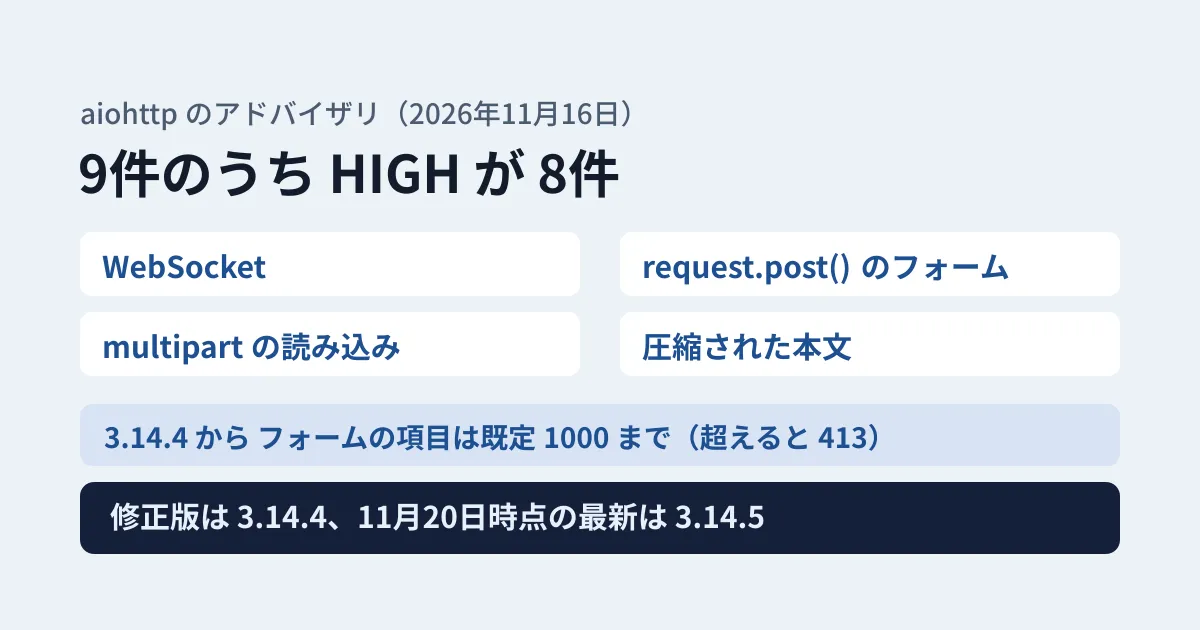
On November 16, 2026, nine advisories for aiohttp were registered in the GitHub Advisory Database. Eight are rated HIGH, and they are mainly denial-of-service issues such as "exhausting memory with a crafted request" and "blocking the event loop so the server cannot respond to other requests." All versions before 3.14.4 are affected, and the fixed version is 3.14.4.
3.14.4 was released in October (dated October 4 in CHANGES.rst and published to PyPI on October 5), and the advisories were registered about six weeks later. Servers running with pinned dependency versions may not have picked up this fixed version. This article lays out the usage patterns the nine advisories apply to and the behavior that changes in 3.14.4.
Usage patterns the nine advisories apply to
Whether each of the nine applies depends on which features you use. Most concern the server side, but some apply when a client (ClientSession) connects to a malicious server.
| Applies when | Advisory (severity) | Possible impact |
|---|---|---|
| Using WebSocket (GHSA-5rmc also affects clients that connect to a malicious server) | GHSA-3rp8-rxj8-mvjw(HIGH)、GHSA-5rmc-48h2-hvcm(HIGH) | Uses memory beyond max_msg_size and the receive queue limits |
| Handlers that receive upgrade requests such as WebSocket and neither accept nor reject them right away | GHSA-pw86-h8fm-j323(HIGH) | Buffers subsequent data without limit until the handler finishes |
Reading URL-encoded forms with request.post() | GHSA-xgw8-8ccx-rmqh(HIGH) | Sending a large number of fields with the same name blocks the event loop |
Reading multipart data (the base64 part) | GHSA-24c4-3p7v-29cm(HIGH) | Reads beyond client_max_size, or the event loop keeps spinning |
| Receiving compressed bodies or messages | GHSA-h4cc-hm5h-fmm9(HIGH) | Concatenated compressed data keeps the CPU busy (also from a malicious server to a client) |
Registering a mask containing two or more * with app.add_domain() | GHSA-jm3w-gw2p-xjfj(HIGH) | A long Host header blocks the event loop |
| Using the pure-Python parser | GHSA-28qf-cpwq-vmc2(HIGH) | An already processed request is passed to the app again, or the buffer keeps growing |
The client's CookieJar | GHSA-5pv8-vvhc-h7jv(MODERATE) | A malicious server can make it store a large number of cookies |
When the event loop is blocked, every other request that process is handling has to wait too. Because an aiohttp server handles many connections concurrently on a single event loop, a single crafted request affects every connection that process is handling.
GHSA-28qf affects only the pure-Python parser, and the advisory gives "Switch to the default C parser" as a workaround. It lists setting the environment variable AIOHTTP_NO_EXTENSIONS and installing from something other than the standard wheels as cases where the pure-Python implementation is used. Conversely, GHSA-3rp8 (WebSocket max_msg_size) is an issue on the C extension side, and the advisory gives "use the pure-Python implementation with AIOHTTP_NO_EXTENSIONS=1" as a workaround if you cannot upgrade. The two workarounds point in opposite directions, so if you adopt one, you need to keep in mind that you become exposed to the other issue.
Behavior that changes in 3.14.4
Along with the fixes, 3.14.4 changes some behavior after you upgrade. From the 3.14.4 section of CHANGES.rst, here are the changes that may affect your application.
- Limit on the number of form fields. A
client_max_fieldsargument has been added toweb.Application, with a default of1000. URL-encoded forms with more than 1000 fields now return413. If you accept forms with many fields, such as admin screens that submit list rows in bulk, check the limit before upgrading and raise it with the argument if needed (0means no limit). - Cookie parsing and limits. The client's parsing of
Set-Cookiehas changed to "one cookie per header," and limits such as the number of stored cookies have been added toCookieJar. For scripts that log in to external services and operate with cookies, check once after upgrading that they still work. - WebSocket receive queue. The receive queue now holds only a weak reference to
WebSocketReader. CHANGES.rst says that code that builds its own reader component and passes it toset_parser()needs to keep its own reference to it. Code that uses only the usualws_connect()orWebSocketResponseis not affected by this change.
3.14.5 was also released on October 10 (published to PyPI on October 11). Its changes include a fix so that WebSockets using permessage-deflate no longer drop the connection when they receive a control frame with the RSV1 bit set, and it is not listed as a fixed version in the advisories. If you upgrade, the simplest option is to go straight to 3.14.5, the latest version as of November 20.
What to check before and after upgrading (editorial suggestion)
From here on are the editorial team's suggestions.
1. Check which version you have installed. It may be installed as a dependency of another library, so check even if it is not listed as a direct dependency.
pip show aiohttp
# uv で管理している場合
uv tree --invert --package aiohttp
2. Compare the features you use against the table. Search your code and environment variables for request.post(), multipart reading, WebSocket, add_domain() and AIOHTTP_NO_EXTENSIONS settings. If your server uses even one of them, prioritize the upgrade.
3. After upgrading, check how forms and clients behave. If you have screens that submit forms with many fields, submit them and make sure you do not get 413. For integrations with external services that use cookies, run through the whole flow once, starting from login.
4. Put limits in front. Setting limits on request body size and header length at a reverse proxy or load balancer narrows the impact of issues like these. The right values depend on the application, so check your current largest requests before deciding.
We also covered common sticking points when updating Python dependencies in our article on uv 0.13 and our article on the Pillow vulnerability.
Scope of verification
On November 17, 2026, we reviewed the nine advisories in the GitHub Advisory Database (data from github/advisory-database), the aio-libs/aiohttp repository (tags v3.14.4 and v3.14.5 and CHANGES.rst), and the publication dates on PyPI (desk research). On November 20, we rechecked the content and scope of the advisories and that no new advisories or versions newer than 3.14.5 had been released since. We did not reproduce the issues with versions before and after the fixes or check compatibility after upgrading.
GleamHub's development, AI and automation consulting can help with updating dependencies and planning maintenance for internal API servers and integrations. Because the approach depends on your setup, please reach out via our contact form.
References
- GitHub Advisory Database — GHSA-3rp8-rxj8-mvjw(WebSocket max_msg_size bypass via integer overflow)
- GitHub Advisory Database — GHSA-5rmc-48h2-hvcm
- GitHub Advisory Database — GHSA-pw86-h8fm-j323
- GitHub Advisory Database — GHSA-xgw8-8ccx-rmqh
- GitHub Advisory Database — GHSA-24c4-3p7v-29cm
- GitHub Advisory Database — GHSA-h4cc-hm5h-fmm9
- GitHub Advisory Database — GHSA-jm3w-gw2p-xjfj
- GitHub Advisory Database — GHSA-28qf-cpwq-vmc2
- GitHub Advisory Database — GHSA-5pv8-vvhc-h7jv
- aio-libs/aiohttp — CHANGES.rst(v3.14.5)
- aiohttp — PyPI