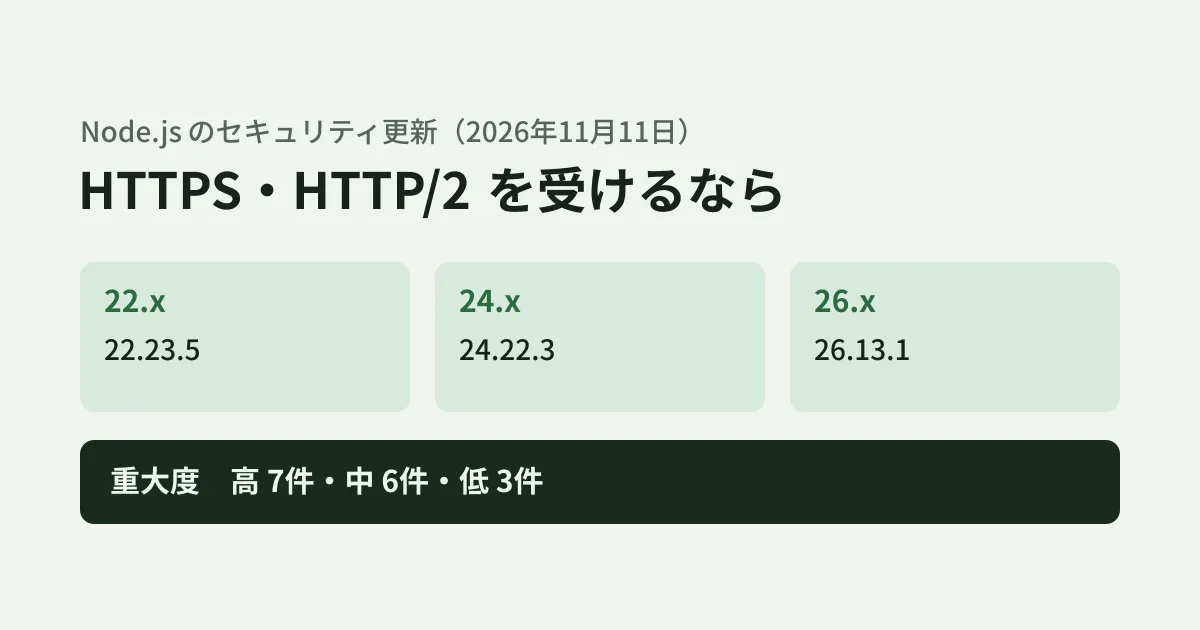
For API servers and admin panels running on Node.js, how urgent this update is depends on where HTTPS is terminated. A setup where a load balancer or reverse proxy terminates TLS and Node.js receives plain HTTP is affected by a different number of vulnerabilities than a setup where Node.js holds the certificate and accepts HTTPS or HTTP/2 directly.
In its November 11, 2026 announcement, "Wednesday, November 11, 2026 Security Releases", Node.js released fixed versions for its three supported release lines, 26.x, 24.x and 22.x. The versions are 26.13.1, 24.22.3 and 22.23.5. In this article, we organize the vulnerabilities in the announcement by usage pattern, and summarize what we checked after downloading 22.23.5 locally and the order for updating.
Vulnerabilities in the announcement
The announcement's "Patched vulnerabilities" section lists 16 CVEs: 7 rated high, 6 medium and 3 low. It also lists dependency updates for llhttp (22.x, 24.x, 26.x), undici (24.x, 26.x) and sqlite (22.x, 24.x). The announcement also says "It’s important to note that End-of-Life versions are always affected when a security release occurs.", so release lines that have reached end of life are treated as affected.
The announcement does not list the 27 Alpha as affected. The release notes for 27.0.0-alpha.0.1.0, released on November 12, include fixes from the 26.13.1 commit list, with the same titles and the same pull request numbers from the private repository for fixes (nodejs-private) (some were already included as of 27.0.0-alpha.0.0.0). However, no CVE numbers are listed, and the distribution index (index.json) does not carry the security release flag (security) either. If you are testing the 27 Alpha in CI, switch to 27.0.0-alpha.0.1.0. We covered where the 27 Alpha stands in our article on the first Node.js 27 Alpha.
Four of the high-severity issues are listed as affecting all release lines (22.x, 24.x, 26.x).
- CVE-2026-123864 (HTTPS): a zero-length TLS write causes the HTTP parser to re-enter, and memory from other connections (including TLS private keys and other users' requests) gets mixed into the request body. The conditions are that the handler calls
res.flushHeaders()while receiving the body and later callsres.end()with non-empty data. The announcement states explicitly: "Cleartextnode:httpis not affected." - CVE-2026-123865 (HTTP/2): triggering a protocol error while a connection is being closed leaves the session uncleaned, so memory and file descriptors keep leaking. It can be triggered without authentication
- CVE-2026-123866 (HTTP/2): if a stream is destroyed while writes are backed up, freed memory (including responses for other connections) is sent to the peer
- CVE-2026-123872 (TLS): changing the servername (SNI) during TLS 1.2 renegotiation allows per-hostname client certificate authentication to be bypassed
The announcement lists the remaining three high-severity issues (CVE-2026-123863, CVE-2026-126051, CVE-2026-123874) as affecting 24.x and 26.x. They are a forced termination when an HTTP/2 session closes, a crash from an exception in a TLS handshake callback, and a use-after-free of a respondWithFile() stream.
Which usage patterns are affected
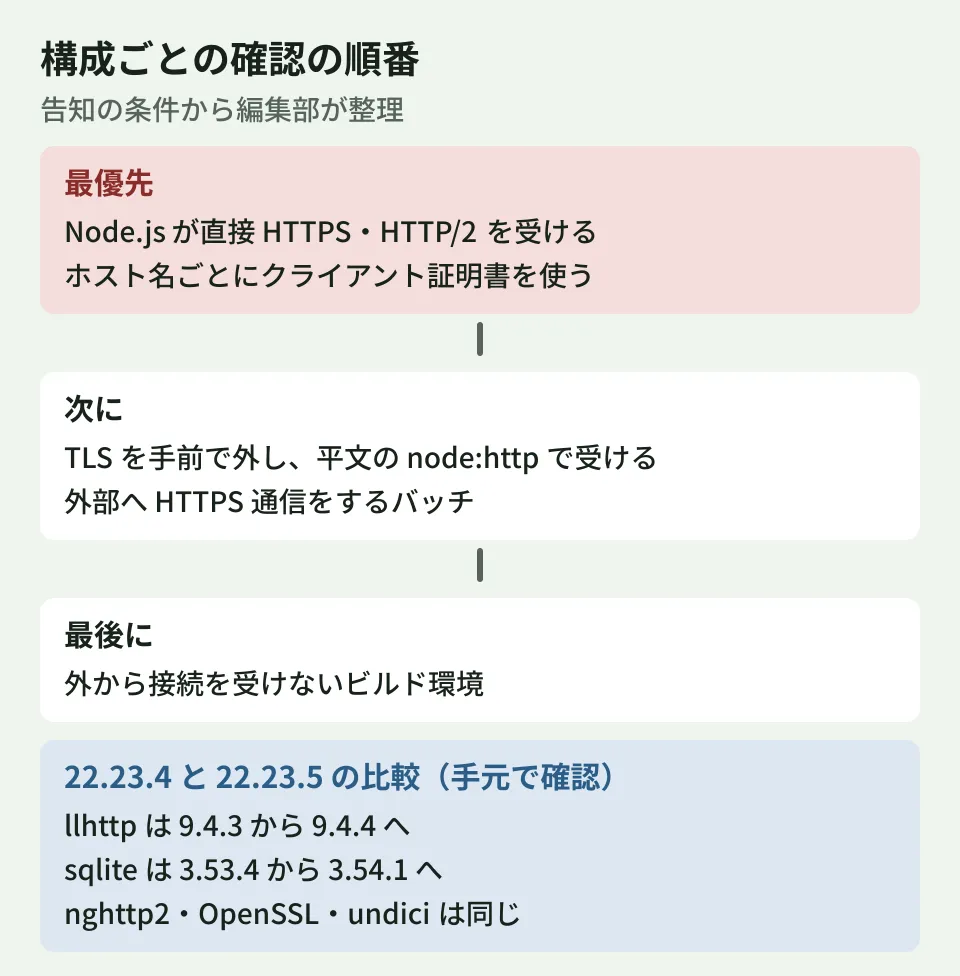
The editorial team has organized the announcement's conditions by configuration as follows. Severities are from the announcement; the mapping to configurations is the editorial team's interpretation.
| Architecture | Mainly affected by | Suggested priority |
|---|---|---|
Node.js accepts HTTPS (node:https) directly | CVE-2026-123864 (high) and the other TLS issues | Highest priority |
Node.js accepts HTTP/2 (node:http2) | The four high-severity HTTP/2 issues (two on 22.x) and the medium-severity ones | Highest priority |
| Uses different client certificates (mTLS) per hostname | CVE-2026-123872 (high), CVE-2026-123867 (medium) | Highest priority |
TLS is terminated upstream and Node.js receives plain node:http | The HTTPS, HTTP/2 and TLS issues above are unlikely to apply | With regular updates |
Makes outbound HTTPS requests with https.Agent | CVE-2026-123877 (medium; certificate verification can be bypassed through TLS session reuse) | With regular updates |
| Does not accept external connections, such as static site builds | The server-side issues are unlikely to apply | With regular updates |
The medium-severity issues also include one where proxy credentials appear in error messages when the proxy URL is misconfigured (CVE-2026-123871, all release lines). If you log errors as they are, check how past logs are handled along with updating.
"Unlikely to apply" means the configuration does not match the conditions in the announcement, not that you can skip updating. There are also exceptions, such as when the same process also acts as an HTTPS client, or when it is started with HTTPS directly only during development.
What we checked after downloading 22.23.5
On November 12, 2026, we downloaded the distribution archive (node-v22.23.5-linux-x64.tar.xz) from nodejs.org and verified its hash against SHASUMS256.txt in the same location (OK). Comparing the bundled library versions with the 22.23.4 we had locally using process.versions gave the following results.
v22.23.4  llhttp 9.4.3  nghttp2 1.69.0  openssl 3.5.9  undici 6.29.1  sqlite 3.53.4
v22.23.5  llhttp 9.4.4  nghttp2 1.69.0  openssl 3.5.9  undici 6.29.1  sqlite 3.54.1
This matches "deps: update llhttp to 9.4.4" and "deps: update sqlite to 3.54.1" in the 22.23.5 changelog (doc/changelogs/CHANGELOG_V22.md). The versions of nghttp2, OpenSSL and undici did not change, and the HTTP/2 and TLS fixes come in as changes to Node.js's own code. The fact that undici was not updated on 22.x is also consistent with "undici on 24.x, 26.x" in the announcement.
Note that the set of CVEs listed in the 22.x changelog does not fully match the scope of impact stated in the announcement. For example, the changelog lists CVE-2026-123874 (HTTP/2, high) and CVE-2026-123873 (low), but the announcement lists the former as affecting only 24.x and 26.x, and the latter does not appear in its list. CVE-2026-123873 also appears in the 24.22.3 and 26.13.1 changelogs. To confirm exactly which release lines are affected, check both the "Impact" of each item in the announcement and the changelog for the release line you use.
Our checks went only as far as downloading the version and comparing the bundled libraries; we have not reproduced the vulnerabilities or verified application behavior after updating.
Order of updates (editorial suggestion)
- Identify servers that accept HTTPS or HTTP/2 directly. Find services whose code uses
https.createServer,http2.createSecureServerortls.createServer, and update them first. Also record whether their handlers useres.flushHeaders(). - Check servers that use mTLS. If you configure different client certificate policies per hostname (
SNICallbackorserver.addContext()), you are affected by CVE-2026-123872 and CVE-2026-123867. On 24.x and 26.x, TLS servers that use theSNICallback,OCSPRequest,newSessionorresumeSessionhooks orserver.addContext()are also affected by CVE-2026-126051 (high; an exception can be triggered from outside to stop the process). - Update the remaining servers and batch jobs. Setups that terminate TLS upstream should also be updated as part of regular updates if they make outbound HTTPS requests.
- Align build environments and developer machines. Bring the versions in
.node-version, CI settings and container base images to the same fixed version as production.
We covered pitfalls found in production builds when updating the Node.js version across multiple repositories at once in our article on the bulk update to Node.js 22.23.4, and how to choose a release line after 24.x entered maintenance in our article on Node.js 26 LTS.
Scope of verification
On November 12, 2026, we reviewed the nodejs.org announcement "Wednesday, November 11, 2026 Security Releases", the distribution index (dist/index.json) and the 22.23.5 changelog (
doc/changelogs/CHANGELOG_V22.mdin nodejs/node) (desk research). We also downloaded the Linux build of 22.23.5, verified its hash, and comparedprocess.versionswith our local 22.23.4 (Ubuntu 24.04.5, Linux 6.18.44). On November 13, 2026, we rechecked the announcement (last updated still November 11) and the distribution index, and confirmed that the latest version of each release line had not changed and that 27.0.0-alpha.0.1.0 had been released. We also compared the change lists of 24.22.3, 26.13.1 and 27.0.0-alpha.0.1.0 in the GitHub release notes. We have not downloaded 24.22.3, 26.13.1 or the 27 Alpha, reproduced the vulnerabilities, or verified application behavior after updating.
GleamHub's development, AI and automation consulting can help with planning updates to services running on Node.js and reviewing where TLS is terminated. What needs attention first depends on your configuration, so please reach out via our contact form.