Git LFS is an extension for managing large files in Git, such as website images and videos or design data. It ships with Git for Windows and is enabled by default. A vulnerability has been found in Git LFS that lets arbitrary commands run through the settings of a fetched repository, and a fixed version has been released.
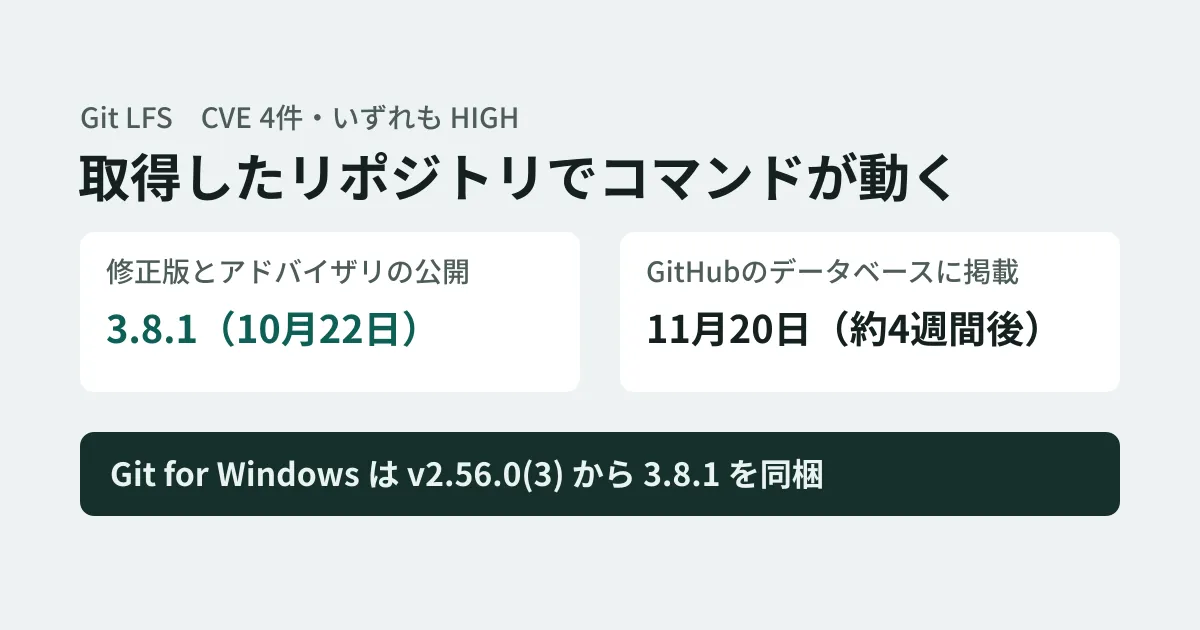
On October 22, 2026, Git LFS released 3.8.1 and, on the same day, published advisories in its GitHub repository for four vulnerabilities (CVE-2026-69260, CVE-2026-69261, CVE-2026-105802 and CVE-2026-105803, all HIGH). They were added to GitHub's advisory database on November 20, about four weeks later. If you learned about them from the database listing, keep in mind that some time has passed since the fix and disclosure. Based on the Git LFS changelog and the original advisories, this article sorts out which operations are affected and how far the workarounds go if you cannot upgrade right away, and also shows what we found when checking the versions in OS distribution packages.
The four issues and the operations they affect
The 3.8.1 changelog says the four issues 'apply to all operating systems supported by Git LFS'. According to the advisories, the 3.x series is affected from 3.0.0 up to (but not including) 3.8.1, earlier series are affected up to 2.13.3, and no fixed version is listed for them. Whichever version you use, the upgrade target is 3.8.1 or later.
| CVE (advisory) | Consequence | Affected operation |
|---|---|---|
| CVE-2026-105803(GHSA-x72p-hmqp-46hw) | Settings written in the repository's .lfsconfig are not properly restricted, so an arbitrary program runs as a custom transfer adapter. Since 1.3.0 | Fetching LFS objects from a malicious repository |
| CVE-2026-105802(GHSA-xrgv-7vx6-5vx6) | A line feed (LF) inserted into a submodule URL or similar causes Git configuration to be misread, so an arbitrary program runs. Since 0.6.0 | Fetching or adding with a malicious repository that contains submodules |
| CVE-2026-69260(GHSA-w3f2-pr6x-wwjc) | The path in an SSH URL is sent without being formatted as a single argument, so if the receiving server passes arguments to a shell without validating them, commands run on that server. Since 0.5.0 | Communicating with an LFS server over SSH |
| CVE-2026-69261(GHSA-x7xj-4j4f-88xr) | After an HTTP redirect, the Cookie header is sent to a different host (Authorization is not sent). Since 0.5.0 | Communicating with an LFS server that returns redirects while carrying credentials in cookies |
On developer workstations and CI, the top two issues deserve the most attention (their CVSS v4 score in the advisories is 8.6; the bottom two are 7.6). Both are paths where simply cloning an untrusted repository and fetching its LFS files runs a program locally. Affected cases include sample repositories received from outside the company, CI that pulls in and builds pull requests from forks created by external contributors, and other companies' repositories fetched to investigate them at a client's request.
The bottom two matter if you run your own Git LFS server (how it handles SSH commands) or use a proxy or server that authenticates with cookies.
What the workarounds cover if you cannot upgrade right away
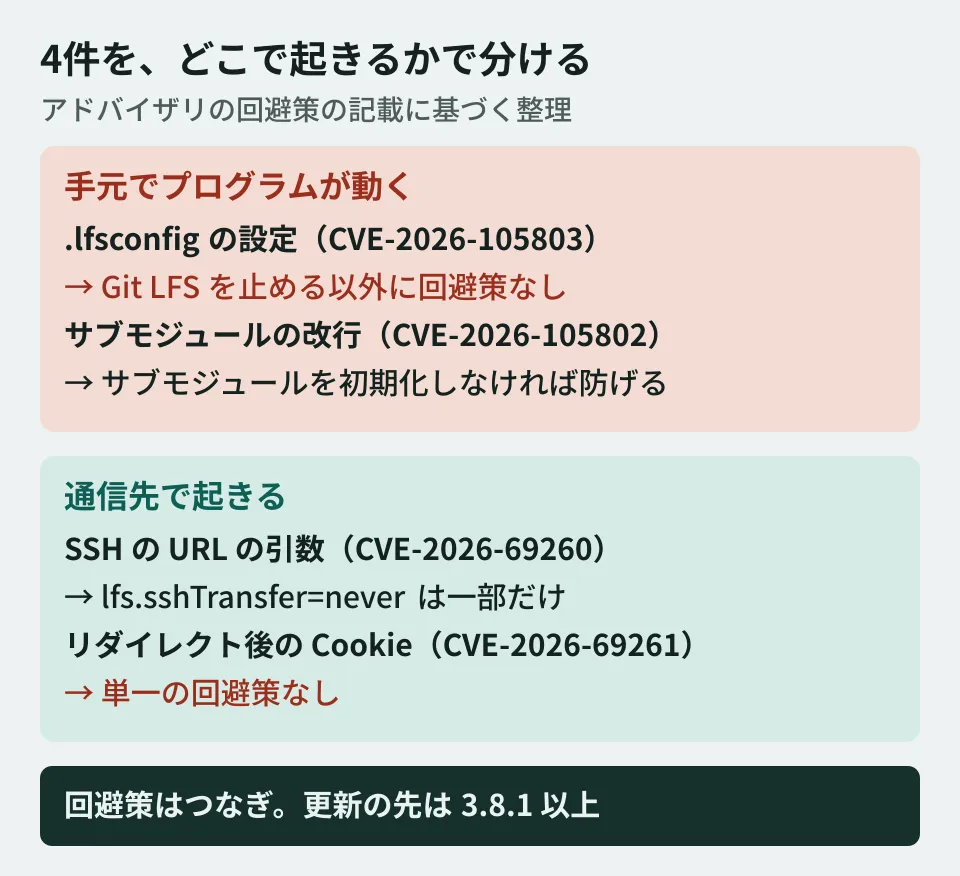
The advisories describe workarounds, but none of them covers all four issues.
- The
.lfsconfigissue (CVE-2026-105803): the advisory says 'there is no single workaround other than disabling Git LFS completely' and asks users to avoid cloning from untrusted sources. - The submodule issue (CVE-2026-105802): disable Git's
fetch.recurseSubmodulesandsubmodule.recurse, and do not rungit submodule init. The advisory says submodules that are already initialized can be removed withgit submodule deinit. - The SSH issue (CVE-2026-69260): setting
lfs.sshTransfertoneverstops object transfers over SSH. However, authentication requests are still sent to the SSH URL, so the advisory says the LFS server needs to validate the commands it receives. - The cookie issue (CVE-2026-69261): there is no single workaround, and the advisory asks users to review whether there are unnecessary redirects and whether secrets are carried in headers other than
Authorization.
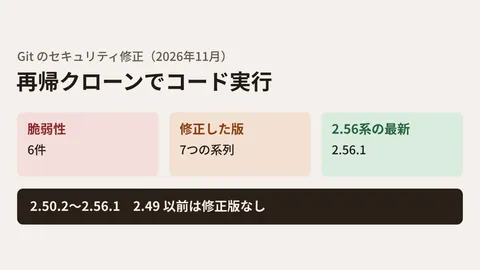
Workarounds are only a stopgap until you upgrade. If your CI handles external repositories, upgrade to 3.8.1 before configuring workarounds. Git's own November fixes also centered on recursive clones that include submodules (our article on Git 2.56.1). Check the versions of Git and Git LFS separately.
Where to check versions, and caveats for distribution packages
First, check the following versions in each environment.
git lfs version
# git-lfs/3.8.1 以上なら修正済みWindows: according to the Git for Windows release notes, v2.56.0(3), released on October 22, bundles 'Git LFS v3.8.1' and explicitly states that it addresses CVE-2026-105803. On workstations running an earlier Git for Windows, update Git for Windows as a whole. The release notes for the later v2.56.0(4) and 2.56.1 (November 10) do not mention any change to the Git LFS version.
Linux distribution packages: for Git LFS installed from OS packages, the version numbers and update timing do not match upstream. Here is what the editorial team found on November 22, 2026, after running apt-get update in this publication's working container (Ubuntu 24.04.5 LTS).
$ git lfs version
git-lfs/3.4.1 (GitHub; linux amd64; go 1.22.2)
$ apt-cache policy git-lfs
  Installed: 3.4.1-1ubuntu0.4
  Candidate: 3.4.1-1ubuntu0.4
The upgrade candidate was 3.4.1-1ubuntu0.4, the same as the installed version, and the latest entry in the package changelog (/usr/share/doc/git-lfs/changelog.Debian.gz) was dated January 30, 2026. None of the four CVE numbers appeared. We could not confirm, in this environment at that time, whether the fixes had been incorporated into Ubuntu's distribution package.
When we checked Ubuntu's CVE pages on November 24, 2026, all four issues were still marked 'Needs evaluation' for each release, including 24.04 LTS (noble). In the Debian security tracker, the distribution packages for Debian 12 (bookworm) and 13 (trixie) were marked 'vulnerable', and the only fixed version was 3.8.1-2 in the development releases (forky and sid).
If you use a distribution package, judge not only by the version number but by whether the package changelog lists the four CVE numbers. If they are missing, decide whether to switch to the 3.8.1 packages or binaries distributed by the Git LFS project, or to configure runners that handle external repositories so they do not use LFS. If Git LFS is installed in your CI container images, the old version also remains until you rebuild the images.
Order of checks (editorial suggestion)
- CI runners that fetch external repositories. Upgrade first where runners automatically build pull requests from forks or regularly fetch clients' repositories. This is especially urgent if the runners hold secrets or deployment permissions.
- Developer workstations. Check that Git for Windows is v2.56.0(3) or later, or, on macOS and Linux, that
git lfs versionreports 3.8.1 or later. - Git LFS servers you run yourself. Check that commands received over SSH are not passed to a shell without validating their arguments. Also check whether credentials are carried in cookies in communication after a redirect.
We covered pinning the versions of actions used in CI in our article on GitHub Actions lockfiles. If you likewise list the versions of the tools installed on runners and assign owners for updating them, it becomes harder to miss fixes, even when there is a gap between a fix and its database listing, as in this case.
Scope of verification
On November 22, 2026, we checked the JSON for the four advisories in github/advisory-database (listed on November 20, 2026), the changelog (CHANGELOG.md) and tag for v3.8.1 in git-lfs/git-lfs, and the release notes in git-for-windows/build-extra (desk research). We also checked the installed Git LFS version and the distribution package's upgrade candidate and changelog in our working container (Ubuntu 24.04.5 LTS); the command output is shown above. On November 24, 2026, we rechecked the repository advisories for git-lfs/git-lfs via the GitHub API (all four published on October 22, 2026), its list of releases, the Git for Windows release notes, Ubuntu's CVE pages and the Debian security tracker. We did not reproduce the vulnerabilities, perform the upgrade to 3.8.1, or check distribution packages other than Ubuntu's and Debian's.
GleamHub's development, AI and automation consulting covers setting up processes for updating developer workstations and CI tools. Please reach out via our contact form.
References
- git-lfs/git-lfs — CHANGELOG.md(3.8.1、22 October 2026)
- GHSA-x72p-hmqp-46hw: Git LFS may execute arbitrary commands via crafted Git LFS configurations(github/advisory-database)
- GHSA-xrgv-7vx6-5vx6: Git LFS may execute arbitrary commands via crafted Git configurations(github/advisory-database)
- GHSA-w3f2-pr6x-wwjc: Git LFS may attempt arbitrary remote commands via crafted SSH URLs(github/advisory-database)
- GHSA-x7xj-4j4f-88xr: Git LFS may leak HTTP headers after redirections(github/advisory-database)
- git-lfs/git-lfs — Security advisories (all four published on October 22, 2026)
- git-for-windows/build-extra — ReleaseNotes.md
- Ubuntu — CVE-2026-105803
- Debian security tracker — CVE-2026-105803