You unpack a repository received from a partner company, submodules and all, on your machine with git clone --recurse-submodules. A CI job clones an external repository before starting a build. Both are everyday operations in development, but this round of Git fixes includes vulnerabilities through which code prepared by the other party could run during such a "recursive clone".
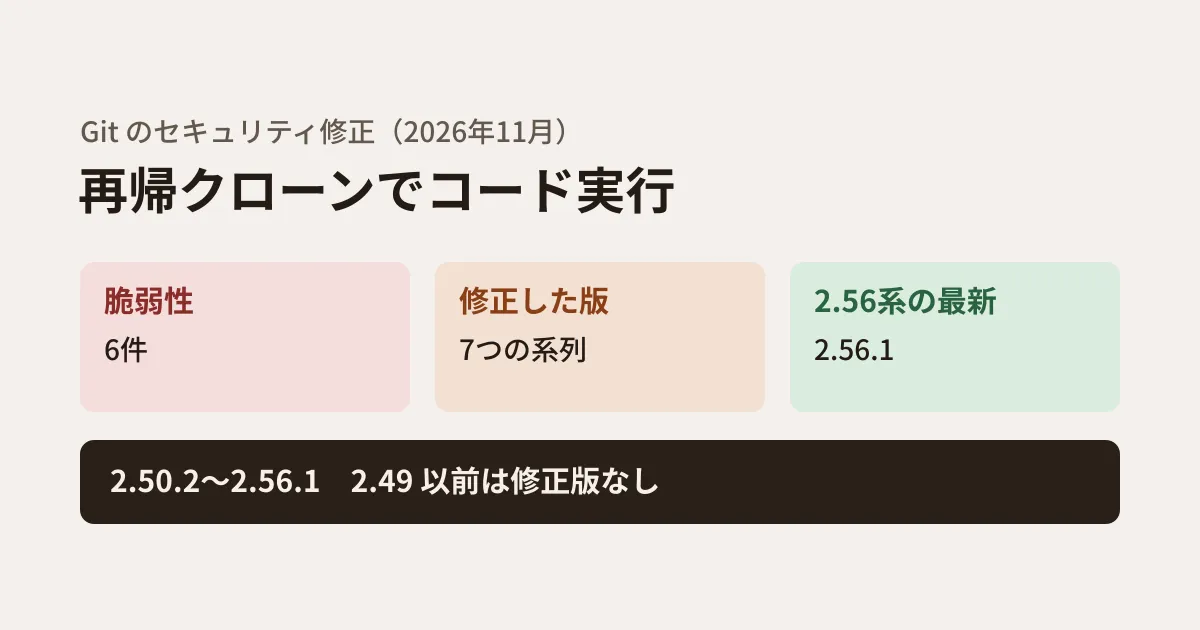
The official Git repository (git/git) has tags for seven versions: 2.50.2, 2.51.3, 2.52.1, 2.53.1, 2.54.1, 2.55.1 and 2.56.1. All of them fix the same six vulnerabilities (CVE-2026-111760, CVE-2026-113408, CVE-2026-114466, CVE-2026-114467, CVE-2026-114469, CVE-2026-105437). GitHub also announced the release in its November 10, 2026 blog post "Git security vulnerabilities announced". In this article, we use the release notes and GitHub's announcement to outline the operations the six issues affect, and summarize which version to update to and where to start checking.
Operations affected by the six issues
The 2.50.2 release notes describe each of the six issues (the notes for the other six versions only say that they "merge the fixes from v2.50.2" and refer to 2.50.2 for details). Organized by the affected operation, they are as follows.
| CVE | Release note content (summary) | Affected operation |
|---|---|---|
| CVE-2026-111760 | During a recursive clone, a submodule's gitfile is replaced with a symbolic link, and the attacker's configuration and hooks are used. Remote code execution | Recursive clones of untrusted repositories |
| CVE-2026-113408 | When a server returns an "unborn HEAD" containing a path such as refs/heads/../../../TARGET, the files ref backend writes to an unintended file | Cloning from untrusted servers (according to GitHub's announcement, when cloning an empty repository over protocol v2) |
| CVE-2026-114466 | rewrite-submodules-to / -from and export-pack-edges in fast-import could read arbitrary paths (according to GitHub's announcement, export-pack-edges could also create and append to files). Now disabled by default | Migration and conversion tools that use fast-import |
| CVE-2026-114467 | Running git merge on a tag with three or more signatures corrupts stack memory. DoS. Forges can also be affected by pushed tags | Merging tags, merges on Git servers |
| CVE-2026-114469 | A binary patch that expands to more than 1 GiB slips past the size check and crashes with an out-of-bounds read | Running git apply and similar on received patches |
| CVE-2026-105437 | In a merge with a very large number of conflicts and a large conflict-marker-size, the buffer size calculation overflows and corrupts the heap | Huge merges, both local merges and services that merge untrusted content |
Only the first issue, CVE-2026-111760, is described in the notes as "Remote Code Execution". For details, the notes point to the GitHub security advisory (GHSA-vp2w-7xxj-jvxr), and for the other five issues to Git issues tracked on GitLab (work_items 809, 810, 811, 812 and 814). The advisory rates the first issue as "High" (8.0 under CVSS 3.1). Its workarounds section says: "We currently believe this can only be triggered when the --recurse-submodules option is used." (that is, it is currently believed to occur only when --recurse-submodules is used).
According to GitHub's announcement, the cause of the first issue is that, during index processing, the length of a very long path is truncated, so the entry is written under a shorter name different from the one that was checked. The fix rejects entries with overly long paths before the length is truncated. The 2.50.2 notes also include the item "Defense-in-depth: read-cache: reject cache entries with over-long names."
Which version to update to
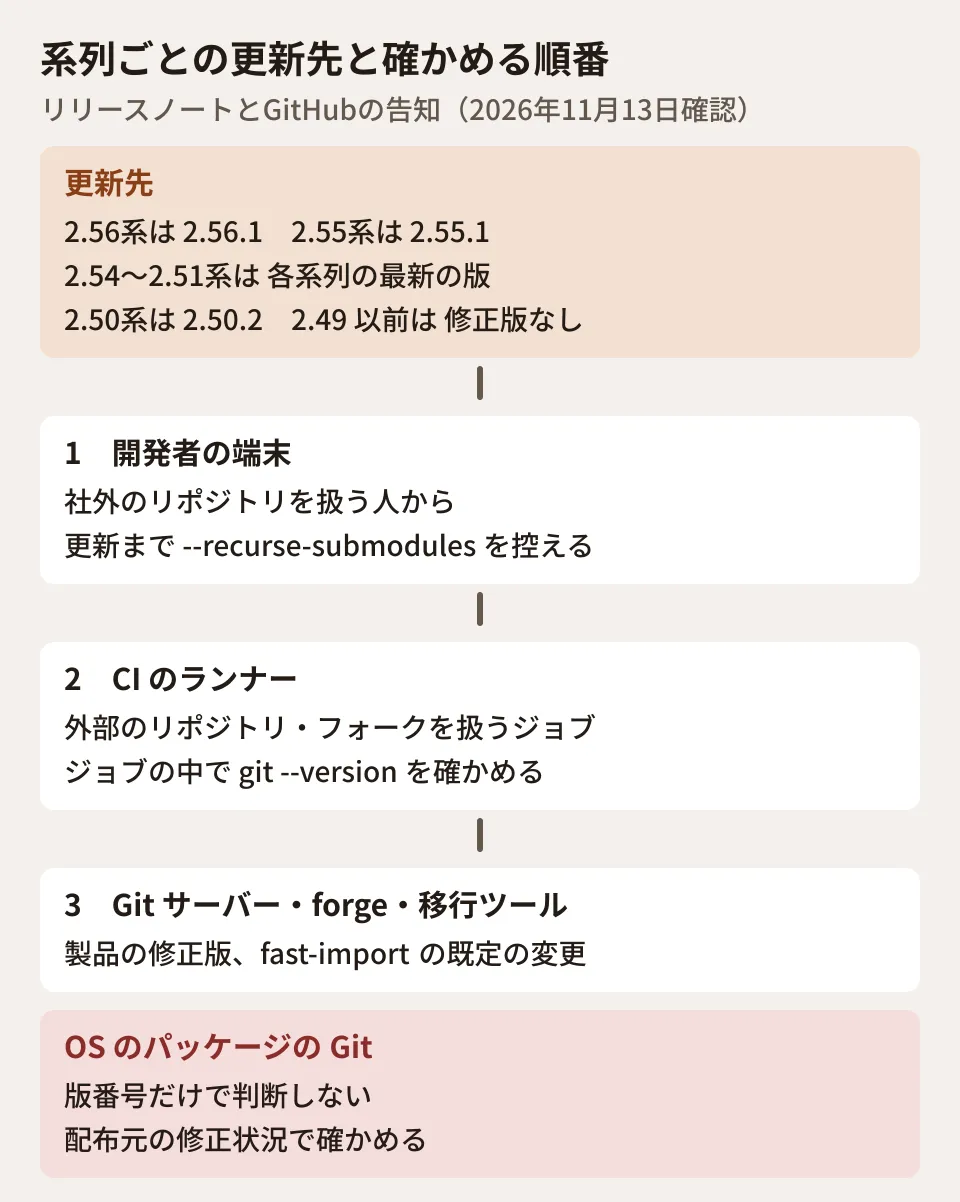
The fixes are released as the latest version of each release line you may be using. The 2.56.1 notes say "This release merges up the fix that appears in v2.50.2, v2.51.3, v2.52.1, v2.53.1, v2.54.1 and v2.55.1", so the same six issues are fixed in every version. GitHub's announcement also says "We recommend updating to Git 2.56.1 or the patched release for your maintenance series, and updating any applications that bundle Git.", recommending updating to 2.56.1 or the patched release of your release line, and updating applications that bundle Git.
- 2.56 line: 2.56.1
- 2.55 line: 2.55.1
- 2.54 to 2.51 lines: 2.54.1, 2.53.1, 2.52.1 and 2.51.3 respectively
- 2.50 line: 2.50.2
- 2.49 and earlier: no fixed version in the official repository
The tags were created on October 26, 2026 for 2.56.1 and on November 3 for the other six. The release was announced on November 10, and GitHub's blog says "Today, the Git project is releasing new versions to address six security vulnerabilities."
Don't judge OS-packaged Git by version number alone
Git in Linux distributions sometimes incorporates fixes without changing the upstream version number (backporting). For example, in the Ubuntu 24.04.5 environment where this article was written, git --version was git version 2.43.0 and the package version was 1:2.43.0-1ubuntu7.4. Upstream 2.43.0 has no fixed version for this round, but how the package is handled is up to the distributor. As of November 13, 2026, we could not yet find Ubuntu's CVE page (ubuntu.com/security/CVE-2026-111760) (404). Debian's security tracker had a page for CVE-2026-111760, where git in bookworm, trixie, forky and sid was all "vulnerable", and the fixed version for unstable was "(unfixed)".
For this reason, how you check depends on where your Git comes from.
- Official source or installers, or package managers that let you choose the version (such as Homebrew): use
git --versionto see whether you are on or above the versions listed above - Linux OS packages: check the distributor's security information for the package version that includes the fixes for these CVEs
- CI runners and container images: check the version and source of Git included in the image. For hosted runners, check for updates to the provider's images
On November 13, 2026, we also checked several non-official distributors.
- Git for Windows: 2.56.1.windows.1 was released on November 10, and its release notes list the six CVEs.
- Homebrew: the stable version of the git formula is 2.56.1.
- GitHub: according to its announcement, the fixes have already been applied to github.com and GitHub Enterprise Cloud (including deployments with data residency), and GitHub Enterprise Server is fixed in 3.19.15, 3.20.11, 3.21.9 and 3.22.4. GitHub says it is preparing versions of the GitHub Desktop and GitHub Copilot apps that include the fixed Git, and that GitHub Actions and Codespaces will also get the fixed Git.
- GitHub Actions hosted runners: in the actions/runner-images updates of November 11 to 12, Git on Ubuntu 24.04 and 26.04, Windows Server 2022 and 2025, and macOS 15 (Arm64) moved from 2.56.0 (2.56.0.windows.4 on Windows) to 2.56.1 (2.56.1.windows.1). Because images are rolled out gradually, the reliable way to confirm is to print
git --versionin an actual job.
We have not checked the status of the Git bundled with Xcode on macOS for this article.
Order of checks (editorial suggestion)
What follows is an editorial suggestion based on the notes above. Of the six issues, the easiest to exploit from outside are the first and second, where you receive something prepared by the other side of a clone or fetch. So start checking where external repositories are received.
- Developer machines. Starting with the machines of people who work with external repositories and submodules, check the Git version and update it. Until the update is done, tell people not to clone repositories of unverified origin with
--recurse-submodules. - CI runners. Prioritize runners with jobs that clone external repositories or pull requests from forks. For self-hosted runners, check the Git version in the image and rebuild it.
- Internal Git servers and forges. For tag merges (CVE-2026-114467) and huge merges (CVE-2026-105437), the notes and announcement also mention the impact on forges and hosting services. Update GitHub Enterprise Server to the versions above; if you self-host GitLab or a similar product, check that product's guidance on fixed versions.
- Migration and conversion tools. For tools that use
git fast-importto migrate from Subversion or other systems to Git, check thatrewrite-submodules-toand similar features are now disabled by default. According to GitHub's announcement, when these are specified in the input stream, they are rejected unless the caller passes--allow-unsafe-features. The announcement says to use this option only when you trust the program that generates the stream. If you rely on these features, their behavior may change after the update.
For cases where you cannot update right away, GitHub's announcement lists cloning only from trusted servers and avoiding recursive clones of untrusted repositories, merging untrusted content or tags, and processing binary patches or fast-import streams from untrusted sources. It adds that these are not a substitute for applying the fixes.
We covered how to remove secrets you have accidentally pushed in our article on GitHub secrets, and how to prioritize updates given the volume of vulnerability disclosures in our article on GTIG's statistics.
Scope of verification
On November 12, 2026, we fetched the git/git repository and checked the tags (v2.50.2, v2.51.3, v2.52.1, v2.53.1, v2.54.1, v2.55.1, v2.56.1) and the original text of
Documentation/RelNotes/*.adocfor each version (desk research). We checkedgit --versionand the package version in an Ubuntu 24.04.5 environment. On November 13, 2026, we checked GitHub's blog, GHSA-vp2w-7xxj-jvxr, the GitLab issues (809, 810, 811, 812, 814), the Git for Windows release notes, the actions/runner-images image updates, the Debian security tracker and Ubuntu's CVE page, and reconfirmed that no new versions had been tagged. We could not open the announcement on the git mailing list from this environment and have not checked it. We have not reproduced the vulnerabilities or verified behavior after updating.
GleamHub's development, AI and automation consulting can help with planning updates to development environments and CI, and with creating procedures for receiving external repositories. Where to check depends on your team structure and the services you use, so please reach out via our contact form.
References
- git/git — Documentation/RelNotes/2.50.2.adoc
- git/git — Documentation/RelNotes/2.56.1.adoc
- GitHub Blog — Git security vulnerabilities announced(2026-11-10)
- GHSA-vp2w-7xxj-jvxr — Recursive clones are susceptible to Remote Code Execution
- Git for Windows 2.56.1 release notes
- Debian Security Tracker — CVE-2026-111760