

Have you ever asked an AI assistant about your company's service, only to receive an outdated description or find information mixed up with competitors? While structured data and copywriting techniques are often discussed as ways to be accurately indexed by AI, in many cases, the page content is simply not being read in the first place.
The operational reality on the reading side became clearly visible in August 2026. Kitesurf, announced by Cloudflare, is a browser purpose-built for AI agents. Because the details of what was implemented and what was discarded have been made public, it serves as concrete material for considering who will read your website going forward.
What did agent browsers discard?
Kitesurf does not use Chromium. It runs on Cloudflare Workers' V8 isolates, using a modular engine derived from Blitz for rendering, Firefox's Stylo for CSS parsing, and Boa, written in Rust, for JavaScript execution.
What was stripped away are things necessary for human viewing but unnecessary for agents: tabs, extensions, themes, pixel-perfect rendering, and smooth scrolling. As a result, measurements across 14 URLs showed that CPU usage for screenshot capture dropped to about one-third of Chromium, HTML extraction to about one-fourth, and memory consumption to between one-fifth and one-seventh depending on the use case.
On the other hand, it currently does not support video, WebGL, responding to TLS-based bot detection challenges, or long-lived authenticated sessions. It is explicitly stated that it is not a replacement for Chromium.
| Dimension | Human-oriented browser | Agent-oriented browser |
|---|---|---|
| Priorities | Visual fidelity, operational smoothness | Fetch speed, low processing overhead |
| JavaScript | Full-featured engine | Lightweight engine; does not assume heavy execution |
| Assumed visit pattern | Log in and use over extended periods | Open, extract, and close |
There is one clear takeaway here: Agents read information that can be read cheaply first. And whether it can be read cheaply is decided by the website.
Three high-impact checks on the site side
Before embarking on a major overhaul, check the following three points on your website.
1. Is main body text included in the HTML returned by the server? View page source in your browser and check whether critical information like service names, pricing, and business hours appears as plain text. If you cannot see it, that information only appears after JavaScript executes. While it renders fine in human browsers, to consumers fetching via lightweight engines, it is nonexistent information.
2. Is it written using semantic tags? Are headings simply styled with large font sizes on a div, are links proper a elements, and are form input fields tied to a label? Humans can judge by appearance, but agents judge by structure. This overlaps with search engine optimization basics, and the concepts discussed in Structured Data and AI Search apply directly here.
3. Is critical information embedded inside images? Many sites still present pricing tables or service coverage areas as single images, and content formatted this way cannot be parsed.
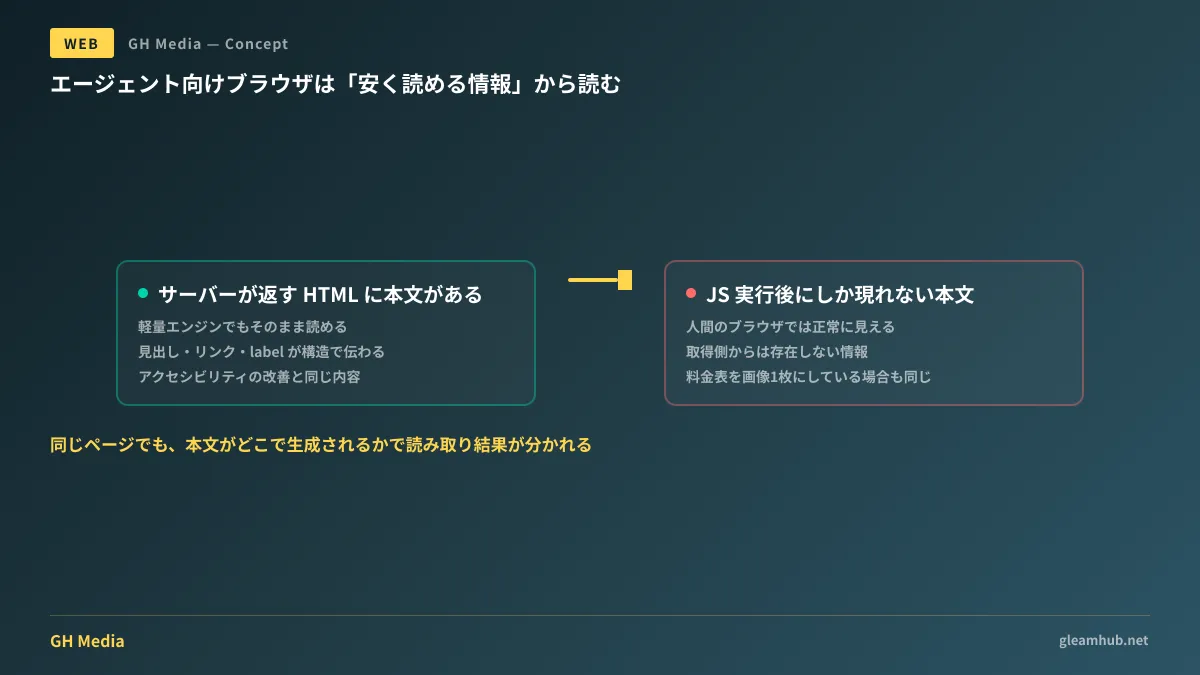
All three of these points largely mirror accessibility improvements. Rather than new requirements piling up, it is more accurate to view this as the bill finally coming due for things that had been postponed.
Deciding not to let them read is also part of the design
There is no need to welcome every agent. If your content is being scraped entirely with nothing coming back to your business, deciding to block them is naturally a valid choice.
However, there is an order to blocking them. First, verify in your access logs which agents are actually visiting. Because there are significant numbers of impostors merely masquerading under legitimate User-Agents, judging by name alone will block legitimate bots while letting impostors through. The verification steps are detailed in How to Distinguish Access Masquerading as AI Crawlers.
Next, distinguish between information you want cited and information you do not want scraped. Company overviews, service details, and pricing concepts benefit from being cited, whereas paid articles and proprietary case studies do not. How to set this boundary in machine-readable format was covered in Designing How You Are Cited with llms.txt.
Furthermore, the fact that Kitesurf currently does not support TLS-based bot challenges implies that if you introduce a challenge, agents cannot get through. Deciding whether to place heavy verification before an inquiry form comes down to weighing protection against lost opportunities.
What to do next
First, verify whether body text is present in the source code of your website's home page and primary service pages. This check takes only a few minutes. If it is not included, that is your top-priority issue.
On top of that, if you are planning a website redesign, include a single line in your requirements: "Return body text server-side." Changing the implementation architecture later is expensive, but deciding it upfront incurs almost no additional cost.
GleamHub offers website production and renewal consultations regarding diagnosing whether your site is structured to be read correctly by AI and search engines, as well as selecting implementation approaches during renewals. Because areas requiring remediation differ depending on how your current site is built, please consult with us individually. Reach out via Contact Us.


