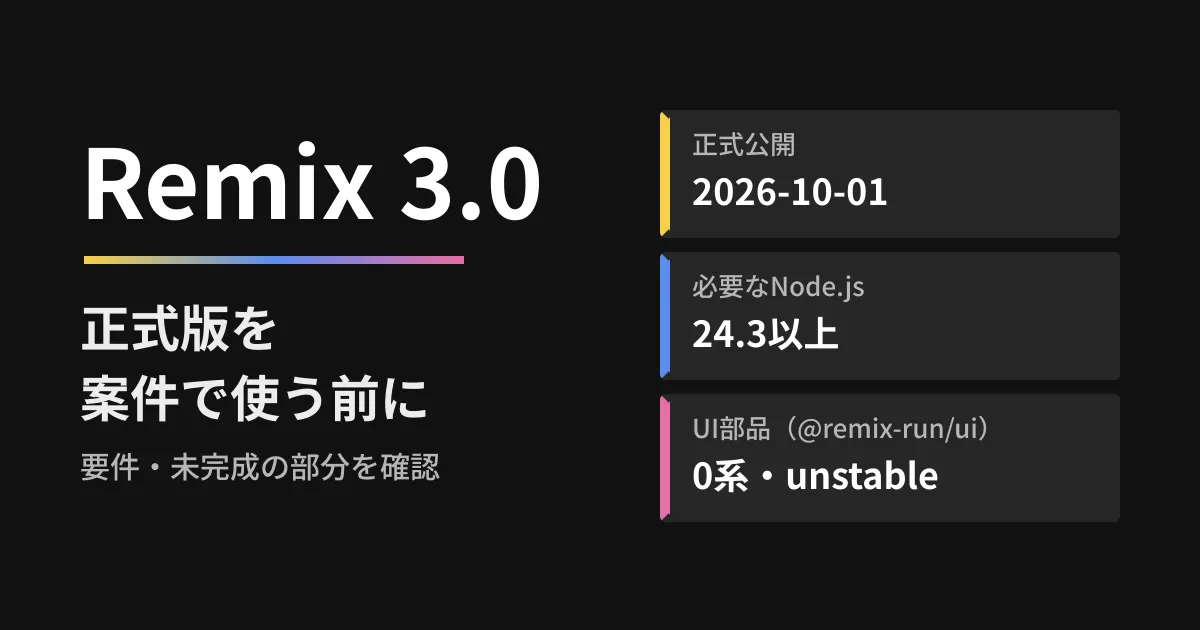
How would you judge a proposal for a new web app or site redesign that says "We will build it with Remix 3"? On October 1, 2026, Remix 3 was officially released as 3.0.0. The condition of not being a stable release, which was a reason to hold off on adoption during the beta and release candidate (RC) stages, no longer applies.
However, being a stable release and being ready for production in client projects are two different things. In this article, we lay out five things to check before deciding on adoption, based on what we confirmed on October 6, 2026 by directly opening the changelog, README and guide at the remix@3.0.0 tag (commit 70cdc64, "Release v3.0.0") of the remix-run/remix repository on GitHub, along with the npm publication records. This is based on document research and editorial proposals; we did not build and run a Remix 3 app to test it.
How Remix 3 switched to a design that does not use React, and its impact on existing Remix 2 projects, are covered in Remix 3 drops React: what it means for technology choices in site redesigns. This article focuses on the contents of the stable release that came out afterward.
What the stable release settled
According to the npm publication records, version 3.0.0 of the remix package was published on October 1, 2026 (22:58 UTC), and the latest tag points to 3.0.0. The first alpha (3.0.0-alpha.0) was released on January 20, 2026, so it took about eight months to reach a stable release. The 3.0.0 entry in the changelog says "First stable release of Remix 3."
The stable remix bundles routing, middleware, component rendering, forms, authentication, sessions, databases, testing and more from 48 packages under @remix-run/ and distributes them as one. According to the changelog, each of those packages was also aligned to 1.0.0, except lazy-file (5.0.8). The beginning of the guide says "For most web apps, remix can be the only runtime dependency in package.json." It is designed so that many apps need only one dependency, remix.
The README lists building on web standard APIs (Request, Response, Web Streams, Web Crypto and others) as a principle, and says it runs on Node.js, Bun, Deno and Cloudflare Workers. On the other hand, the template generated by the project creation command (npx remix new) is set up to start as a Node.js server.
Check 1: Node.js 24.3 or later is required
The package.json of remix 3.0.0 specifies "engines": { "node": ">=24.3.0" }. Environments running Node.js 22.x do not meet the requirement.
Check the Node.js versions in your internal development environment, CI, and production servers or hosting first. The maintenance periods for each Node.js version are covered in Node.js 26 entering LTS and the maintenance period for 24. Other tools continue to raise their requirements as well, and we listed the same check in our article on Vite+ 1.0.
Check 2: Import paths changed from the RC to the stable release
The stable release includes breaking changes for those moving from the release candidate. According to the 3.0.0 "Major Changes" in the changelog, the component runtime, JSX, server rendering and testing features previously imported from remix/ui have moved to remix/component.
-import { createRoot, css, on } from 'remix/ui'
+import { createRoot, css, on } from 'remix/component'
Apps that use JSX also need to change jsxImportSource in tsconfig.json from remix/ui to remix/component. The import path for hot module replacement (HMR) during development has also changed from remix/ui-hmr to remix/component-hmr.
If you have prototype code written with the beta or RC, it will not run on the stable release as is. When reusing a prototype estimate for full development, you need to factor in the work of making these replacements.
Check 3: UI components are not included in the stable release
Regarding UI components, the changelog says the following.
The
remixpackage no longer exports UI components, primitives, or animation utilities. Headless, accessible UI primitives and animation utilities remain in@remix-run/ui. This package is currently unstable, versioned independently in the v0.x range, and not part of the Remix 3.0 release candidate.
Unstyled components (headless UI) such as accordions, comboboxes, menus and tabs, along with animation, have been split into a separate package, @remix-run/ui. This package is marked "unstable," and as of October 6, 2026 its latest on npm is 0.12.1. In addition, the styled components (breadcrumbs, button, checkbox, input and radio) have been removed.
In other words, what is stable in the "Remix 3.0 stable release" is the server side and the component model, while the UI component layer is still at 0.x. For systems with many admin screens or input forms, you will need to estimate effort on the assumption that you either build UI components yourself or combine it with another library.
Check 4: Five chapters of the guide are unfinished
The guide at the remix@3.0.0 tag (docs/guides) consists of 16 chapters. Of these, the following five chapters begin with "This chapter is unfinished." and contain only headings for the content and the general direction.
- Authentication, sessions and security (Chapter 10)
- Files and static assets (Chapter 11)
- Errors and cancellation (Chapter 12)
- CLI and development tools (Chapter 14)
- Production operations (Chapter 15)
The production operations chapter lists items such as validating environment variables, configuring trusted proxies, graceful shutdown, where to store sessions in multi-server setups, caching policy and monitoring, and then directs readers to each package's README for actual code examples. The fact that the chapters on authentication and production operations, which form the foundation of business systems, are unfinished should weigh heavily in the adoption decision. Whether the development company is able to work through package READMEs and source code on its own will determine the quality.
Check 5: Database and testing are optional add-on packages
remix specifies MySQL (mysql2), PostgreSQL (pg), Redis (redis) and Playwright (playwright) as optional peer dependencies. If you use a database, a session store or browser testing, you need to install these separately.
The data chapter of the guide describes managing SQL changes in numbered directories such as db/migrations/0001_create_albums/up.sql. How to fit this with an existing database or with operations built around an ORM (such as Prisma or Drizzle) is a design decision for each project.
Guidelines for deciding on adoption (editorial summary)
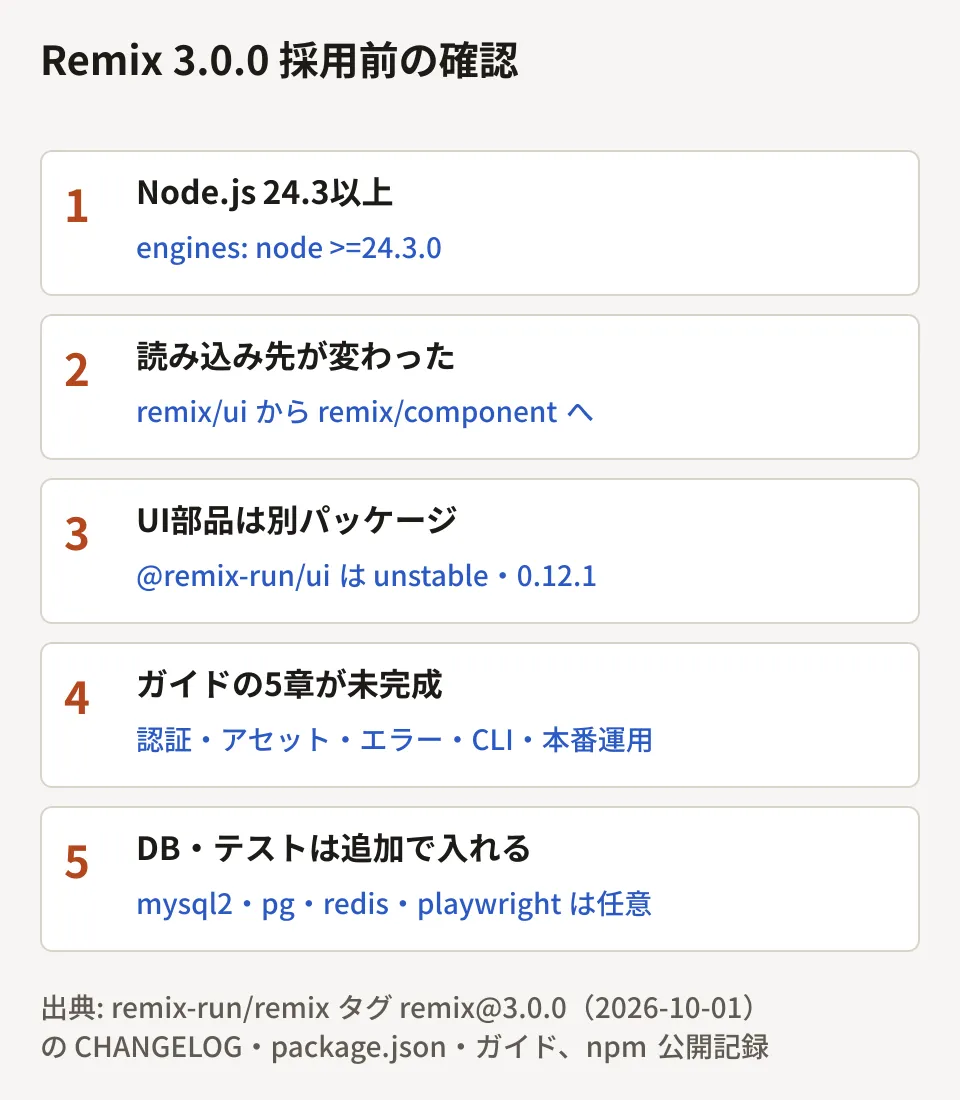
Taking these five points into account, the current guidelines are as follows.
- A good fit: Small to medium-sized apps that can assume Node.js 24.3 or later and maintain their own UI components. Projects that prioritize a setup aligned with web standards, where the development company can devote effort to evaluating a new framework
- Decide carefully: Business systems that include authentication or payments, systems with many admin screen components, and projects whose long-term maintenance may be handed over to another company. Decide first who will fill the gaps in the unfinished parts of the guide and the 0.x
@remix-run/ui, and how - Hold off: Projects where the Node.js version in the production environment cannot be upgraded
If a proposal says "Remix 3," ask the development company how they plan to handle each of the five points above. For a comparison with the option of running Next.js on a different foundation, our article on Vinext 1.0 is also a useful reference.
On October 6, 2026, we directly retrieved and cross-checked the
packages/remix/CHANGELOG.md,packages/remix/package.json,README.md,packages/remix/README.mdanddocs/guideschapters at theremix@3.0.0tag of remix-run/remix on GitHub (commit 70cdc64, 2026-10-01) and the npm publication records forremixand@remix-run/ui(document research). The adoption guidelines are editorial proposals. We have not confirmed creating, building or deploying a Remix 3 app, or its behavior on Bun, Deno or Cloudflare Workers. As of October 6, the official blog (remix.run/blog) had no post announcing the stable release; the latest was "Remix 3 Release Candidate" from August 31, 2026.
GleamHub's development, AI and automation consultation can help with technology choices for web apps and sites and with reviewing proposals. Because the right setup depends on your operating environment and maintenance structure, please reach out through our contact form.
References
- remix-run/remix — Release v3.0.0 (remix@3.0.0 tag, commit 70cdc64)
- remix-run/remix — packages/remix/CHANGELOG.md(remix@3.0.0)
- remix-run/remix — packages/remix/package.json(remix@3.0.0)
- remix-run/remix — README.md(remix@3.0.0)
- remix-run/remix — docs/guides 15-production.md(remix@3.0.0)
- npm registry — remix
- npm registry — @remix-run/ui