“I think it was at its best when we launched.” Visit a company roughly two years on from a redesign and you hear this often. Traffic has not collapsed, and the design has not suddenly aged. It is simply that the business described on the site differs from what they actually sell now, or the recruitment page still lists last year’s openings.
A website does not lose value by breaking; it loses value by being left alone until it no longer matches reality. And yet at many companies the web budget is set up as “rebuild the whole thing once every three or five years”. That budgeting model is itself what makes launch day the peak.
Launch day is the peak because no time is set aside afterwards
A site right after launch is usually in excellent shape. The agency’s director spent months organizing the information, the internal owner engaged with the copy, and management reviewed the content. As an organization, time was set aside to face the website.
Once it launches, that time returns to zero. The regular meetings with the agency end and the owner goes back to their real job. From then on, updating the site becomes “whoever notices, whenever they have room”. Nobody is at fault, but if this continues for two years, the information on the site is two years out of date.
Smashing Magazine’s Why Your Website Should Never Stop Changing describes the phenomenon this way: every website peaks on launch day and drifts quietly from there, not because it breaks, but because nobody has the time to keep it current. The same thing is happening at small and mid-sized companies in Japan.
The problem with the all-at-once redesign budget
Suppose you set aside a budget of 2 million yen for a corporate site redesign. For a standard 10 to 15 page structure, a quote of that scale is not unusual. The amount itself is not unreasonable. How to read the breakdown is organized in website production cost benchmarks.
The problem is that nothing remains afterwards.
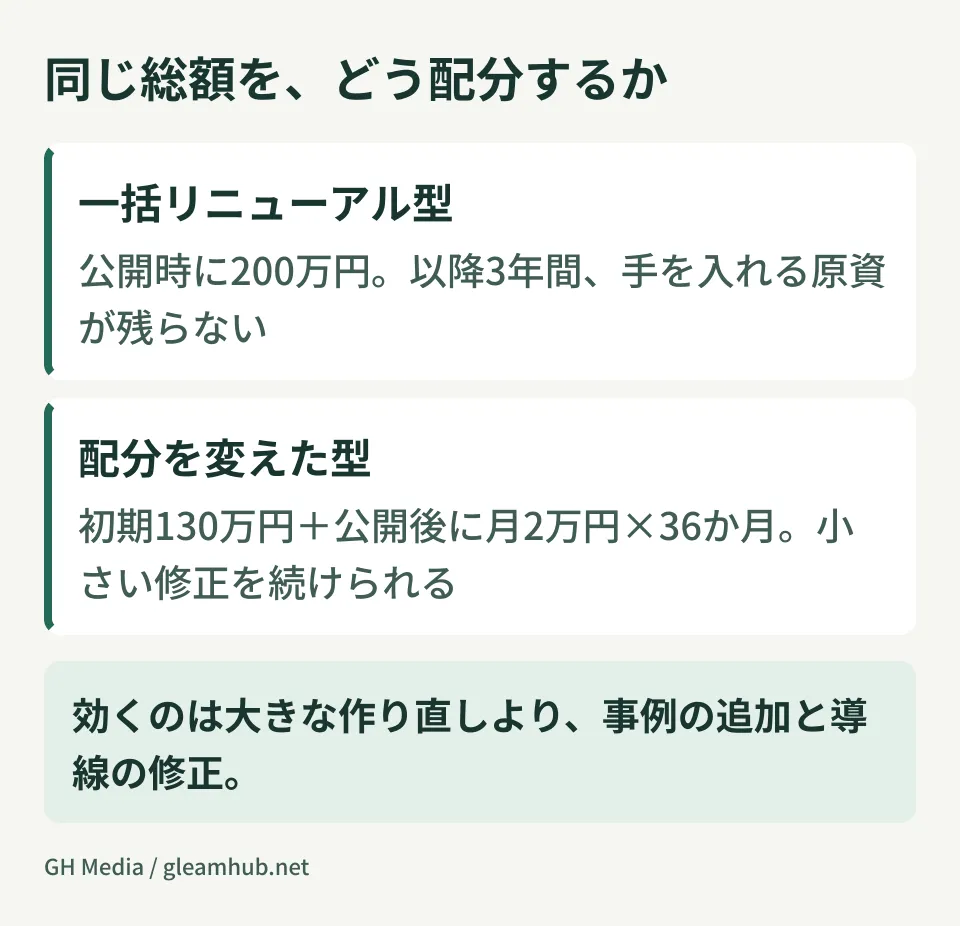
In the all-at-once model, the budget is spent in full at the moment of launch. From the following month until the next budget round, there is no funding to make changes. You stay in a state where you find something you want to fix, but it is too small to justify an internal approval request. Then three years later, once the drift has grown too large, the conclusion becomes “there is no choice but to rebuild everything”, and another lump-sum budget is approved. What this cycle often amounts to is rebuilding the same content over and over.
The other problem is that you never accumulate evidence. If you only touch the site once every three years, you never get the chance to confirm which change worked. At the next redesign, you will be deciding on instinct again.
Keep the total the same, change the allocation
The realistic proposal is not “please increase the budget for continuous improvement”. For many small and mid-sized companies, the total web budget does not move easily. The question is whether the allocation can change within the same total.
For example, a 2 million yen envelope over three years can be restructured as follows.
| Allocation | All-at-once model | Reallocated model |
|---|---|---|
| Initial build | 2,000,000 yen (at launch) | 1,300,000 yen (at launch) |
| Post-launch improvement | None | 20,000 yen per month × 36 months = 720,000 yen |
Holding the initial build to 1.3 million yen means narrowing what you build. Rather than perfecting every page from the outset, build the pages that carry the business and the path to the inquiry form properly. Pages whose content grows over time, such as case studies and recruitment, get the frame only, and are filled in after launch.
This shape works because it keeps you in a state where there is funding to make small fixes after launch. Twenty thousand yen a month will not buy large development, but it is enough for copy changes, adding a case study, or revising the fields on a form. And it is precisely these small fixes that do the most for inquiry volume.
How to run the redesign itself is covered in the corporate site redesign guide.
What the post-launch budget actually pays for
“Continuous improvement” sounds vague, so here are the specifics, listed from the highest priority down.
- Fix what comes before the inquiry form. Look at which pages lead to inquiries and where people drop off, and repair the paths one at a time. It produces results faster than adding more pages
- Add case studies and results. Add one each time you win new work. A site with only three case studies at launch will pass twenty within two years. This is an asset an all-at-once redesign can never create
- Delete stale information. Discontinued services, directors who have stepped down, last year’s recruitment details. Deleting does more for trust than adding
- Match the words people actually search for. The words people search and the words used on the site are often out of step. Reviewing this once a quarter is enough
All four take between a few hours and a few days. That is exactly why they get deferred inside a lump-sum budget, and why they are never started without a budget of their own.
Cases where rebuilding all at once is still faster
Changing the allocation is not always the right answer. If any of the following apply, consider a straightforward all-at-once redesign.
The foundation is too old to fix in parts. When the layout breaks on smartphones, or the CMS version is too old to update, the unit cost of small fixes rises sharply. Replacing the foundation works out cheaper. The criteria for judging this are organized in when to redesign.
The business itself has changed. If your core business or target has changed, the information has to be rebuilt from the way it is arranged. Improvement will not reach that far.
There is nobody to hand it over to. When you cannot reach the previous agency and nobody knows where the source lives, simply establishing the current state costs money. As covered in how handover and maintenance work, the investigation alone can run to several hundred thousand yen.
What to do next
For your own site, try counting the places you updated in the last 12 months. Adding a case study, fixing wording, anything counts. If it is zero, or one or two, your current budgeting structure makes it impossible to touch the site after launch.
When you request the quote for your next redesign, try asking: “could you also structure this with a narrower initial build and a monthly allowance kept for post-launch improvement?” Agencies differ in how well they handle this, so the way they answer that question is itself useful material for choosing one.
GleamHub offers website and redesign consultations covering redesign planning, budget allocation that assumes post-launch improvement, and assessing the state of an existing site. Because the best structure depends on your current site and where the business is heading, please get in touch through the contact form.