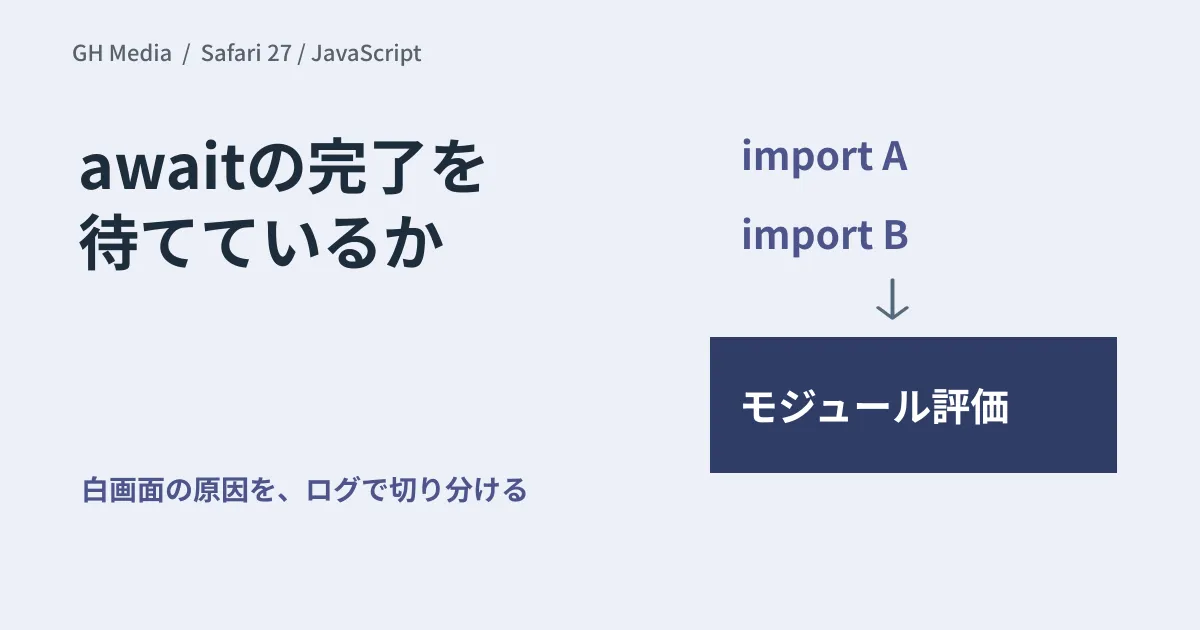
Blank screens occurring only in Safari, or errors referencing uninitialized values: the module loader fix in Safari 27 provides context for some of these issues. However, not all blank screens in Safari are resolved by this fix.
In a technical article on September 2, 2026, WebKit explained module evaluation issues related to top-level await and a rewrite of the loader. This targets cases such as when concurrent dynamic imports of the same asynchronous module cause the importer to proceed before evaluation completes. The fix is also included in the Safari 27.0 release notes.
Investigate errors to determine if your site is affected
Relying solely on results showing "it was fixed after updating to Safari 27" can overlook differences in cache, served JavaScript, or network conditions.
During investigations, record the following details together:
| Item | Reason to record |
|---|---|
| URL and reproduction steps | Pinpoint on which screen or transition it occurs |
| OS and Safari versions | Use for comparison with environments containing the fix |
| Served build identifier | Verify you are not comparing different JavaScript files |
| Console errors | Distinguish initialization order, network failures, syntax errors, etc. |
| Cache conditions | Confirm differences between initial visits and return visits |
Even if your own code does not use top-level await, dependencies and build outputs may warrant review. Conversely, an error with a similar name alone does not confirm that it is this specific bug.
Preserve a baseline environment for comparison before updating
Losing the legacy environment where the issue reproduces makes isolating the root cause difficult. If possible, preserve verification environments for both older and newer versions, and compare them using the identical build, operations, and data. On iPhones, record the OS version as well. For Mac, Safari updates are not always tied to major macOS updates.
Record verification findings as in the following example:
Example record: On Screen B of Build A, an error occurred 2 out of 3 times in the older environment. In the newer environment, it did not occur in any of the 3 attempts. However, this result alone does not confirm the module loader as the cause.
This is an example format, not our company's measured data. To isolate the cause, create a minimal reproduction of the failing module dependencies and compare it against the relevant WebKit fix details.
Separate fix adoption from user communication
Even when recommending that users update, you need to define supported environments if non-updatable devices remain. Consider app-side workarounds only after reproducing the targeted bug, avoiding arbitrary changes to overall loading order.
Cases where external services fail to load are also covered in Architecture for Coping with Embedded SaaS Outages. While blank screens may appear identical, the layers to investigate differ.
Official WebKit documentation was confirmed on September 20, 2026. Reproduction comparisons between older and newer Safari versions have not been conducted. WebKit test results are not treated as our own verification results.
Please consult GleamHub for diagnosing browser-specific issues.