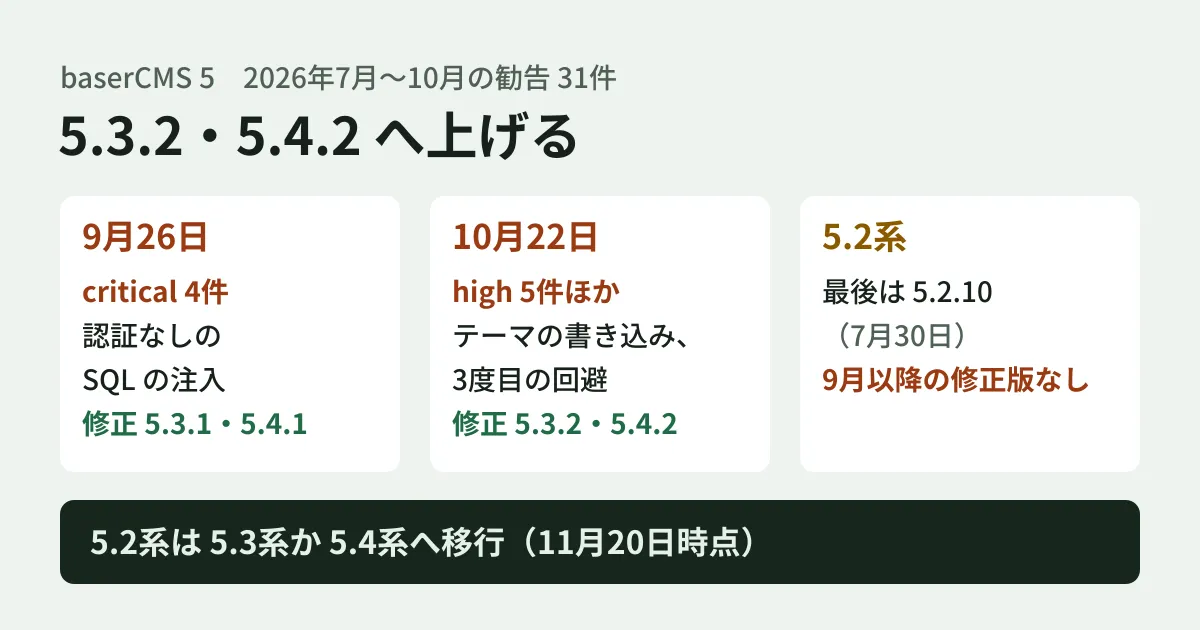
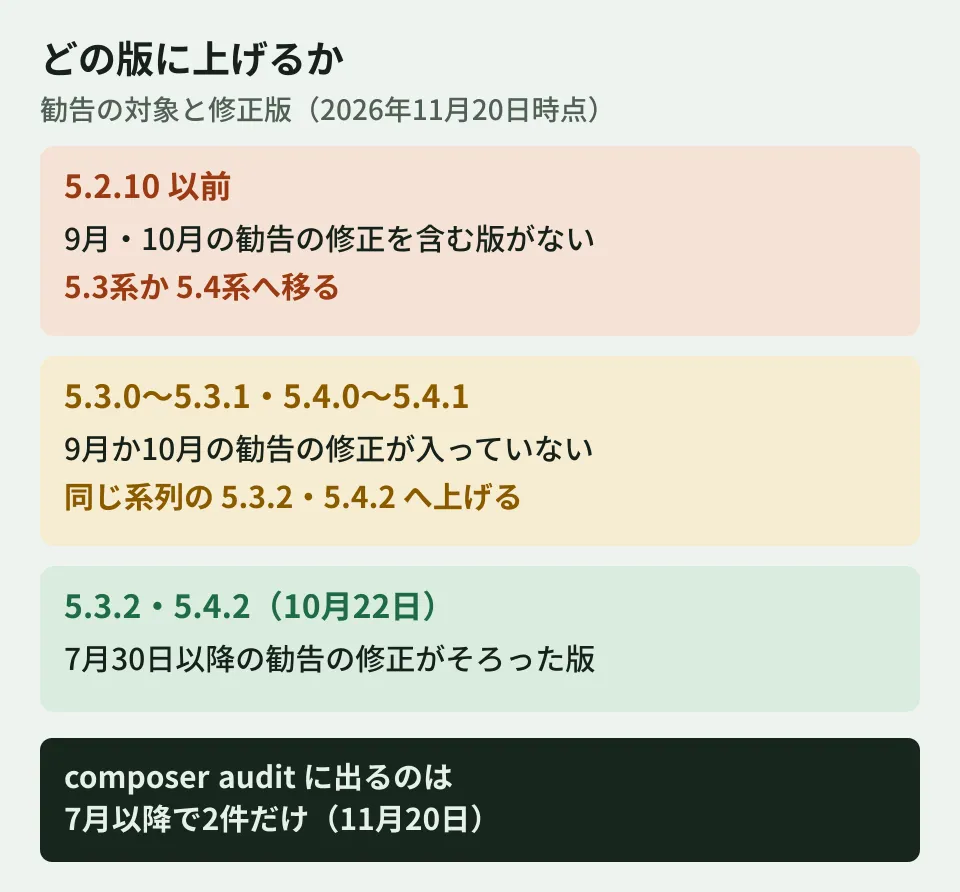
Sites built with baserCMS 5 need to be updated to 5.3.2 or 5.4.2 (both released on October 22, 2026). Since July 30, 31 advisories have been published in the baserCMS repository in three rounds. The September 26 round includes four SQL injections (severity: critical) that let someone who is not logged in reach the database from public pages.
If you are using the 5.2 series, updating to a newer release in the same series is not enough. The last 5.2 release is 5.2.10 from July 30, and as of November 20, no 5.2 release containing the fixes for the September and October advisories has been published. The official notices also describe the countermeasure as updating to a 5.3 or 5.4 release. In this article, we cover what the three rounds of advisories contain, the fixed releases, how the 5.2 series is handled, and the steps for checking.
Three rounds of advisories and the fixed releases
The counts and severities are based on the list of advisories in the baserCMS repository. Dates are the dates the advisories were published in the repository.
| Advisory publication date | Count and severity | Key features | Fixed version |
|---|---|---|---|
| July 30, 2026 | 12 (3 critical, 8 high, 1 medium) | SQL injection in the admin API and the blog tag API, a missing path check in theme file writes, an issue that lets operator privileges reach administrator APIs, code execution via database restore, and more | 5.3.0 (5.2.10 for the 5.2 series) |
| September 26, 2026 | 11 (4 critical, 1 high, 6 medium) | Unauthenticated SQL injection in public pages and public APIs (4 advisories), brute-forcing of two-factor authentication codes for the admin panel, stored XSS, and more | 5.3.1 and 5.4.1 (released September 24) |
| October 22, 2026 | 8 (5 high, 3 medium) | SQL injection in the admin panel and the admin API, a third bypass of the theme file write protection, stored XSS from blog comments, insecure deserialization (restoring objects from saved data), and more | 5.3.2 and 5.4.2 (released October 22) |
In the September round, the fixed releases came out first on September 24, and the advisories were published on September 26. On the same day, September 24, an official notice was also issued asking users to update a separate plugin, Addon Migrator (BcAddonMigrator), to 5.2.1 or later.
Most of the July 30 advisories list only "5.3.0" as the fixed release. For the 5.2 series, 5.2.9, released the same day, includes a commit (464227b) that backports the 12 fixes to the 5.2 series. Two advisories (GHSA-cg65-f2m7-9fqj and GHSA-pqpg-933x-f4c5) list 5.2.10 as the fixed release, so 5.2.10 is the 5.2 release that contains all of the July 30 fixes.
The four critical advisories from September 26 are reachable without logging in
The four advisories (GHSA-v9g2-xmwr-23vc, GHSA-ch8f-q957-r9xm, GHSA-2ghw-gwvv-mv56 and GHSA-636g-rgj6-542v) describe how sending crafted parameters to public pages for blogs and custom content, or to the public blog tag API, allows SQL to be injected. No login is required. According to the advisories, the reporters confirmed not only reading and modifying the database, but also creating an administrator in the database and executing PHP via the standard plugin upload. The reporter writes that the same chain was confirmed on 5.2.10 as well (GHSA-v9g2-xmwr-23vc and GHSA-ch8f-q957-r9xm).
The official notice says that some of the September advisories "require action only if the admin panel is used by an unspecified large number of users," but these four are not among them. You should assume an update is needed regardless of who uses your admin panel.
In addition, GHSA-2w6g-wp3r-26m3 from October 22 has the same root cause as these four, and states that the September fix covered only the public pages and public APIs, leaving the admin panel and the admin API unfixed. This is one reason to update all the way to 5.3.2 or 5.4.2 rather than stopping at 5.3.1 or 5.4.1.
Theme file writes: a third bypass (GHSA-q7g3-qwrc-mp89)
The issue of being able to write PHP files outside the theme through the theme file editing API began with CVE-2026-30940, published in March (fixed in 5.2.3). On July 30, loopholes in that fix were closed, such as GHSA-2pj4-v76f-wjvx, where the check was skipped if the theme did not have the target directory.
GHSA-q7g3-qwrc-mp89 (high) from October 22 is titled "third bypass of CVE-2026-30940." The path check is performed on the still URL-encoded value, and the value is decoded when the file is written, so it slips past the check. The affected range is ">= 5.2.3, <= 5.4.1," which also includes 5.2.9, 5.2.10 and 5.3.0, the releases that contain the July 30 fix.
According to the advisory, the conditions are being logged in as an administrator and having the theme file management plugin (BcThemeFile) installed, and the plugin is not included in a standard installation. The official notice also places this issue in the group that "requires action only if the admin panel is used by an unspecified large number of users."
The July 30 operator privilege issue (GHSA-wgvx-x5g3-9v29, medium) involved a mechanism in the admin API that authenticated requests with the logged-in session when the Referer header was present, allowing even an operator account to reach the administrator settings API. This was fixed in 5.3.0 and 5.2.9.
Dates differ between publication in the repository and listing in the database
baserCMS advisories are first published in the baserCMS repository. They are listed in GitHub's global advisory database (GitHub Advisory Database) only after GitHub reviews them.
| Source | Date |
|---|---|
| Publication of advisories in the repository | July 30 (12), September 26 (11) and October 22 (8) |
| Security information on the official baserCMS website | July 30, September 24 and October 22 |
| JVN#14353754 (covering part of the September round and more) | September 25 |
| Listing in the GitHub Advisory Database | November 20 (only two: GHSA-wgvx-x5g3-9v29 and GHSA-2pj4-v76f-wjvx) |
As of November 20, of the 31 advisories published since July 30, only the two above were listed in the GitHub Advisory Database. The remaining 29 could not be found through the database API.
Composer's composer audit refers to Packagist's list of advisories by default. Packagist also had only the same two advisories for baserproject/baser-core. Even if composer audit does not report the September and October advisories, that does not mean you are not affected. Judge by the version number.
If you are using the 5.2 series
- The last 5.2 release is 5.2.10 (July 30). As of November 20, neither Packagist's
baserproject/baser-corenor the GitHub tags have a newer 5.2 release. - The 5.2 series is within the scope of the September and October advisories. The September 26 advisories cover "<= 5.4.0," and the October 22 advisories cover ranges such as "<= 5.4.1" and ">= 5.2.3, <= 5.4.1." The fixed releases are only 5.3 and 5.4 releases.
- The official notices and JVN also include the 5.2 series. The official notice of October 22 gives the affected versions as "baserCMS 5.0.0 to 5.4.1" and the countermeasure as "update to baserCMS 5.4.2 or 5.3.2 or later." JVN#14353754 also gives the affected versions as "baserCMS versions prior to 5.3.1 (including all versions in the 5.3 series and earlier)."
- We could not find any official guidance on how the 5.2 series will be handled going forward. The 5.2.x branch on GitHub contains commits that backport the September and October fixes to the 5.2 series, and its version is shown as "5.2.11-dev." However, as of November 20, it has not been published as a release. We also could not find any announcement on the official website or in the repository about whether maintenance will continue or end.
To get the September and October fixes in a published release, you need to migrate to the 5.3 or 5.4 series.
Steps to check (editorial suggestion)
- Check the running version. Run
composer show baserproject/baser-coreon the server, or look at the version ofbaserproject/baser-coreincomposer.lock. If it is earlier than 5.3.2 or 5.4.2, you are affected. - Decide which version to update to. The official notice points to 5.4.2 or 5.3.2 (or later). When updating from the 5.2 series, the CakePHP requirement rises from 5.0 to 5.2 in the 5.3 series (the PHP requirement is 8.1 or higher for both, according to Packagist). 5.4.0 added BurgerEditor as a standard feature and MCP server functionality (release notes). If you want to keep changes small, you can choose 5.3.2. We could not find any guidance on how long the 5.3 series will receive fixes.
- Test in a staging environment before updating. First confirm that your theme, custom plugins and any integrations that call the API from outside work on the new version. For the procedure, follow the official auto-update guide referenced in the release notes. The release notes state that a separate procedure is required when updating from 5.1.0 or earlier.
- Decide on interim measures until you update. The four critical advisories do not list any workarounds. Within the scope of the advisories, updating is the countermeasure. Only some advisories list workarounds: for SQL injection in the admin panel and admin API (GHSA-2w6g-wp3r-26m3), "until you update, limit admin panel accounts to trusted users"; for the mail form auto-reply (GHSA-w47c-4g8m-gjv9), "enable the email format check on the email field of each mail form"; and for displaying files with restricted access (GHSA-p22r-jcj7-mf93), "disable or restrict the bc-uploader plugin and do not share administrator accounts," among others. None of these replaces updating.
- If your site was slow to update, check what is inside it. For the four critical issues from September, the advisories describe a chain of "creating an administrator and executing PHP via plugin upload." If your site was public on a version earlier than 5.3.1 or 5.4.1 for any period, it is reassuring to check for unfamiliar administrator accounts or plugins, and for PHP files you do not remember creating in themes or public directories.
- Keep an eye on the next release. Check the security information on the official website and the releases on GitHub. On GitHub's milestones, the due date for 5.4.3 is set to November 26. This is a plan, not a promise of release.
In responding to CMS vulnerabilities, we covered deciding whether to keep using or switch CMSs in our article on Movable Type, how to proceed with updates on managed hosting in our article on the urgent PHP fixes, and taking over a site whose builder can no longer be reached in our article on maintenance takeovers.
Scope of verification
On November 20, 2026, we reviewed the list of advisories in the baserproject/basercms repository (retrieving all of them through the GitHub API and checking the severity, publication date, affected versions, fixed releases and documented workarounds of the 31 advisories since July 30), the GitHub releases and tags, the commits and version display on the 5.2.x branch, the release dates and requirements of each version of
baserproject/basercmsandbaserproject/baser-coreon Packagist, the advisory lists in the GitHub Advisory Database and on Packagist, the security information on the official baserCMS website (July 30, September 24 and October 22), JVN#14353754, and the Composer documentation (document research). We did not reproduce the issues locally or perform any updates.
GleamHub accepts consultations on maintaining baserCMS sites and on reviewing or redesigning sites that have stopped receiving updates as part of our website development services. Please reach out via our contact form.
References
- baserCMS — 2026/10/22 Multiple vulnerabilities in baserCMS, including SQL injection
- baserCMS — 2026/09/24 Multiple vulnerabilities in baserCMS, including XSS
- baserCMS — 2026/07/30 Multiple vulnerabilities in baserCMS, including CSV injection
- baserproject/basercms — Security advisories
- GHSA-q7g3-qwrc-mp89: Path traversal in the theme file API(third bypass of CVE-2026-30940)
- GHSA-v9g2-xmwr-23vc: Unauthenticated SQL Injection + Code Execution via Nested contain in the Public BlogTags API
- GHSA-2w6g-wp3r-26m3: SQL injection in the admin panel and admin API of baserCMS
- GitHub Advisory Database — GHSA-wgvx-x5g3-9v29
- GitHub Advisory Database — GHSA-2pj4-v76f-wjvx
- baserproject/basercms — Release 5.4.2
- baserproject/basercms — Release 5.3.2
- JVN#14353754 Multiple vulnerabilities in baserCMS
- Packagist — baserproject/baser-core
- Composer — Command-line interface(audit)