When you want to summarize or search internal documents without sending them outside the company, llama.cpp is a strong option. It is written in C/C++, can run on a CPU alone, and once you start llama-server, internal systems can call it as an OpenAI-compatible API. On the other hand, the numbered nightly builds released almost daily (such as b12345) did not tell you which update broke compatibility. Version tags such as v0.1.0 have also been added since August, but before 1.0.0 the MAJOR number stayed at 0.
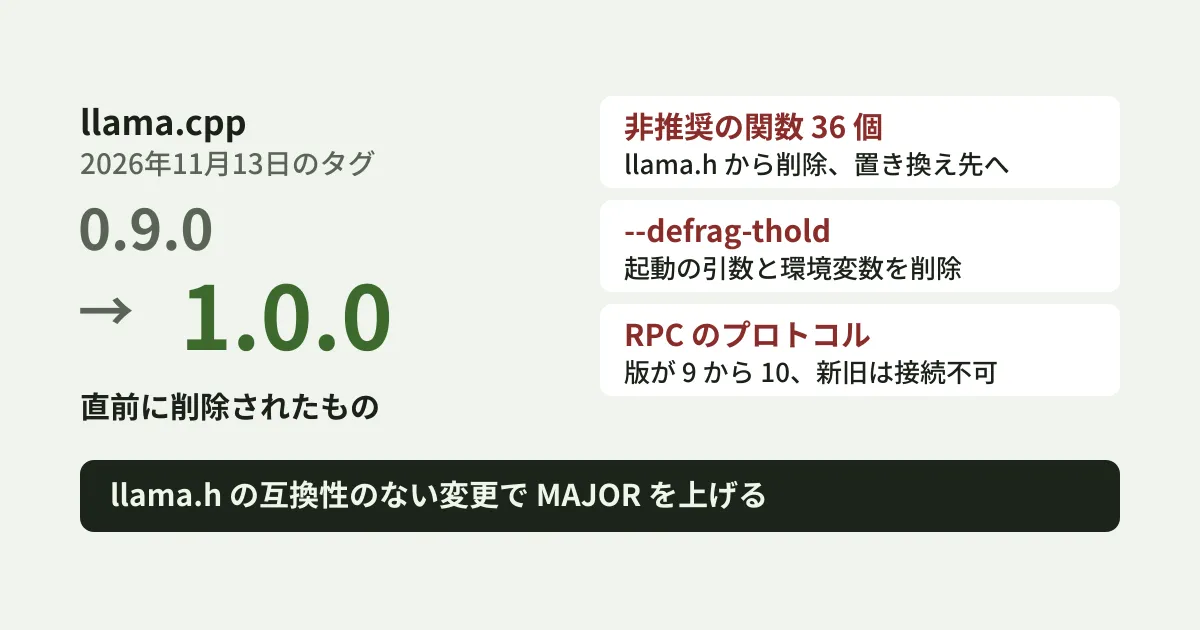
The llama.cpp repository was tagged v1.0.0 on November 13, 2026. It was announced the same day on the GitHub Release page and the Hugging Face blog, and the blog says “Moving forward, both llama.cpp and ggml will reflect API and ABI incompatibilities with major-version bumps.” This means that, from now on, incompatible changes to the API (how functions are called) and the ABI (compatibility with already-built programs) will be signaled by bumping the MAJOR number. The versioning document also specifies that incompatible changes to include/llama.h (the public C API) bump the MAJOR number. Just before 1.0.0, a change landed that removed the deprecated functions in bulk. In this article, based on the repository diff and the Release page, we lay out what those embedding it should check before upgrading.
What 1.0.0 established
The versioning scheme was introduced in an August 12 commit (#26839). The repository’s docs/release.md specifies the following.
- Incompatible changes to the public C API (
include/llama.h) are MAJOR - Compatible feature additions, new model support and API additions are MINOR
- Bug fixes that do not change the API are PATCH
docs/release.md defines official versions as annotated git tags such as v1.0.0, and states: "No GitHub Release object is created, the tag is the release artifact." and "Currently releases are not published to github releases, only nightly/development builds are available there." In practice, however, v0.9.0 and v1.0.0 have GitHub Release pages, and the v1.0.0 page lists the changes. That page has no prebuilt files and points to b12359 as the corresponding nightly. The versions starting with b listed on the Releases page are still in-development nightly builds, as before. If you build from a tag and distribute the result, the version string will include -dev unless you add -DLLAMA_BUILD_IS_DEV=OFF.
The version number was 0.9.0 in b12345, the last nightly before the removal commits landed, and rose to 1.0.0 in v1.0.0 (the v0.9.0 tag is dated November 4). The internal computation library (ggml) also went from 0.29 to 1.0.
What was removed just before 1.0.0
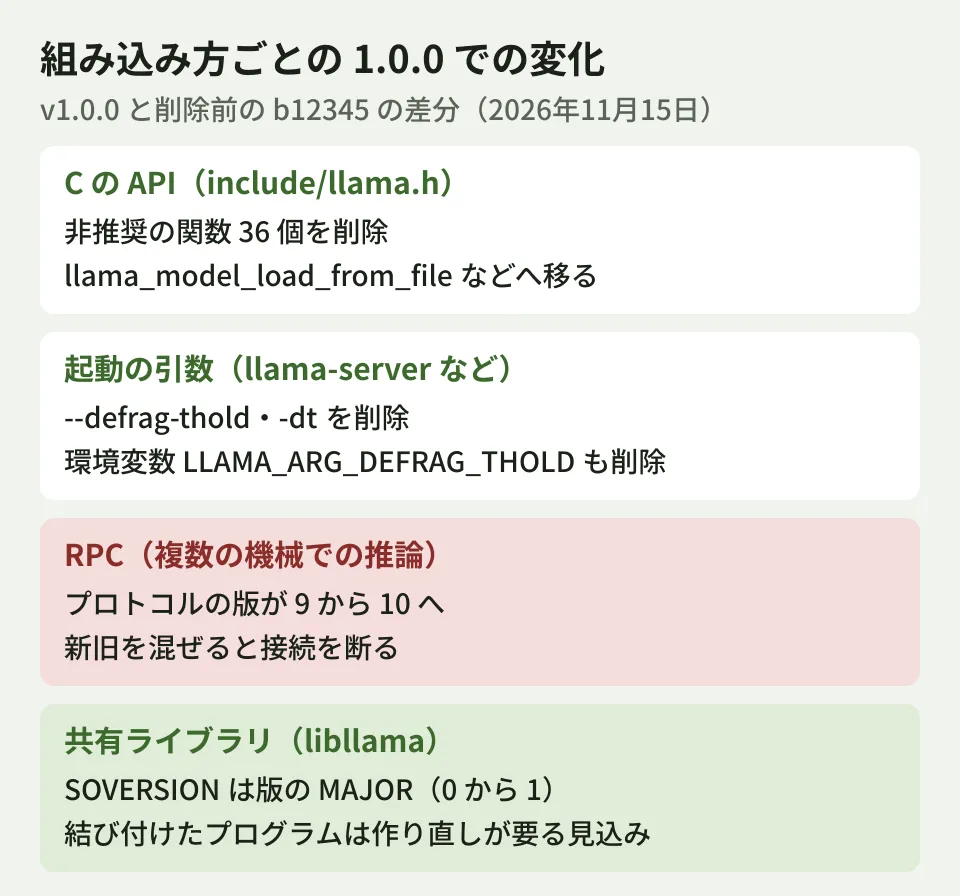
36 deprecated functions (C API)
A November 12 commit (#30565), titled "Drop the APIs marked DEPRECATED in llama.h", removed the functions marked with DEPRECATED. We confirmed that all 36 functions marked in llama.h at b12345 are gone from llama.h at v1.0.0. The Releases page counts this removal as "remove llama_set_warmup, 35 deprecated functions" (36 in total). The replacements are as stated in the markers before the removal.
| Removed functions (examples) | Replacement Destination |
|---|---|
llama_load_model_from_file・llama_free_model | llama_model_load_from_file・llama_model_free |
llama_new_context_with_model | llama_init_from_model |
llama_n_ctx_train・llama_n_embd・llama_n_layer・llama_n_head | Names starting with llama_model_, such as llama_model_n_ctx_train |
llama_n_vocab | llama_vocab_n_tokens |
Token-related functions such as llama_token_bos, llama_token_eos and llama_token_is_eog | llama_vocab_bos, llama_vocab_eos, llama_vocab_is_eog, etc. |
State saving, such as llama_get_state_size and llama_save_session_file | llama_state_get_size, llama_state_save_file, etc. |
llama_set_warmup | No replacement (the caller performs warm-up) |
Because this includes functions for loading models and cleaning up, code written from older samples is quite likely to stop building here. In the same commit, some APIs in llama-ext.h moved to llama.h, and llama_set_embd_state_src was renamed to llama_set_ctx_state_src.
--defrag-thold launch arguments
The same commit removed -dt / --defrag-thold, which set the threshold for defragmenting the KV cache, along with the corresponding environment variable LLAMA_ARG_DEFRAG_THOLD. These were already shown as deprecated. Because argument parsing in 1.0.0 reports "error: invalid argument" for unknown arguments, llama-server is expected to fail to start if this argument remains in launch scripts or systemd settings (this article did not verify this with an actual launch).
RPC protocol version
In the RPC feature, which splits a model across multiple machines, the protocol MAJOR version went from 9 to 10 (it was 8 at the v0.9.0 tag and rose to 9 in a later nightly). The commit (#29801) explains that the numbers identifying operation types are sent over the wire, and because three types were removed, the later numbers shift, so "peers built before and after this change would misinterpret each other’s ops." If the MAJOR versions do not match at connection time, the connection is refused with "RPC server version mismatch", so mixing old and new rpc-server builds will not work. All machines must be on the same version.
Shared library version number
The libllama shared library is configured to use the MAJOR version as its SOVERSION (the compatibility number in the library file name). With the move from 0.9.0 to 1.0.0, this number should accordingly change from 0 to 1. Programs built and linked against libllama.so.0 are expected not to work simply by swapping in the 1.0.0 library, and will likely need to be rebuilt (we did not build it and check the file name).
llama-server changes when upgrading from 0.9.0
If you are upgrading from the v0.9.0 tag, the security changes to llama-server made on November 11–12 also apply. They are already in b12345, so they are not included in the diff above. According to the "Server changes" section of the Releases page and the individual pull requests, the following behavior changed.
- If tools or MCP are enabled and the server is started on a non-loopback address (
--host) without an API key, it stops with an error. To continue, you must explicitly allow this with--allow-unauthenticated-tools(#32113). - URLs for images and other content passed in chat input are rejected by default if they point to local or internal network addresses. Passing them from an internal NAS or similar requires
--media-allow-private-urls(#32115). - The handling of
--cors-originswas fixed and now matches the port as well. Browser requests from origins that are not allowed are rejected (#32098, #32113).
This article did not verify these with an actual launch.
What to check before upgrading, in order (editorial suggestion)
- Check how you integrate it. The impact differs depending on whether you call the C API directly, use only the HTTP API of
llama-server, or go through Python or other bindings or a product such as Ollama. If you use only the HTTP API, the main things to check are the launch arguments and thellama-serversecurity changes above. - Search for removed functions. Search your own code with something like
grep -rnE 'llama_(load_model_from_file|free_model|new_context_with_model|n_vocab|n_embd|token_(bos|eos|eot|is_eog|get_text|fim_[a-z]+))\(' src/and rewrite calls to use the replacements (the example covers only some names;llama_token_to_piecestill exists in 1.0.0, so searching for all names starting withllama_token_will produce false matches). - Search your launch settings. Look for
--defrag-thold,-dtandLLAMA_ARG_DEFRAG_THOLDin shell scripts, systemd units and container settings, and remove them. - Align your RPC machines. If you run a distributed setup, rebuild every
rpc-serverfrom the same tag before switching over. - Check your binding version. llama-cpp-python on PyPI released 0.3.37 on November 15. Its CHANGELOG says it updated the bundled llama.cpp to
a956a852c(a commit afterv1.0.0). The pull request for this update (#2414), titled "Preserve deprecated Python entry points", explains that the old entry points on the Python side were kept. Because bindings choose their bundled llama.cpp version independently, check the version of the binding you use and the llama.cpp commit it bundles before upgrading.
We covered how to approach running local language models in-house in our article on running Gemma 4 locally, and the move to build them into the OS in our article on Ubuntu's local AI.
Scope of verification
On November 15, 2026, we cloned the ggml-org/llama.cpp repository with git and reviewed the diffs between the tag
v1.0.0and the pre-removal nightlyb12345for the headers, build settings, argument parsing, RPC handling and versioning document, along with the related commit messages (document research). On November 20, 2026, we checked the GitHub Release page (v1.0.0), the Hugging Face blog announcement, thellama-serversecurity pull requests (#32098, #32113, #32115), the RPC version inv0.9.0, and PyPI and the llama-cpp-python CHANGELOG. We did not verify building, launchingllama-server, loading models, connecting over RPC or behavior through bindings.
GleamHub offers development and AI consultations on building local language models into internal systems and on how to check updates. What needs checking depends on your setup, so please reach out through our contact form.
References
- ggml-org/llama.cpp — Release v1.0.0
- Hugging Face — llama.cpp v1.0.0 : A stronger foundation for the local AI ecosystem
- ggml-org/llama.cpp — docs/release.md(v1.0.0)
- ggml-org/llama.cpp — include/llama.h(v1.0.0)
- ggml-org/llama.cpp — llama : prune(#30565)
- ggml-org/llama.cpp — ggml : prune(#29801)
- ggml-org/llama.cpp — cmake : introduce semantic versioning(#26839)
- ggml-org/llama.cpp — server: explicit opt-in tools via non-loopback addr(#32113)
- ggml-org/llama.cpp — server: disallow reaching local addresses from CORS proxy and media URLs(#32115)
- PyPI — llama-cpp-python
- abetlen/llama-cpp-python — CHANGELOG.md