You want AI agents to work with your internal code and business systems, but company policy does not allow entrusting the record of their work (session history) to an external service. Claude Managed Agents was a product whose evaluation often stalled at this barrier, because it is a service operated by Anthropic that stores session records on Anthropic's side.
On November 12, Anthropic released "self-hosted Claude Managed Agents", which runs the Managed Agents server in your own environment, as a private beta. You apply through your account representative, so it is not something anyone can try right away. Based on the official announcement and documentation, this article outlines what you will own, what leaves your network and which features become unavailable, and shows what to decide before considering adoption.
Three operating models
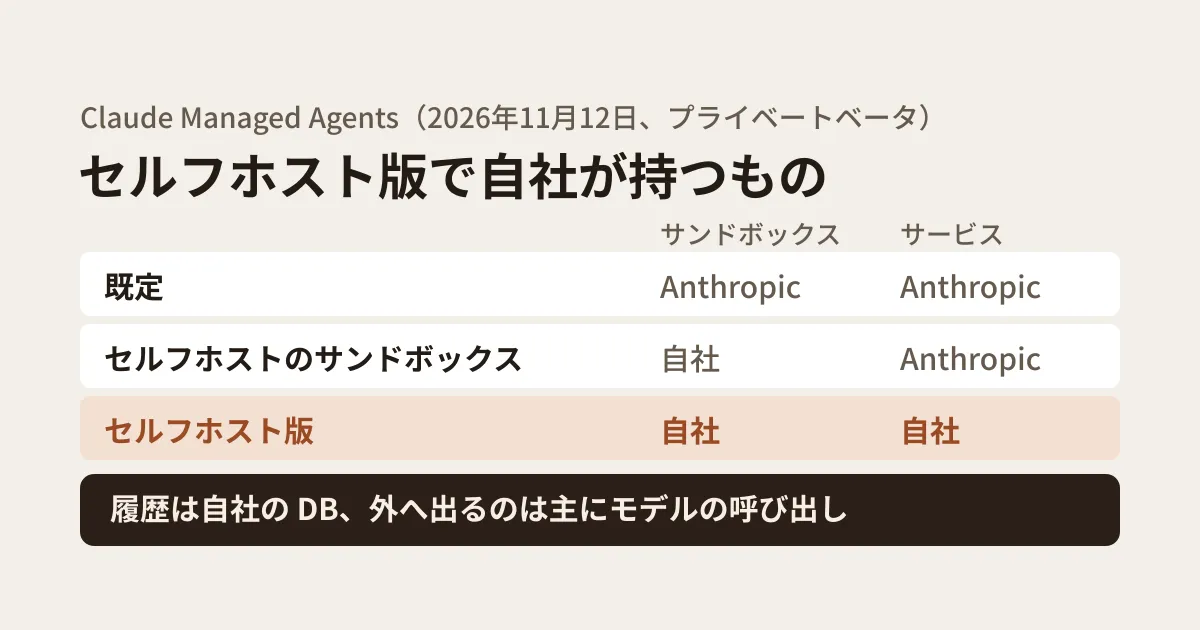
Managed Agents is made up of a "sandbox", where the agent's tools (shell and file operations) run, and a "service", which handles the API, the agent loop and storage of session history. The documentation lists three models depending on who operates which.
| Model | Sandbox | Service | Model |
|---|---|---|---|
| Cloud sandbox (default) | Anthropic | Anthropic | Anthropic |
| Self-hosted sandbox | Your company | Anthropic | Anthropic |
| Self-hosted version (new) | Your company | Your company | Anthropic or a provider you choose |
The documentation gives two reasons to choose the self-hosted version: when you must store agents, sessions and history yourself, and when model calls must go to Amazon Bedrock, Claude models on Google Cloud, Microsoft Foundry or your own model gateway. If you only want tools to run in your own environment, it directs you to the self-hosted sandbox, where Anthropic operates the service.
The relationship with zero data retention (ZDR) is also described. The data retention page lists Managed Agents as not covered by ZDR, because in the model where Anthropic operates the service, Anthropic stores session records until they are deleted. In the self-hosted version, you are the one storing those records. The announcement states that for organizations with a ZDR agreement with Anthropic, ZDR applies to requests sent to Claude just as it does to other Messages API calls.
What you run yourself
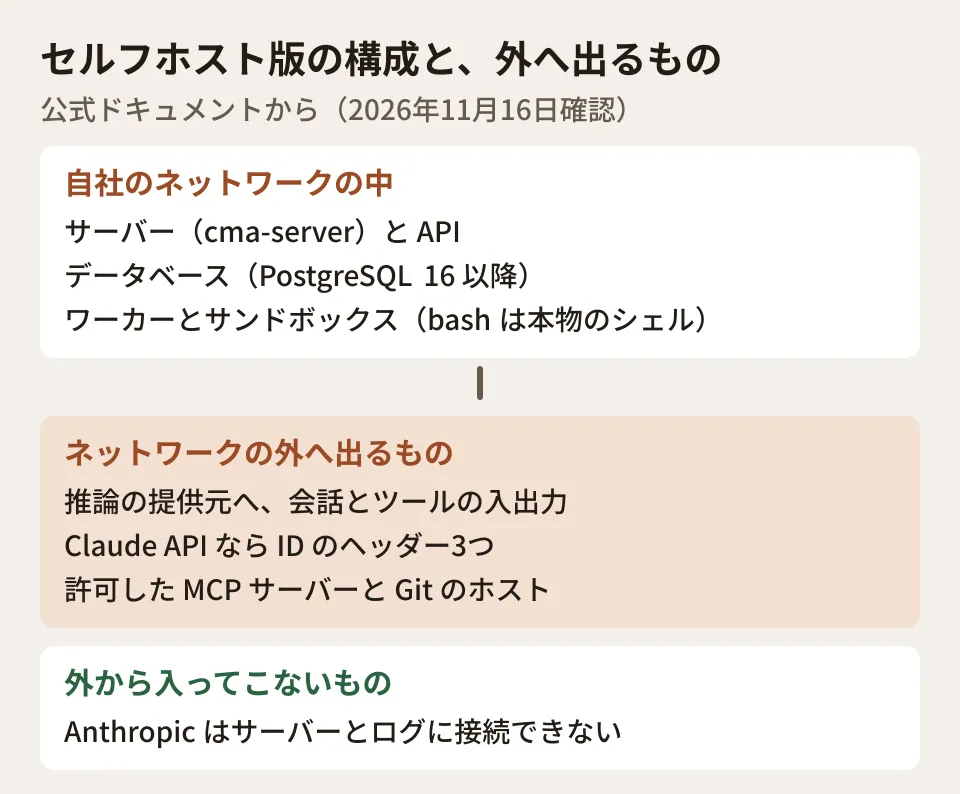
According to the documentation, a single deployment consists of the following components.
- Server (
cma-server): Provides the API, runs the agent loop and stores session history. It does not run the agent's shell or file tools. - Database: PostgreSQL 16 or later. If not configured, data is stored in memory and lost on restart.
- Worker: A program that receives work from the server and runs shell and file tools inside the sandbox.
- Console on the server: A web interface where you sign in with your own identity provider to create agents and run sessions.
- Admin CLI (
cma-server-admin): Creates environments and per-environment keys.
The API is the same as the service Anthropic operates, so the SDKs and the ant CLI can point to your own server as is.
A Docker Compose setup for trying it on a single machine is also provided. However, the documentation describes it as "for development, not production." For production, it recommends deploying to Kubernetes with the two Helm charts included in the release. You handle the rollout of each release yourself.
What leaves your network
The page for answering security reviews (Data and access) lists the destinations the server connects to. The main ones are as follows.
- Inference provider
- Your database
- Allowed MCP servers
- Allowed Git hosts
- OpenTelemetry collector, identity provider and secrets manager, if configured
It connects to Anthropic only when the inference provider is the Claude API.
Each time the model is called, the conversation so far (including prompts and tool inputs and results) is sent to the inference provider. When sending to the Claude API, headers containing the session, agent and environment IDs are attached. The documentation states that "the IDs contain no names or content, but do indicate when they were created," and that there is no setting to turn this off.
The documentation also notes the following two points for sending to the Claude API.
- A
User-Agentindicating the name and version of the server software is attached. - The server checks with the Claude API at startup and every 60 seconds whether the credentials used for calls are valid (the interval can be changed with
health.check_interval). These checks do not perform inference, and the ID headers above are not attached.
In addition, the body of model calls may include a marker, cma-server (metadata.user_id), that is the same on every server. The documentation states that Anthropic can use this marker and User-Agent to count usage of the self-hosted version.
In the other direction, it states that "Anthropic has no remote access to the server or its logs." The credentials the server accepts are those you create, those issued by your own identity provider, or those the server itself creates.
Unavailable features and features that stay off until configured
From the page summarizing differences from the service Anthropic operates (Differences), we pick out the items that matter for business use.
| Classification | Main items |
|---|---|
| Unavailable | Anthropic's cloud environments (only your own workers), the Messages API and Files API (the server does not provide them), mcp_oauth credentials, the built-in docx, pdf, pptx and xlsx skills, scheduled runs, and webhooks |
| Off until configured | MCP servers (allowed hosts only), Git repositories (allowed hosts only), web_search and web_fetch |
| Behaves differently | The model keeps processing even with no worker present, and waits without an error at the first tool call. The model does not see images or documents passed by URL, but no error is raised |
Because tokens refreshed through OAuth cannot be used, MCP server authentication has to rely on fixed tokens that you rotate before they expire. The documentation also says that, since the server does not reject force pushes, you should protect the branches you hand to agents on the Git host side. web_search and web_fetch may still be unavailable depending on the inference provider, even after you enable them in the settings. web_search works only with the Claude API, Google Cloud and Microsoft Foundry, and web_fetch only with the Claude API and Microsoft Foundry; with any other provider, the model simply cannot call them, without raising an error.
Security responsibilities that fall on your company
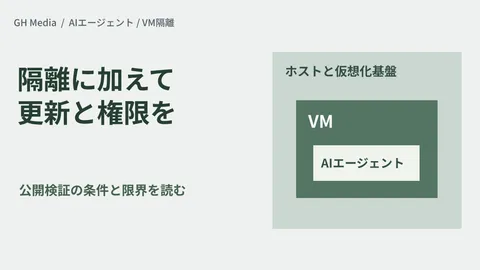
The most serious warning in the documentation is that the agent's bash tool is "a real shell with the permissions and network of the worker process," and that the worker itself is not isolated. The Compose setup and the Helm chart start a worker in a separate container or Pod for each session. If you start workers yourself, the documentation asks you to run them in disposable containers or VMs that hold nothing worth protecting.
Tenant separation also works differently from Anthropic's service. A single deployment handles only one tenant and one trust level. The server's API key reaches every environment, and any user with permissions can run sessions in any environment. If departments or clients handle data at different levels, split the deployment itself, with separate databases, API keys and workers.
What to decide before you start evaluating
From here on is the editorial team's own analysis.
- Which form do you really need? Separate the cases: whether internal policies restrict where history is stored, whether you want to limit model calls to your own cloud, or whether you only want tools to run on your internal network. If it is only the last, a self-hosted sandbox, which does not require you to take on operating the service, is enough.
- Who will operate it? The server, PostgreSQL, Kubernetes, updates for each release, and logging and monitoring become your company's job. First check whether the people in charge of your existing infrastructure have the capacity to take this on.
- Will the unavailable features be a problem? If your design relies on the built-in document-creation skills, scheduled runs or webhooks, decide in advance how you will replace them.
- How many trust levels will you have? You need one deployment per data level you handle, so the operational burden grows in proportion to that number.
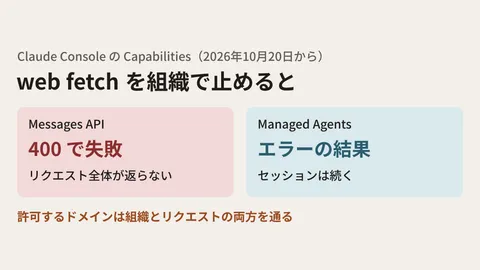
We covered the concepts behind Managed Agents in our explainer on Claude Managed Agents, and restrictions on outbound destinations in the hosted version in our article on web_fetch restrictions.
Scope of verification
On November 16, 2026, we reviewed the announcement on claude.com (Operate Claude Managed Agents inside your security perimeter, November 12, 2026) and the documentation on platform.claude.com (Self-hosted Claude Managed Agents, Differences from the hosted service, Data and access, Inference provider, Get started) (desk research). On November 20, we rechecked the announcement, the Markdown versions of the five documents, and the Claude Platform release notes. Because we do not have access to the private beta, we did not obtain or start the server, try the Docker Compose setup, or observe its network traffic. The materials we reviewed did not state the pricing of the self-hosted version, the countries and regions where the beta is offered, or when the beta will end.
GleamHub's development, AI and automation consulting can help you choose an architecture and design networking and permissions when building AI agents into your internal systems. Please reach out via our contact form.
References
- Claude — Operate Claude Managed Agents inside your security perimeter(2026-11-12)
- Claude Docs — Self-hosted Claude Managed Agents
- Claude Docs — Differences from the hosted service
- Claude Docs — Data and access in self-hosted Claude Managed Agents
- Claude Docs — Inference provider
- Claude Docs — Get started with self-hosted Claude Managed Agents