On sites that serve different pages for Japanese and English, or for each country, a mistake in how caching is set up can show content built for one language to users of another. Even if no personal information is shown, mixing up prices, stock, or region-specific notices can lead to inquiries and damage trust.
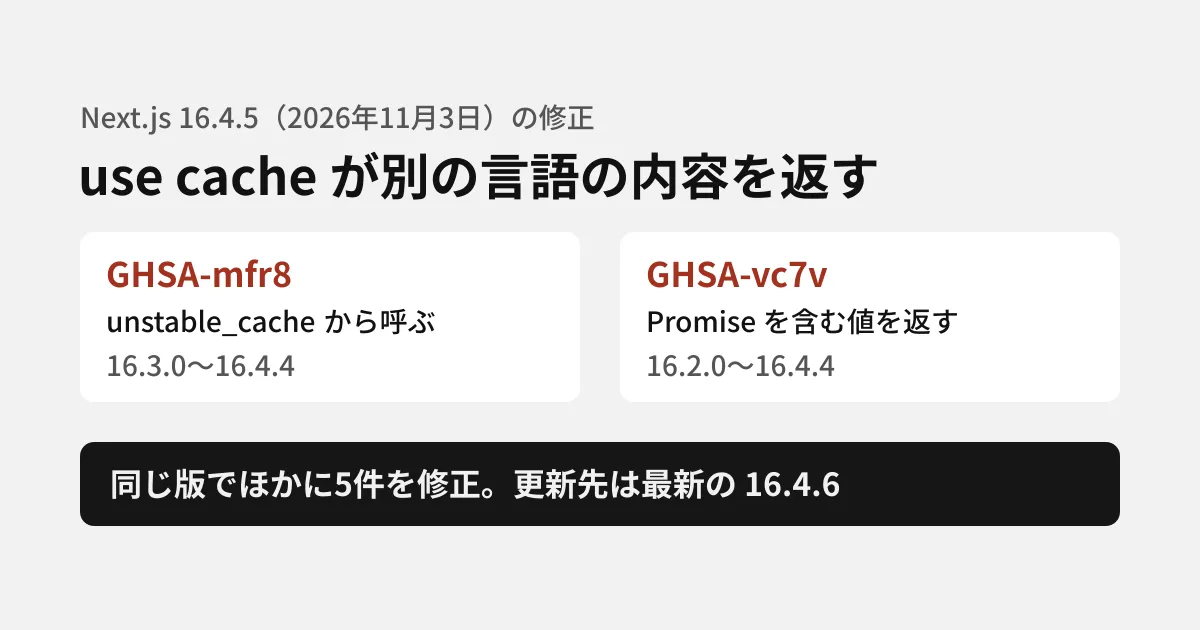
Two issues that cause exactly this kind of mix-up in Next.js Cache Components ('use cache') were added to GitHub's advisory database (November 16 and 17). Both are fixed in 16.4.5, released on November 3. On the same day, November 3, the official Next.js blog published an announcement of 7 issues including these 2 (November 2026 Security Release), and the remaining 5 were added to the database on November 19. In this article, we use the original announcement and advisories and the commits in the vercel/next.js repository to lay out the affected code patterns and which version to update to.
The two advisories
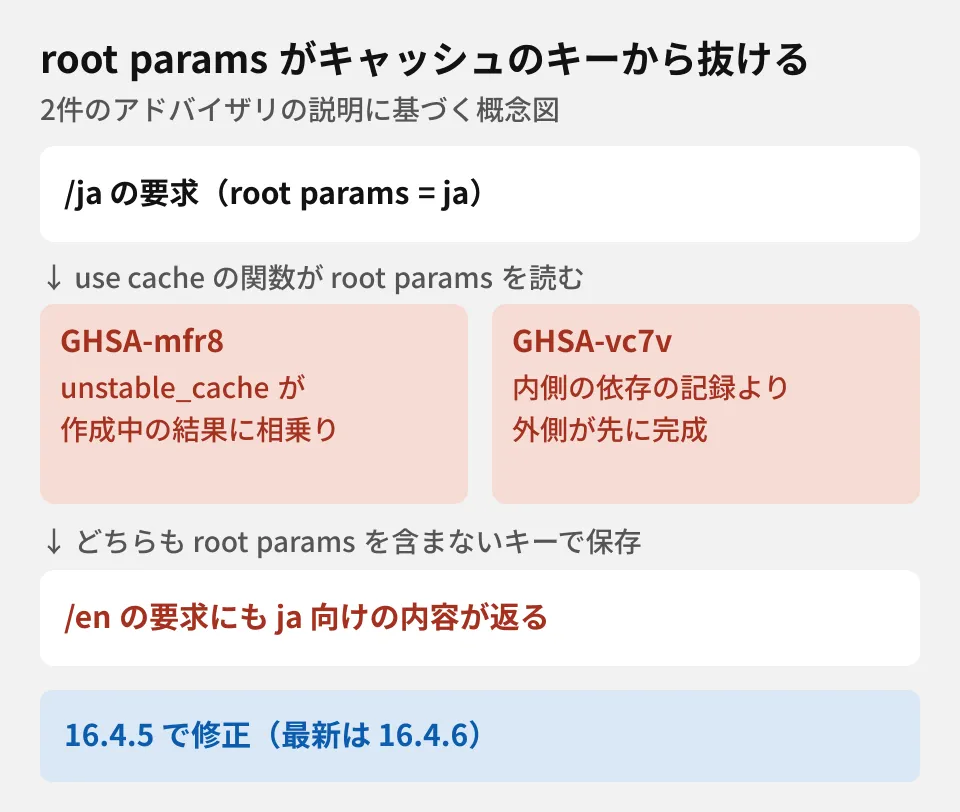
Both hinge on "root params." Root params are the route parameters of the root layout (the outermost layout, such as app/[lang]/layout.tsx), and the advisories describe them as "commonly used to separate data by language." The official blog gives a tenant (customer) identifier as an example and says that if you separate tenants with root params, another tenant's data may be returned.
| Advisory | Affected versions | What happens | Conditions for being affected |
|---|---|---|---|
| GHSA-mfr8-8qww-v76h (CVE-2026-119790; MODERATE in the database, High on the official blog) | 16.3.0 or later, earlier than 16.4.5 | A cache built for one root params value is also returned to requests with other values | The same 'use cache' function is called directly during rendering and also from inside unstable_cache(), and that function reads root params |
| GHSA-vc7v-qv4w-wrv8 (CVE-2026-119351; MODERATE, and Medium on the official blog as well) | 16.2.0 or later, earlier than 16.4.5 | The outer 'use cache' entry is stored under a key that does not include root params and is reused for every value | Cache Components is enabled, and an inner 'use cache' reads root params with next/root-params and returns a value containing a Promise that has not yet settled |
GHSA-mfr8: when called from unstable_cache()
If a request via unstable_cache() arrives right after the process starts, before the function's first cache entry has finished being created, the deduplication logic hands that request the result of the direct call. This is a call that should have been rejected by the root params check, and because the result it receives is stored under a key that does not include root params, the same content is returned to requests for other values until the entry is revalidated or evicted. The database rates the severity as MODERATE (6.3 in CVSS 4.0), while the official blog rates it as High.
According to the advisory, outside of this race condition the call results in the error 'use cache' inside unstable_cache() is unsupported. For that reason, not calling a 'use cache' function from inside unstable_cache() is described as a complete workaround.
GHSA-vc7v: when an inner function returns an immediately available value together with a slow value
When an inner 'use cache' returns an immediately available value together with a slow value (a Promise), and the outer function finishes without waiting for the slow value, the outer function completes before the inner entry has finished recording its dependency on root params. The outer entry is written only once and reused for every value of root params. The official blog explains that content specific to a tenant, site, or language can be returned across those boundaries. The advisory states that which value's content appears is determined by the call that wrote the entry first, and is not something an attacker can choose. Entries written this way may also ignore tag-based invalidation and expiration of the inner cache.
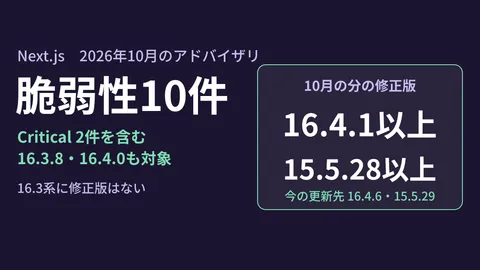
It is described as a variant of GHSA-h694-7cp9-m8p3, disclosed in October (fixed in 16.3.8), in a form that the earlier fix does not prevent.
Five other issues fixed in the same 16.4.5
Of the seven commits between 16.4.4 and 16.4.5, the five besides the two above are also fixes for vulnerabilities listed in the official blog announcement. The five advisories were added to the database on November 19 (UTC). All are rated MODERATE (Medium on the official blog).
| Advisory | Affected versions | What happens | Conditions for being affected |
|---|---|---|---|
| GHSA-rhh4-g77r-r9qj(CVE-2026-119349) | 16.0.0〜16.4.4 | Binary arguments with different contents produce the same cache key, so another user's result is returned, or your own result can be made to return to other users | Values that distinguish users or accounts are passed to a 'use cache' function as binaries such as Uint8Array or Blob |
| GHSA-vvgp-ww4w-46vf(CVE-2026-119350) | 16.4.0〜16.4.4 | A single unauthenticated GET poisons the cache of the shell (the page skeleton) shared by a group of routes. A 404 persists, or the page is rendered with a different argument value | Self-hosted with next start, partialPrefetching unset or false in cacheComponents: true, plus other conditions on route shape |
| GHSA-pc58-hwjq-p385(CVE-2026-119348) | 16.0.0–16.4.4, 15.5.28 and earlier | In a proxied fetch response, the compression information in the headers does not match the actual body, and the response is delivered to a different user | Self-hosted, returning fetched responses as is, behind an HTTP/1.1 reverse proxy that queues responses |
| GHSA-f3mh-rxg3-f5g2(CVE-2026-119346) | 16.0.0〜16.4.4、15.0.0〜15.5.28 | Cookie values appear in the internal header x-middleware-set-cookie, so same-origin JavaScript can read HttpOnly cookies | Sensitive cookies are set with NextResponse in Edge runtime route handlers or API routes |
| GHSA-7qx7-33qx-rqx2(CVE-2026-119347) | 16.0.0〜16.4.4、15.0.0〜15.5.28 | In image optimization (/_next/image), an SVG misidentified as AVIF slips past dangerouslyAllowSVG: false | Self-hosted, handling images from allowed sources, and using an image processor that can read SVG |
GHSA-vvgp lists a workaround of setting partialPrefetching: true in next.config. The other four list no workaround.
On the 15.x line, 15.5.29 was released the same day and fixes three of these: GHSA-pc58, GHSA-f3mh, and GHSA-7qx7. The 15.x line is not among the affected versions for the two root params issues, GHSA-rhh4, or GHSA-vvgp. GHSA-pc58 affects "15.5.28 and earlier," and the advisory lists no fixed versions for the 14.x line or earlier.
Steps to check (editorial suggestion)
- Check the version. If
npm ls nextshows 16.0.0–16.4.4, you are within the affected versions of some of the seven issues. npm'slatestis 16.4.6 from November 9, which includes all the fixes in 16.4.5. Update to 16.4.6. For the 15.x line, upgrade to 15.5.29, npm'sbackport. - Check whether you use Cache Components. Look for
cacheComponents: trueinnext.configand for functions that include'use cache'. If you do not use them, the two root params issues do not apply. - Find functions that read root params. Check whether
next/root-paramsimports or root layout arguments such asapp/[lang]/layout.tsxare used inside'use cache'functions. - Remove the combination with unstable_cache(). If you cannot update right away, the workaround the advisory gives for GHSA-mfr8 is to restructure the code so that
'use cache'functions are not called from insideunstable_cache(). The advisory lists no workaround for GHSA-vc7v. - Check the self-hosting conditions. If you run on
next start, check whether you meet the conditions for GHSA-vvgp, GHSA-pc58, and GHSA-7qx7 in the table above. If you set cookies fromNextResponsein Edge runtime routes, GHSA-f3mh may also apply. - Replace the cache after updating. Entries stored under the wrong key are said to remain until revalidated or evicted. The 404 entries from GHSA-vvgp are also said to persist even after a server restart. After updating, clear the cache in your deployment environment or revalidate by tag to rebuild it.
We covered the fixes for the ten advisories announced on September 30 and October 14 and the conditions for self-hosting in our article on the October Next.js vulnerabilities, and the changes to the 16.3 dev server in our article on Next.js 16.3.
Scope of verification
On November 19, 2026, we checked GHSA-mfr8-8qww-v76h (published November 16, 2026) and GHSA-vc7v-qv4w-wrv8 (published November 17) in github/advisory-database, the JSON for GHSA-h694-7cp9-m8p3, the commit subjects and changed files between the vercel/next.js tags v16.4.4, v16.4.5, v16.4.6, v15.5.28, and v15.5.29, and the publication dates on the npm registry. On November 20, we checked the announcement on the official Next.js blog (November 2026 Security Release, November 3) and GHSA-rhh4, GHSA-vvgp, GHSA-pc58, GHSA-f3mh, and GHSA-7qx7, which were added to the database on November 19, and confirmed that npm's
latestwas still 16.4.6 (document research). We have not reproduced the issues or verified behavior after updating.
For update planning for sites built with Next.js or reviewing cache design for multilingual sites, please contact us through Development, AI, and automation consultations.
References
- GHSA-mfr8-8qww-v76h: Information disclosure across root params when a ‘use cache’ function is called through unstable_cache()(github/advisory-database)
- GHSA-vc7v-qv4w-wrv8: Cache leak across root param values in nested ‘use cache’ functions via delayed inner stream metadata(github/advisory-database)
- vercel/next.js — commit d605874(Fix
unstable_cacheleaking cold'use cache'fills across root params) - vercel/next.js — commit 80c96ed(Fix outer
'use cache'entries reused across root param values) - vercel/next.js — v16.4.5
- npm — next
- Next.js — November 2026 Security Release
- GitHub Advisory Database — GHSA-rhh4-g77r-r9qj
- GitHub Advisory Database — GHSA-vvgp-ww4w-46vf
- GitHub Advisory Database — GHSA-pc58-hwjq-p385
- GitHub Advisory Database — GHSA-f3mh-rxg3-f5g2
- GitHub Advisory Database — GHSA-7qx7-33qx-rqx2