Minor WordPress updates are installed without any action from administrators on sites with automatic updates enabled. However, if your custom theme or plugin passes values directly to WP_Query or WP_Meta_Query, or you have built an integration that changes a post's author via the REST API, results may change after the update. WordPress 7.1.5, released on November 18, 2026, is an update that touches exactly those areas.
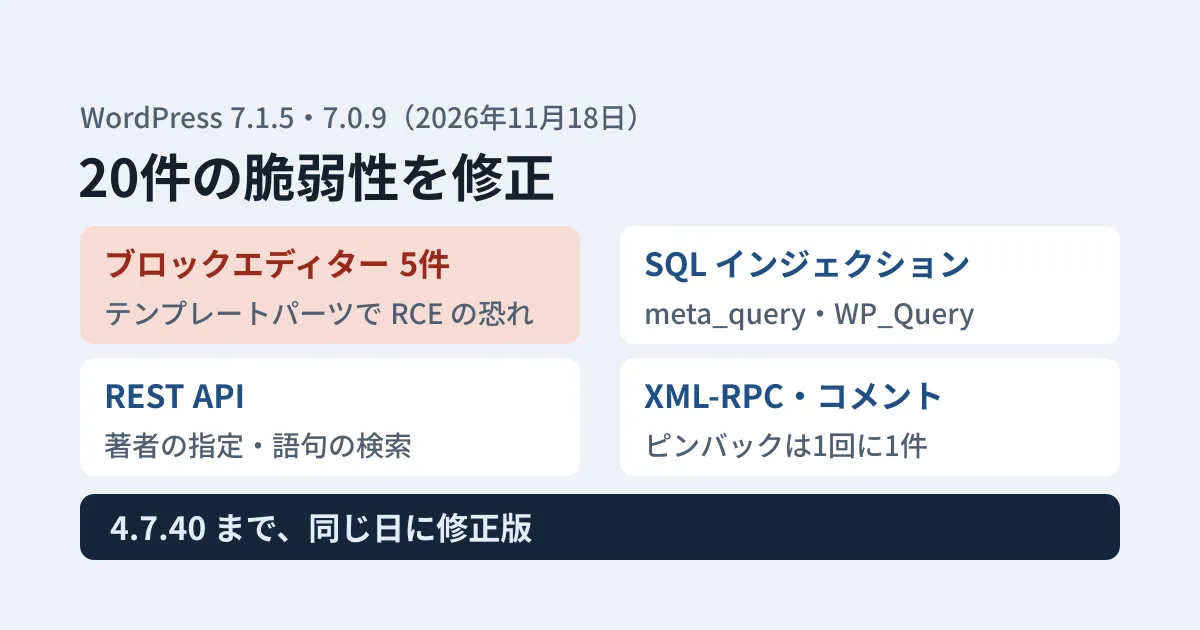
The announcement lists fixes for 20 vulnerabilities and says, "Because this is a security release, it is recommended that you update your sites immediately." In this article, we read the wordpress.org announcement and release notes (HelpHub), and the diff of the security fix commit (be8f460) in the 7.1 branch of the core development repository (WordPress/wordpress-develop), and lay out what site builders and maintainers should check. The announcement and release notes do not include CVE numbers or severity scores.
The 20 items in the announcement and the 15 items in the core commit
The announcement and release notes list 20 items. By contrast, the description of the commit "Security: Backport the WordPress 7.1.5 security fixes to the 7.1 branch.", which landed just before the 7.1.5 version bump (68aa336, November 18, 16:05 UTC), lists 15 items. The remaining 5 are block editor issues and appear to have come into the 7.1 branch through the same day's update of the pinned block editor (Gutenberg) version (fb596c8). fb596c8 changes files such as those of the Comment Date block, and the security fix commit for the 6.7 branch lists items corresponding to the same 5 on the core side. We could not open the Gutenberg-side diff and have not verified it.
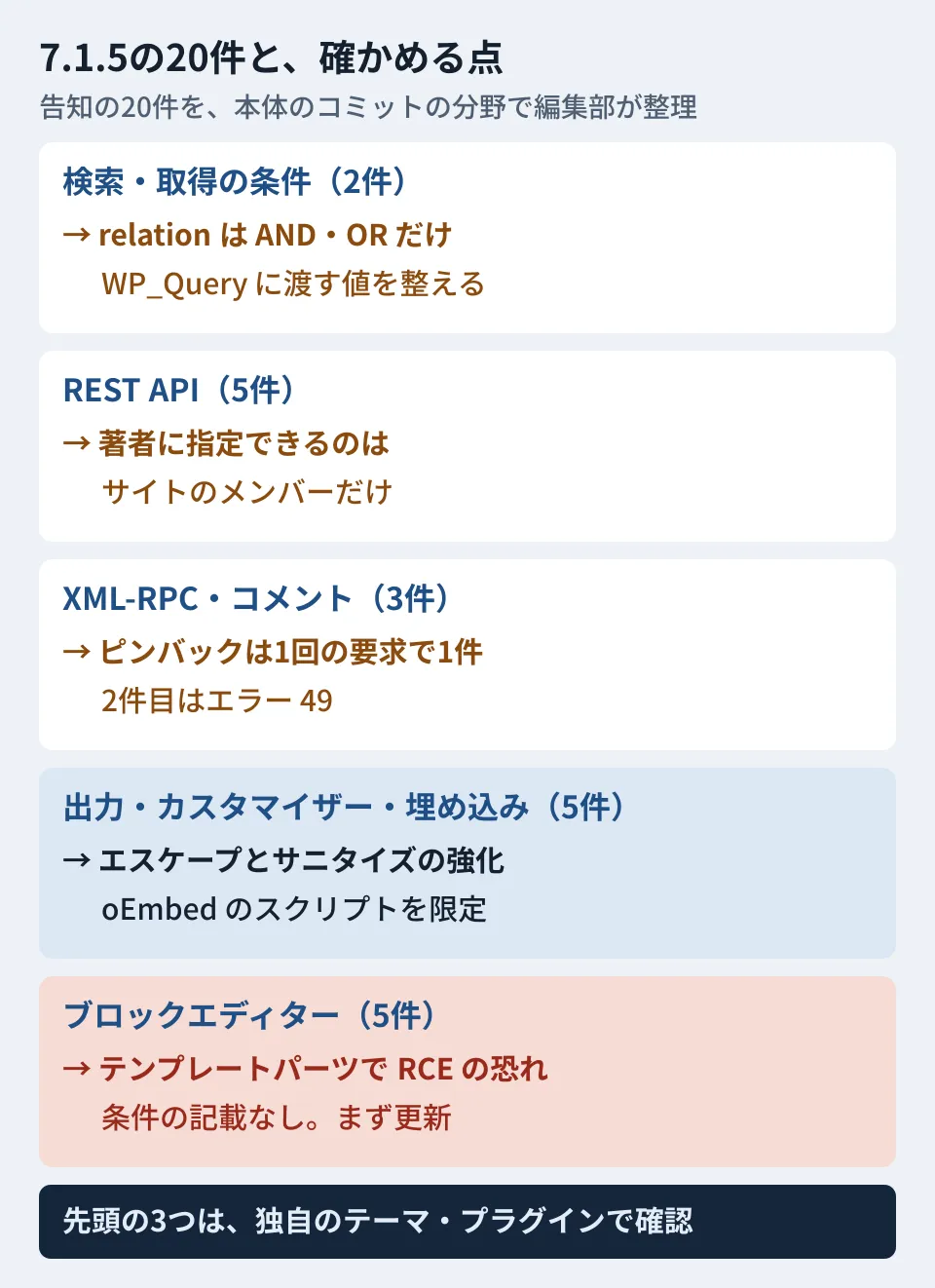
After reading the diff, we grouped the 15 items by area and added the 5 block editor items, as follows.
| Area | Items (commit subjects; announcement descriptions for the block editor) | Changes visible in the diff |
|---|---|---|
| Query and retrieval conditions | Query: Use prepared statements for more WP_Query clauses. / Meta API: Validate the relation argument in WP_Meta_Query. | Conditions such as p, page_id, menu_order, m (year, month, and day), and post status are built with $wpdb->prepare(). relation treats everything other than OR as AND |
| REST API | Restrict post and template author assignment to site members. / Harden comment author handling. / Only serve rest_route requests outside of the admin. / Return no terms when a term search resolves to no taxonomy. / Escape a hyphen in wp_is_json_media_type(). | Only members of the site can be set as authors of posts and templates. Permission checks are tightened when setting someone else as a comment's author. Inside the admin screens, rest_route requests are not treated as REST API requests. Searches for terms with no matching taxonomy return 0 results |
| XML-RPC and comments | Only return comments the user can read from wp.getComments. / Process only one pingback per request. / Check permissions before moving a comment to another post in the admin. | wp.getComments returns only comments the user has permission to read, and returns commenters' email and IP addresses only to people who can moderate or edit comments. Only one pingback is processed per request |
| Output, Customizer, and embeds | Shortcodes: Prevent attribute escape sequences from forming HTML. / Customize: Sanitize option settings with sanitize_option() when previewing. / Customize: Harden nav menu args handling. / Embeds: Return scripts from the oEmbed proxy only for embed handlers. / Interactivity API: Escape the store namespace in wp_interactivity_data_wp_context(). | Tightens handling of shortcode attributes, setting values during Customizer previews, scripts in oEmbed proxy responses, and Interactivity API namespace output |
| Block editor | Privilege escalation via Template Part block attributes / XSS via the Comment Date block's date format / XSS via Openverse image metadata / XSS via file names when converting a media block to a File block / Removal of Imgur embeds (hardening) | In 7.1, these appear to have come in with fb596c8. Diff not verified |
Issues the announcement says can be exploited without authentication
The following 4 items are described as "Unauthenticated" in the announcement.
- Privilege escalation via Template Part block attributes that could lead to remote code execution (block editor side)
- Stored XSS via shortcode attributes written in comments (the Shortcodes item)
- Denial of service by sending XML-RPC pingbacks in bulk (XML-RPC: Process only one pingback per request.)
- Information disclosure in which terms from non-public taxonomies are visible through the REST API search endpoint (the REST API: Return no terms … item)
Of these, the announcement does not state the affected conditions for the Template Part issue. Rather than first investigating whether your own site is affected, the safest course is to finish updating.
Some of the other items are annotated in the announcement with the privileges required to exploit them, such as "Author+" (Author or higher) and "Contributor+" (Contributor or higher). On sites that accept user registration and where outside people hold roles such as Contributor, more items may apply.
What to check in themes you have built and custom plugins
From here on, these are editorial suggestions based on the diff above. We did not update an actual site to 7.1.5 and verify its behavior. Because no mapping between the announcement's descriptions and the core commit's items has been published, the mapping below is our editorial judgment based on the subjects and descriptions.
1. Are you passing anything other than AND or OR to the meta_query relation?
The announcement describes this as "SQL injection in WP_Meta_Query via a nested relation value." The newly added WP_Meta_Query::sanitize_relation() treats as OR only strings that become OR when uppercased, and returns AND for everything else, including arrays and empty values. Lowercase 'or' remains OR as before. relation in nested conditions now goes through the same processing.
If a custom filtering screen puts user-selected values directly into relation, versions before 7.1.5 may be affected by this issue. After the update, unintended values become AND. For peace of mind, search your code for patterns like 'relation' => $_GET['mode'].
2. Are you passing arrays or non-numeric values to WP_Query?
For p, page_id, menu_order, and others, places that previously built SQL by concatenating strings now use %d. A code comment says that "array values are queried as 0 rather than dropping the condition." The announcement's "SQL injection via the front page settings in Customizer change previews" appears to correspond to this change, since the reporter is listed in this commit's contributor field (Props).
On listing pages that pass URL parameters directly to WP_Query, the results may change when unexpected values arrive. Review whether the code that builds display conditions sanitizes values first with absint() or similar.
3. Do you have integrations that set a post's author via the REST API?
The announcement describes this as an issue where "information leaks through setting post and template authors in the REST API, with Editor or higher privileges." When author is specified while creating or updating a post, the request is now rejected if the specified person is not a member of the site (is_user_member_of_blog()). This does not apply to yourself or to someone who is already the author of that post. On multisite, if you have a mechanism that imports articles with an author who belongs only to another site, it will fail after the update. Setting template authors is handled the same way.
4. Are you using XML-RPC pingbacks?
The announcement describes this as "unauthenticated denial of service via batched pingbacks." Only one pingback is now processed per request. According to a code comment, the change prevents a single system.multicall request from making the site process pingbacks without limit. From the second pingback on, error code 49 and "Only one pingback can be processed per request." are returned. Sites that use XML-RPC for posting from external tools are likely unaffected unless they send multiple pingbacks in a batch. If you do not use XML-RPC at all, this is a good opportunity to confirm that it is disabled through a plugin or your web server settings.
Confirming the update and older branches
Confirm that the site is on 7.1.5 in the admin "At a Glance" panel or with WP-CLI's wp core version. As of November 20, WordPress.org's version information (api.wordpress.org) also shows 7.1.5 as the latest. We covered how to check the version and automatic update settings in our article on 7.1.2.
Fixed versions for older branches were also released on the same day. According to the release notes, each branch from 7.0 to 6.5 is affected by all 20 issues, fixed in 7.0.9, 6.9.12, 6.8.13, 6.7.12, 6.6.12, and 6.5.15. Older branches are affected by fewer issues: 19 for 6.4, 17 for 5.9, and 11 for 4.7. Fixed versions go back to 4.7.40, and 4.6 and earlier are not covered by security updates. Because the announcement says "only the latest version is actively supported," the baseline for any branch is to upgrade to the latest, 7.1.5.
According to the announcement, the fixed versions for 6.9.12 and earlier also include a change that removes 1024-bit certificates from the root certificates bundled with WordPress (already done in 7.0). In addition, the next major version, 7.2, is scheduled for December 8, and 7.2 RC 2, released on the same day, also includes the applicable fixes.
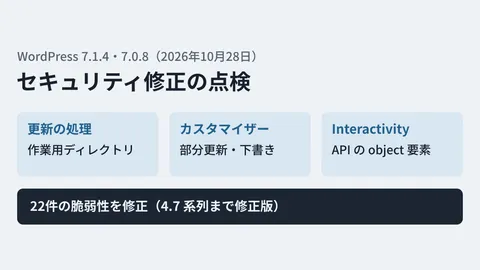
Even if you leave WordPress updates to the automatic updater, reading through once to see whether any changes affect your custom code, as with our previous article on the 7.1.4 fixes, makes it faster to isolate problems after an update.
Scope of verification
On November 19, 2026, we checked the description and diff of commit be8f460 in the 7.1 branch of WordPress/wordpress-develop (the 7.1.5 security fixes, November 18, 2026, 15:17 UTC), fb596c8 (the update of the pinned Gutenberg version), 68aa336 ("WordPress 7.1.5."), and the 7.1.5 tag. We also checked the descriptions of the security fix commits in the 7.0, 6.9, 6.8, 6.7, and 4.7 branches, and the dates of the tags from 7.0.9 to 4.7.40. On November 20, we checked the wordpress.org announcement (WordPress 7.1.5 Release), the release notes (Version 7.1.5 on HelpHub), the version information on api.wordpress.org, and the contributor fields of individual commits in trunk (documentation research). We could not open the Gutenberg-side diff and have not verified the content of the 5 block editor changes. We have not verified updating an actual site or the behavior of the 4 points above.
GleamHub's website development consultations cover maintaining WordPress sites and setting up checks before and after updates. Because what to check depends on your themes and plugins, please reach out via our contact form.
References
- WordPress.org News — WordPress 7.1.5 Release
- WordPress.org Documentation — Version 7.1.5
- WordPress/wordpress-develop — commit be8f460(Backport the WordPress 7.1.5 security fixes to the 7.1 branch)
- WordPress/wordpress-develop — commit fb596c8(Bump the pinned hash for Gutenberg in 7.1 branch)
- WordPress/wordpress-develop — commit 68aa336(WordPress 7.1.5.)
- WordPress/wordpress-develop — commit d9fcfe3 (backport to the 7.0 branch)
- WordPress/wordpress-develop — tag 7.1.5