On Astro sites with a growing number of articles, a concern arises that CI builds will fail because astro build runs out of memory. When you see the line "reduced memory usage" in a changelog at such a time, it seems like updating would solve the problem. However, you cannot tell which phase's memory is reduced without looking at what the fix actually does.
The changelog for Astro 7.4.12, released on November 13, 2026, says, "Reduces memory usage during astro build by releasing content collection entries from memory once the content layer sync is complete." In this article, we check what this fix does, then report the results of building this site's repository, which includes 1,219 GH Media articles, in a working environment and comparing memory usage across 7.4.11, 7.4.12 and 7.4.13.
The fix is a single line
The diff of the fix commit (6f1a2a8, #18709) is a single line. It changed the target of the memory-release step that runs after the content layer sync from a variable created inside a function to the globally shared instance (globalContentLayer).
// packages/astro/src/core/sync/index.ts
await contentLayer.sync();
if (!skip?.cleanup) {
  // Free up memory (usually in builds since we only need to use this once)
- contentLayer.dispose();
+ globalContentLayer.dispose();
}
The added test confirms that the shared instance becomes empty (null) after the sync for the build. According to the reporting issue (#18708) and the PR description, before the change the shared instance kept referencing the data store holding all entries loaded during sync, so it stayed in memory during page generation (prerendering) until the build finished. What this fix releases is this data store used for sync. The issue states that page generation probably also holds a separate copy of the bundled data store (the issue did not measure this directly).
In the issue's reproduction steps (5,000 entries of about 20 KB each, about 100 MB in total), the heap (memory used by JavaScript), measured after forcing garbage collection (reclaiming memory no longer in use) at the end of the build (astro:build:done), dropped from 143 MB to 47 MB. What was measured is the heap at the end of the build, not peak memory during the build.
We measured three times each on this site
On November 23, 2026, we placed a copy of this site's repository in a working container (Linux, 4 vCPU, Node.js 22.23.5), swapped only Astro between 7.4.11, 7.4.12 and 7.4.13, and ran astro build (we swapped versions for measurement, separately from the version used in production builds). The target had 2,248 pages and about 1,250 Markdown content files (including 1,219 GH Media articles, 24 of which are drafts). Image conversion results were generated in one build beforehand and reused in every run. Each time the version was swapped, the content data store was rebuilt (the build log shows "Astro version changed" and "Clearing content store").
The peak memory (maximum resident set size) of the build process, measured over three rounds in which we swapped versions in the order 7.4.11, 7.4.12, 7.4.13, was as follows.
| Release | Run 1 | Run 2 | Run 3 |
|---|---|---|---|
| 7.4.11 | 1,935MB | 2,292MB | 2,377MB |
| 7.4.12 | 2,221MB | 2,396MB | 2,447MB |
| 7.4.13 | 2,359MB | 2,402MB | 2,334MB |
The variation between runs (about 1.9–2.4 GB) was larger than the difference between versions, so we cannot say that peak memory dropped from 7.4.12 onward. Build times were also 56–63 seconds for every version, except for one run. Note that there were periods during measurement when other work was running in the same container, which may have contributed to the variation (we have not identified the cause).
Memory peaks in the build phase after sync
Next, for 7.4.11 and 7.4.13, we recorded the memory of the entire build process every 0.5 seconds. In both, memory was about 1.1 GB when the content sync finished (about 21–22 seconds from the start, according to the log). It then increased during the phase that bundles the code used for page generation ("Building static entrypoints" in the log), reaching its peak of about 2.3 GB between 29 and 39 seconds after measurement began. 7.4.13 peaked near the end of the bundling phase and 7.4.11 in the first half of page generation, and memory stayed at about 1.8–2.0 GB for the rest of page generation.
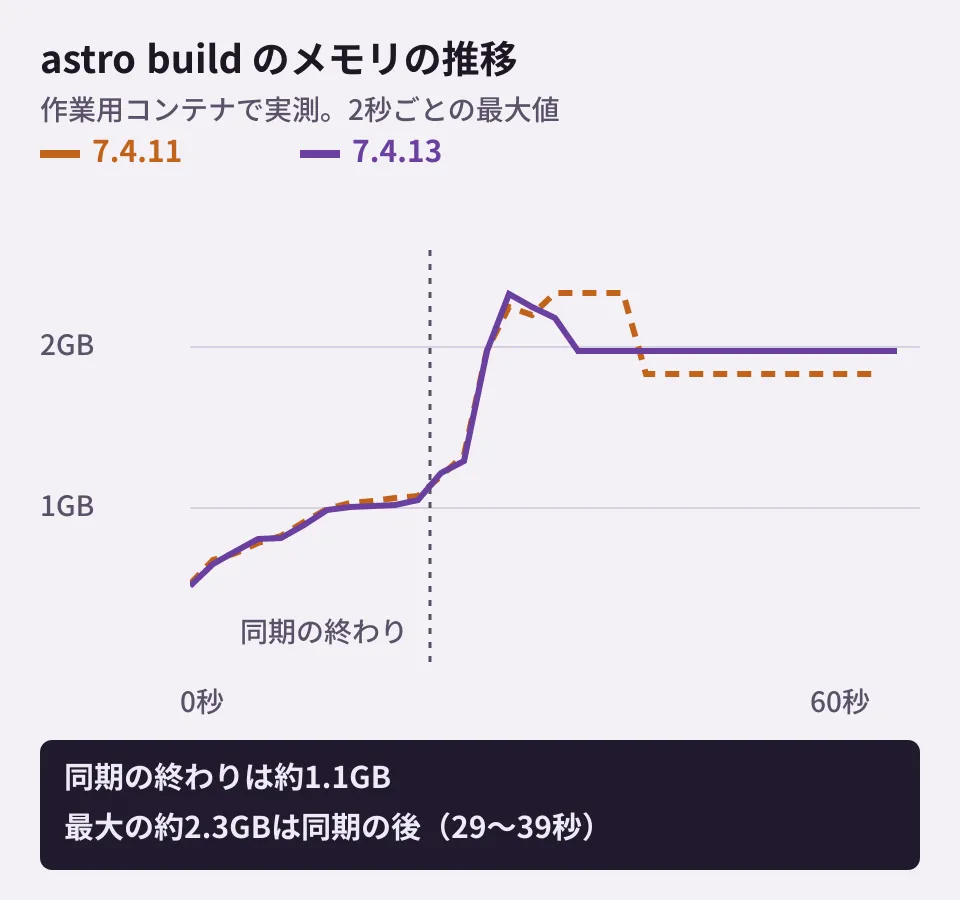
What the 7.4.12 fix can release is the data store used for sync. The Markdown content on this site totals about 13 MB, smaller than the issue's reproduction (about 100 MB), so we believe the amount released was buried in the variation between runs (up to about 440 MB for the same version). Also, the peak occurred when memory grew during the code bundling phase and page generation after sync. However, this is the editorial team's inference from the measurements; we did not examine the size of the data store or the breakdown of Astro's internal memory.
The 7.4.13 changelog also includes a fix (#18536) for an issue where all content ended up in the server bundle when there were no server-side pages calling render(). This does not matter for setups like this site that output every page statically, but for sites with server-rendered pages, output size may change.
How to check on your own site (editorial suggestions)
These results come from one site in one environment. The effect of the 7.4.12 fix can vary with the amount of content and how pages use data. For sites where memory is a concern, the reliable approach is to compare locally as follows.
- Change only the version in a copy of the repository. In a directory separate from your production working branch, switch
npm i astro@7.4.11andnpm i astro@7.4.13and build under the same conditions. Image conversion uses time and memory, so build once beforehand and keep the results before comparing. - Look at the trend, not just the peak. On Linux, "Maximum resident set size" from
/usr/bin/time -vgives the peak. To see which phase increases memory, record the build process's memory at regular intervals and match it against the times of "Synced content," "Building static entrypoints" and "generating static routes" in the log. For this article, we used Python to sumVmRSS(physical memory actually in use) from/proc/<PID>/statusfor the build process and its child processes every 0.5 seconds. - Run it multiple times. This time, 7.4.11 and 7.4.12 in the first round came out lower than other runs of the same version. Comparing single runs cannot distinguish version differences from variation.
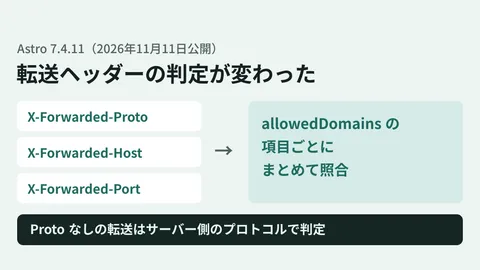
There are reasons to update other than memory. In 7.4.11, how headers used behind CDNs and similar services are evaluated changed (our 7.4.11 article). We covered ways to reduce build times for sites with many articles in our article on incremental static builds.
Scope of verification
On November 22–24, 2026, we reviewed
packages/astro/CHANGELOG.mdin withastro/astro (7.4.11–7.4.13), the diff and added tests of commit 6f1a2a8, the wording of.changeset, the descriptions of the reporting issue (#18708) and PR (#18709), and the versions and release dates on npm (document research). As of November 24, the latest on npm is still 7.4.13. In addition, on November 23 we built a copy of this site's repository with 7.4.11, 7.4.12 and 7.4.13 a total of 11 times in a working container, in addition to one preliminary build to generate image conversion results, and recorded peak memory and memory over time (hands-on testing). We measured onlyastro build; we did not measure the entire production build process, including type checking and search indexing, or in Cloudflare's build environment.
GleamHub can help with building and maintaining Astro sites and with running media sites with a growing number of articles. Please reach out through our contact form.
References
- withastro/astro — packages/astro/CHANGELOG.md
- withastro/astro — Issue #18708(Content layer data store stays in memory for the whole
astro build) - withastro/astro — PR #18709(Free content collection entries from memory after the build sync)
- withastro/astro — commit 6f1a2a8(fix(content): release the content layer after sync in builds (#18709))
- astro(npm)