Try opening an older article on your company's website and clicking the citation links inside the text. For articles three years old, several will return 404s. For five-year-old articles, the linked domains may have disappeared entirely or turned into unrelated advertising pages.
The same applies to client sites featured on your case study pages: services shut down, company names change, or website redesigns alter URL structures. Without touching anything on your end, links quietly die on their own.
A study measuring the exact speed of this phenomenon across a large sample was published in August 2026.
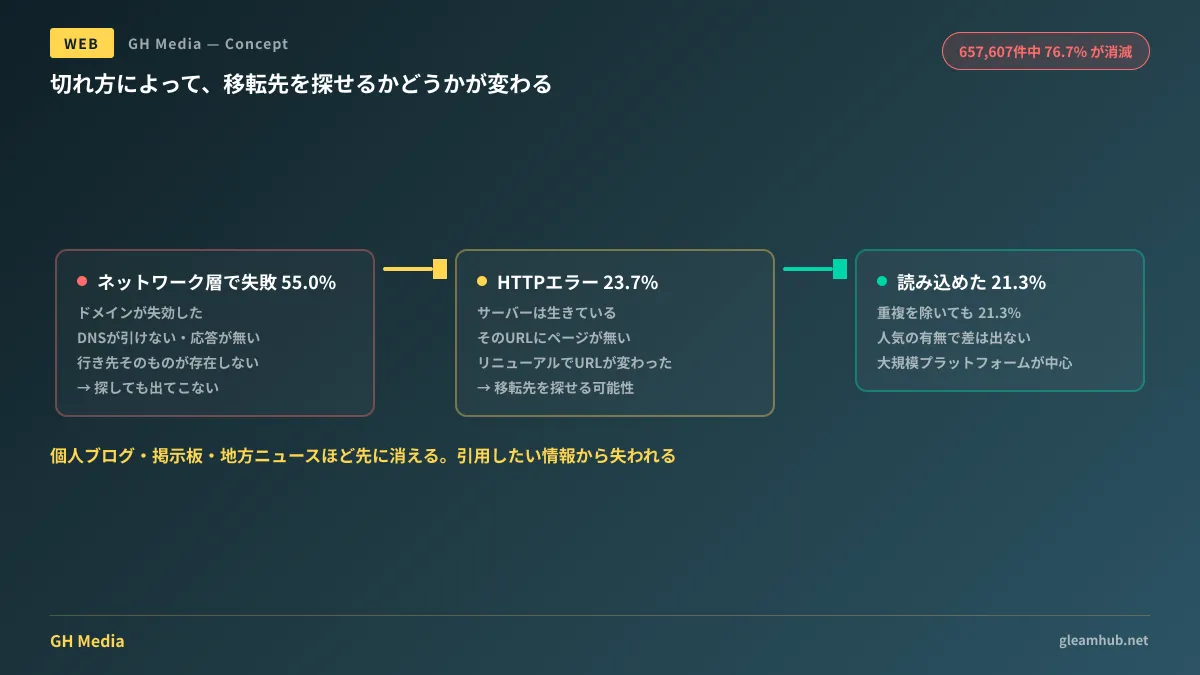
Tracing 657,607 links: only 21.3% loaded
The study examined 657,607 links registered with URL shortener services between 2009 and 2014. In August 2026, researchers accessed all recorded destinations to test whether they could still be loaded.
The result was that 76.7% of tracked records could no longer be loaded. Only 21.3% loaded successfully. Even after removing duplicate entries pointing to the same destination, 78.7% failed to load, leaving the figure virtually unchanged. This shows there was no noticeable tendency for popular links to survive better.
Failures fell into two main categories.
| Failure type | Proportion | What is happening |
|---|---|---|
| Network layer failures | 55.0% | Domain expired, DNS cannot resolve, or server fails to respond |
| HTTP errors returned | 23.7% | Server is active, but no page exists at that URL (404, etc.) |
This distinction is critical because each requires a different response. With HTTP errors, because the target site still exists, searching may uncover the new address. With network layer failures, the destination itself has vanished from existence, so searching will turn up nothing. Over half of all failures fall into this latter group.
Furthermore, disappearances were skewed: personal blogs, discussion forums, and regional news sites vanished at particularly high rates, whereas massive platforms like YouTube and Wikipedia endured. In short, the high-quality resources you are most eager to cite—such as SMB websites and expert commentary articles—are the first to disappear.
When your site becomes the breaker: during redesigns
So far, we have discussed external links you place breaking over time. The reverse happens with the exact same probability: links pointing to your site from other organizations die when you redesign your site.
Here, the loss is even more direct. Inbound external links form the bedrock of your search ranking authority, and real visitors arrive through them. If you change URL structures and forget to set up redirects, both disappear at once. Moreover, your analytics will merely show it as though those users never visited to begin with, leaving you with no trigger to notice the loss.
When shutting down a website, the effect is even more absolute: the moment you release the domain, every link pointing to it turns into a network-layer failure. Why decisions on handling retired domains should be made when launching web services is detailed in Deciding How Web Services End at the Time of Procurement. For migration planning when changing domains or URL structures, refer to Domain and Origin Migrations: Preserving SEO Equity.
Moving inspection out of "tasks done when remembered"
Inspecting for broken links gets deferred because it lacks urgency: even with dead links, pages still display and show no errors. Because no one appears troubled, the task never rises in priority.
A practical approach is to narrow the inspection scope and run checks systematically on a fixed schedule. There is no need to audit every page monthly.
- Articles containing citation links — When references disappear, the credibility of the content itself erodes. Specialized articles often point to personal sites or specialized institutions, which carry higher chances of disappearing
- Case studies and client portfolio pages — Continuing to feature client sites as portfolio achievements when those sites have vanished creates a poor impression on visitors
- Links to documents and forms — Files and forms your company is supposed to manage break due to relocation or recreation far more often than expected
- External links in footers and navigation — Because these appear on every page, their visibility when broken is maximized
For infrequently updated corporate websites, checking twice a year is sufficient; for media sites publishing articles continuously, once a quarter is appropriate. Adhering strictly to a planned schedule matters more than frequency. Because various crawler-based link checkers exist, running the scan itself can be automated. What requires human judgment is deciding how to address broken links (updating to a new URL, removing the mention, or linking to an archive).
What happens to abandoned websites and which items should properly be included in maintenance agreements are covered in Why "Build-and-Forget" Websites Are Dangerous. Incorporating broken-link inspections as a standard maintenance item is a natural fit.
What to do next
Open the oldest article on your site and click through its external links from top to bottom. It is a five-minute task, but within those five minutes, the debate over whether you need link inspections is settled. If none are broken, you need do nothing; if half are broken, the rest of your articles are in the exact same state.
Once confirmed, write the inspection schedule into your maintenance contracts or operational guidelines. Any task not written down disappears the moment a busy month arrives.
If you are planning to change your URL structure as part of a site redesign, or if you want to review the scope of your maintenance, GleamHub offers consultations for website creation and redesigns. Because deciding how much of your existing link equity to preserve forms the foundation of migration planning, please consult us before getting started. Feel free to reach out via Contact Us.