
As internal discussions about utilizing AI progress, proposals like these often arise: "Let's automatically place purchase orders when inventory drops" or "Let's automatically match prices whenever competitors lower theirs."
These discussions often end up shelved without anyone clearly articulating why they should be paused. Those opposing them rarely have arguments beyond "it's too risky." In reality, the danger lies not in automation itself, but in building systems where nobody notices when an error occurs—yet conveying that difference as an architectural distinction is far from simple.
The commerce agent blueprint released by Anthropic is well worth examining as an implementation example of this boundary.
What was released is a blueprint in the form of runnable code
On September 3, 2026, Anthropic open-sourced Claude Commerce Agents under the Apache 2.0 license.
It includes two types of agents. One handles the consumer side, searching for products, comparing items, and adding selections to carts. The other operates on the merchant side, managing sales status, inventory, pricing, and promotions. It includes reference implementations for retail, travel, telecommunications, and entertainment, designed to serve as a starting foundation rather than building from scratch.
The runtime environment runs locally provided Python 3.11 or later, Node 22, and an API key are present. Execution is not locked to the Claude API; the same code is designed to run across Amazon Bedrock, Microsoft Foundry, and Google Cloud Vertex AI.
This is an in-house-maintained reference implementation. Anthropic's official guidance also distinguishes it from supported products and services with SLAs. The operational benefits must be evaluated against your company's own products and workflows.
What is useful in implementation is what not to allow, rather than what it can do
More important than a feature list is how permissions are delineated for the merchant-side agent.
For price adjustments, inventory replenishment, and campaign modifications, this agent only goes as far as generating proposals. Human approval is required to actually apply them.
What deserves attention is where those constraints are placed. Rules governing payments, item procurement, price change caps, and human approvals are enforced at the code level, rather than through prompt instructions.
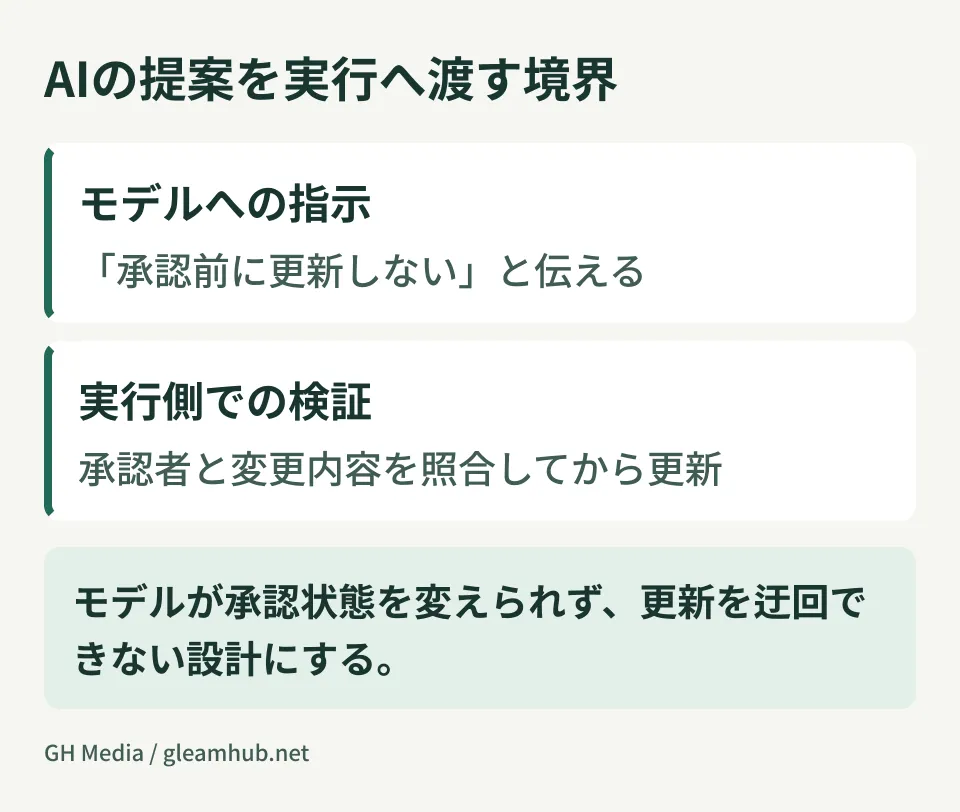
This difference is critical in practice. An approach that writes "Do not lower prices by 10% or more" in the prompt breaks down whenever the model misinterprets instructions or the input is manipulated. It is also difficult to verify after the fact whether it broke down. On the other hand, if the execution side verifies the approver and the approval target, and ensures the model itself cannot rewrite the approval status, control is achieved without relying on the model's interpretation of instructions. Merely placing an approved flag is insufficient; bypassable update paths must also be closed.
Fail-safe design when introducing AI agents into operations often comes down to this point. Rather than adding prohibitions through language, control dangerous operations on the execution side. This philosophy is not limited to commerce. When designing permission models for direct AI access to core systems, you arrive at the same conclusion.
Two perspectives to consider internally
For companies that sell merchandise, this movement has two aspects.
As the seller. The key issue is whether product information is presented in a format agents can read. A page humans can understand is different from a page machines can interpret structurally. For sites where prices, inventory, and specifications exist only inside images, it becomes harder for agents to retrieve information accurately. This is not a new topic, but an extension of structured data practices.
As the user. When leaving inventory or pricing decisions to an agent, the design of approval and execution permissions is critical. If approvers are not designated, the approval screen cannot be reviewed during business hours, or approval becomes a rubber stamp, the purpose of inserting approval is lost. Setting up an approval mechanism and having approval actually function are two different things.
Continuously inspect how approvals are operating. Check how many of the proposed items were sent back. Even if zero items were sent back, that alone does not mean approval has become a mere formality. Check approval duration, sample reviews, the presence of erroneous approvals, and proposal difficulty together. Only after verifying these can you determine whether approval is functioning.
Additionally, the cost of hosting such an agent foundation in-house goes beyond model usage fees. As outlined in hidden costs when building in-house agent infrastructure, monitoring, logging, and operating approval workflows add continuous overhead. When payments are involved, keeping an eye on how easily you can switch payment providers at the same time helps avoid situations where modifying your architecture later becomes difficult.
The meaning of having a blueprint
The practical benefit of a reference implementation being released as open source is that you can read the internals before deciding whether to build it yourself.
When you receive a pitch to "streamline e-commerce with AI agents," the published code serves as a benchmark. It makes it easier to verify specifically which features are included in the proposal, what parts require custom development, and operational responsibilities. However, a single reference implementation does not define the standard architecture for the entire industry.
Regarding an incremental system replacement approach, reviewing architectures for incrementally migrating commerce platforms will also make it easier to avoid being swept along by proposals that rewrite everything at once.
What to do next
Identify one task within your company's operations that people want to delegate to AI. Then, draw a clear line between the parts of that task where delegating up to the proposal stage is acceptable, and the parts where execution requires human judgment.
Tasks where that line cannot be drawn are not yet at the stage to be targeted for automation. Once the line can be drawn, the next step is designing how to lock down the execution side. Only when you reach this point are you in a position to discuss estimates.
At GleamHub, we assist with applying AI agents to business operations, implementation design including approval workflows, and integration with existing systems through our development, AI, and automation consulting. Because the approach depends on your target workflows and existing architecture, please reach out via Contact Us for individual consultations.
Sources
- Claude Commerce Agents — Anthropic Official Repository
- Commerce agents — Anthropic Official Guidance
- Anthropic Releases Blueprint for Commerce AI Agents, "Claude Commerce Agents," as Open Source — gihyo.jp
- Anthropic Released Claude Commerce Agents: An Apache-2.0 Blueprint for Shopping and Merchant Agents — MarkTechPost