
You open the monthly SEO report and several keywords that were listed through last month are now blank. Whether the rankings dropped out of range or the data simply was not collected, you cannot tell from the look of the report. Ask the agency and the answer comes back as "the tool vendor is investigating."
At times like this, the first thing to suspect may not be your own site. On 26 August 2026, Google confirmed it was rolling out a change that replaces each search result link with a relay address called google.com/goto. The destination URLs that used to be written plainly in the page HTML become relay links with encrypted parameters.
From a user's point of view, the behavior is almost unchanged. What changed is the side that was reading search results mechanically.
What changed
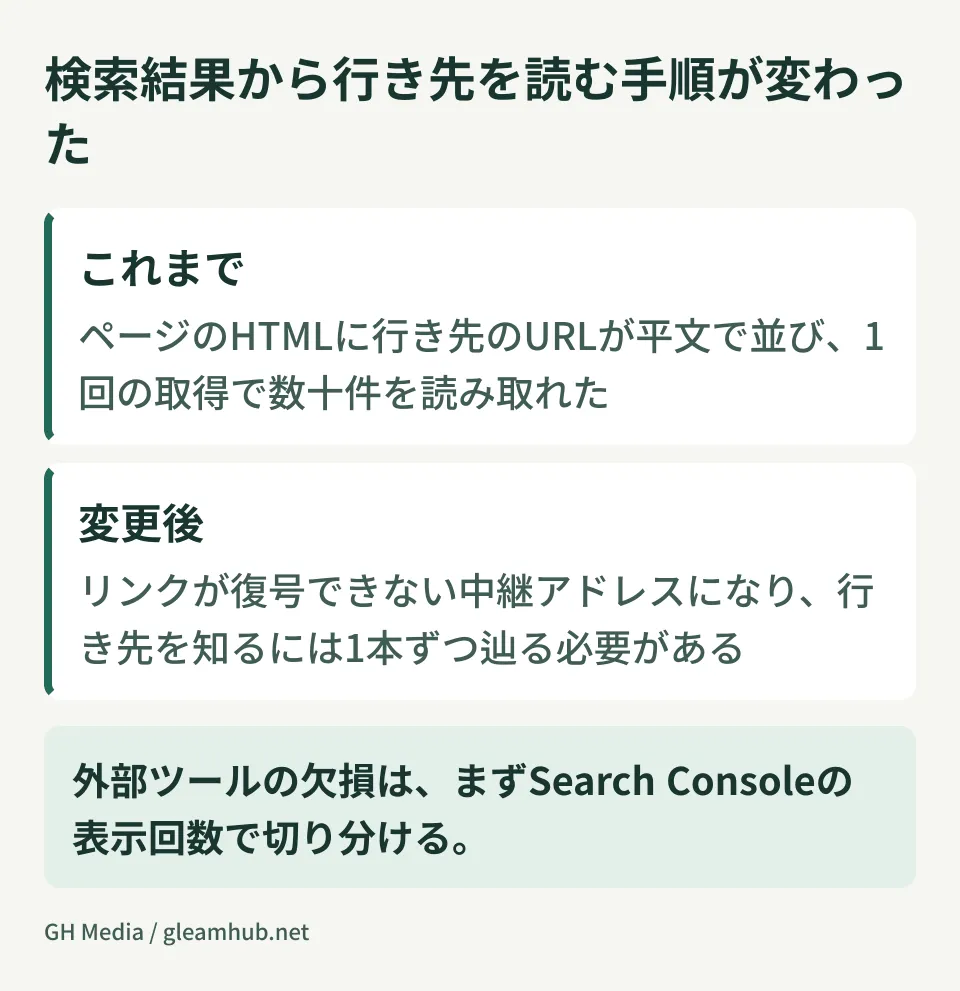
Until now, the destination URLs sat in plain text in the HTML of the search results page. A rank tracking tool could fetch the page in a single request and read dozens of URLs from it at once.
After the change, links become relay addresses and the parameters cannot be decrypted. The structure means that the only way to learn the destination is to follow each link one at a time. Reading one page of results now requires as many additional requests as there are links. Reports say the situation has become one where checking a single keyword takes 500 to 1,000 requests.
Google's aim is believed to be making large-scale scraping harder. Whatever the purpose, the collection cost for external tools rises by an order of magnitude.
Symptoms that show up in the report
Here is what happens on the tool side once collection has become expensive.
| How it looks | What is actually happening |
|---|---|
| Data is missing only for certain keywords | Collection for that keyword did not complete |
| Rankings swing unnaturally far | Only part of the results could be read, shifting what the ranking was calculated against |
| Report updates are delayed | Collection frequency has been reduced to manage load |
All of them show up in a form that looks like "the site's evaluation changed." Redo your tactics here and you end up spending effort on a problem that is not happening.
The order of elimination
Whether the problem is your own site can be checked in the following order.
- Open Search Console. Look at impressions, clicks and average position over the period with the gaps. This is data Google produces directly, so it is unaffected by relay links
- Check whether impressions are holding. If rankings really dropped, either impressions or clicks will move. If the Search Console side is normal and only the tool side has gaps, it is a measurement problem
- Look at the distribution of the gaps. If it is happening across multiple sites and multiple keywords at once, rather than only a particular keyword group, the tool side is the more likely cause
- Check with the tool vendor. Ask about "where they stand on this change" and "how they are treating the period with missing data." If they are in the middle of changing their collection method, it is safer not to compare the numbers from that period against the periods around it
The order matters. Skip step 1 and start from step 3 and you will be quick to jump to the conclusion that "only we dropped."
Handle primary and secondary data separately
This case aside, numbers around search differ in nature depending on where they come from.
Search Console is primary data. Google produces it from its own records, so it is not affected by external collection methods. You get impressions, clicks, average position and queries. How to widen the measurement scope is laid out in Search Console platform properties.
Rank tracking tools are secondary data. They are built by observing search results from the outside, so when the observation method changes, the numbers change too. What makes them useful is the views you cannot get from Search Console, such as competitor rankings or how results appear in a particular region or on a particular device.
The principle for choosing between them is to lean on primary data for numbers used in decisions. Use secondary data to grasp trends and compare against competitors, not as grounds for an absolute value. The structure is the same as in how measurement gaps break year-over-year comparisons, which covered analytics numbers going missing depending on the environment because of browser extensions. Change the instrument and you change the scale.
What this change does not affect
Because this is the kind of topic where worry spreads easily, let us also be clear about what is not affected.
It has no effect on your own site's SEO. Page content, internal links, load speed, structured data, backlinks. The way Google evaluates sites has not changed; what changed is only how links are written on the search results page.
Search Console and your own analytics are not affected either. Search Console is data Google produces directly. Analytics tools record what happens after a visitor reaches your site, so measurement continues even when the route is relayed. The share of search traffic classified as "no referrer" may change, but the traffic itself does not decrease.
What is affected is only the part that was reading search results mechanically from the outside. Once you can separate that out, you will see there is no need to rush into changing your tactics.
What to fix in your internal reports
Reworking the report format itself will save you from confusion the next time this happens.
- State the source of the data on each table. Add one line saying whether the numbers came from "Search Console" or a "rank tracking tool"
- Write gaps as "not collected" rather than leaving them blank. A blank is misread as "zero" or "out of range"
- Make monthly judgments on Search Console impressions and clicks. List rank movement alongside them as a reference value
As the appearance of search results keeps changing, a single number like rank means less than it used to. The question of how your links are treated on the search results screen was also covered in link discoverability in the AI Overview era. Whether you were shown and clicked matters more than whether your rank went up, and it connects more directly to practical decisions.
What to do next
If there are gaps in this month's report, open Search Console for the same period and check whether impressions and clicks are normal. If they are, there is nothing to act on from the site side.
Then ask the person or vendor producing your report to confirm, once, where they stand on this change. If they are still adapting, it is enough to decide not to use the ranking data from that period in before-and-after comparisons.
At GleamHub, we handle consultations on collecting search data, automating internal reports, and building out aggregation from Search Console and analytics tools through our development, AI and automation advisory services. Because the build depends on the tools you use, please get in touch via Contact.