You have started building AI agents internally, but you cannot answer, in a single list, with what permissions those agents run, where they run and how much they have spent. Claude Code runs on developers' PCs, while other agents run in the cloud. The announcement Google Cloud made on October 22 is aimed precisely at this question of how to manage agents running in scattered places.
The announcement opens as follows.
Today at AGNTCon + MCPCon, we are delivering these capabilities to customers by launching Agent Compute Engine, a purpose-built compute service that already powers Gemini as an agent for work tasks. It will be available in preview in the coming months, providing hardware-isolated runtime sandbox security.
However, many of the announced features are still to come. Based on the wording of the announcement, we sort out the availability stages and outline what companies running agents internally can decide now.
The announcement has two pillars
The announcement is divided into two parts: where agents run (the execution platform) and how agents are managed (governance).
Where agents run: Agent Compute Engine
This is a service that provides a dedicated small virtual machine (microVM) for each agent. According to the announcement, it is already used as the working environment for Gemini's agents. The features highlighted are as follows.
- Fast-starting microVMs that pause while the agent is thinking (while waiting for tool execution) and resume quickly from a snapshot
- A hardware-isolated execution environment using Google's custom chip (Titanium) and Cloud Hypervisor, designed on the assumption that untrusted code will run inside the agent
- Each microVM has short-lived credentials and a unique identity, and credentials for external services are added outside the microVM (at the network egress)
- Each microVM has its own dedicated disk (Hyperdisk), so the intermediate state of long-running work can be preserved
For companies that want to run things themselves on Kubernetes, the option of using the open-source "Agent Substrate" on GKE is also presented. Agent Substrate was released in May 2026, and we covered it in another article (Agents spend a lot of time waiting: the premise AX has reset). The announcement says Agent Substrate works regardless of the agent framework, including Claude Code.
How agents are managed: agent governance
The announcement explains that Gemini for business (Google's Gemini for organizations) already has the following four features.
- Agent Gateway: a checkpoint for traffic to and from agents. It protects sensitive data, defends against attacks on agents and applies custom policies
- Agent Registry: a registry of approved agents, tools, MCP servers, skills, models and connections
- Agent Identity: a unique identity for each agent based on a standard called SPIFFE
- Observability: logs, metrics and traces aligned with OpenTelemetry
This announcement extends the scope of this governance.
Sorting out the availability stages
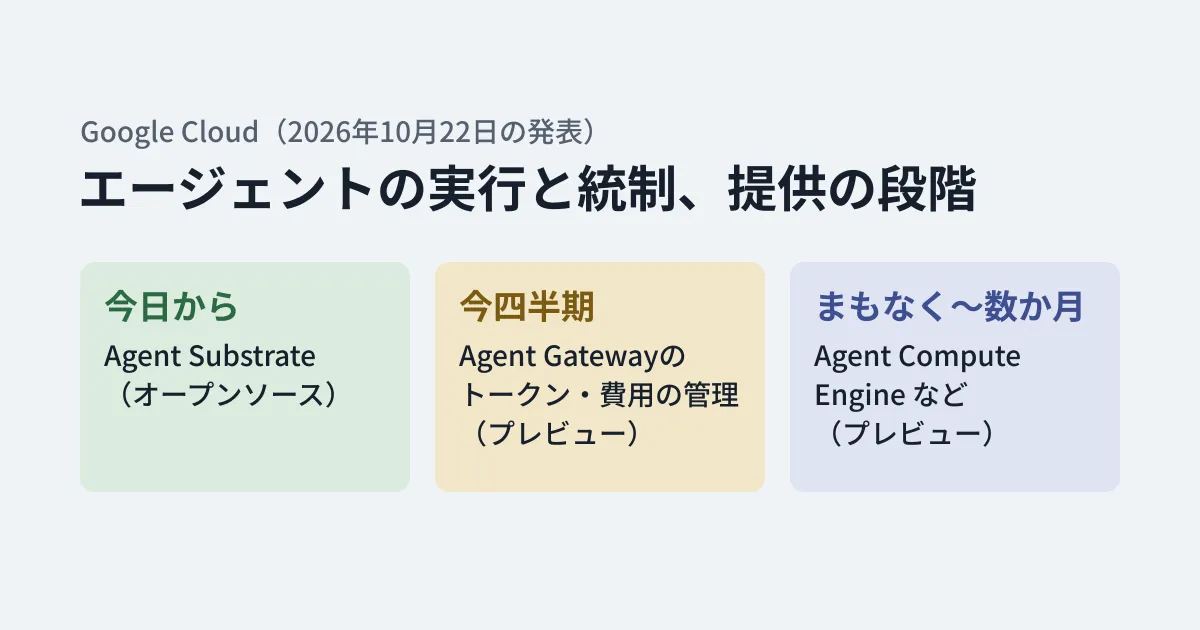
Listing the announcement's wording as is, availability breaks down as follows.
| Features | Stage stated in the announcement |
|---|---|
| Agent Compute Engine | Preview in the coming months (registration of interest open) |
| Agent Substrate(GKE) | Open source. "Available to try today" (according to the GKE release notes, available since September 11 for evaluation and non-production use; production support is a limited GA with an allowlist) |
| Extend governance to Google Cloud runtimes such as Agent Runtime, Cloud Run and GKE | Stated as included (Agent Compute Engine is in preview) |
| Governance for other clouds and on-premises (Envoy-based) | Preview coming soon |
| Governance of Claude Code and Antigravity CLI on employees' PCs (OS-level sandbox) | Preview coming soon |
| Agent Gateway token and cost management, model routing, and more | Preview this quarter |
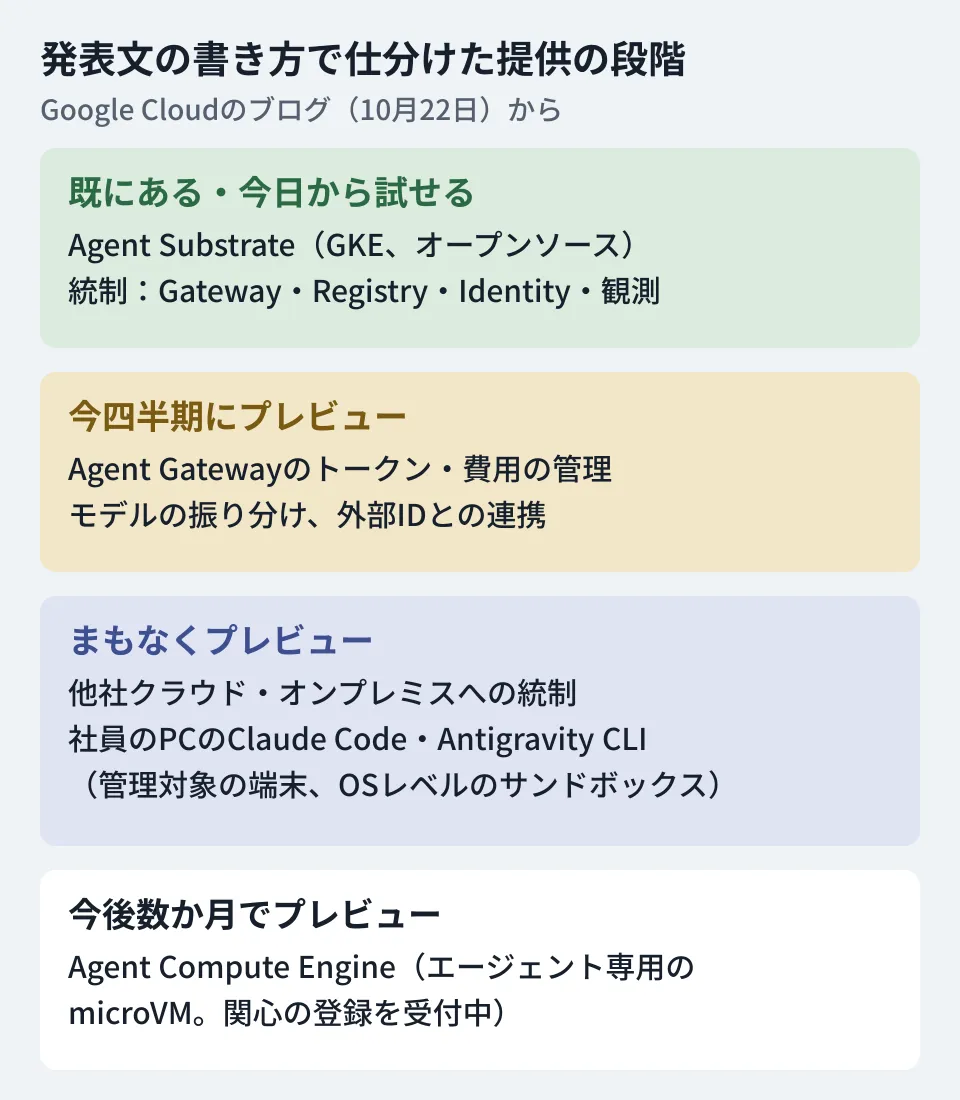
"Soon" and "in the coming months" are not specific dates. As of October 27, the Google Cloud release notes have no entry for Agent Compute Engine, and there is no documentation page yet. Preview features may change before general availability. It is safer to wait until availability begins and you have checked the terms before designing a client's production system on the assumption that these features will be available.
What it means to cover Claude Code on employees' PCs
The part of the announcement most relevant to companies using agents internally is the extension of governance to employees' PCs.
Governance for local agents on endpoints: Extends governance to coding agents like Claude Code and Antigravity CLI on managed devices with an OS-level sandbox and local governance services (in preview soon).
Agents running in the cloud are relatively easy to manage through network egress and permissions, whereas coding agents running on developers' PCs read files and run commands with that PC's permissions. The announcement says it will use an OS-level sandbox and local governance mechanisms on managed devices. The requirements for managed devices, the supported operating systems and pricing are not stated in the announcement.
Claude Code also has administrator settings provided by its vendor, Anthropic. As one example, we cover how administrators can disable the default behavior of the "mod" extension in Managing Claude Code mods in your company. Before waiting for Google Cloud's new features, first check whether the management tools available now are sufficient.
What you can decide now
Even while waiting for the preview, there are things you can decide regardless of which platform you choose. From here on, these are the editorial team's suggestions.
- Create an agent inventory: which agents run where (in the cloud or on employees' PCs), with whose permissions, and connected to what. Start by keeping in a table the role that the announced Agent Registry will play
- Decide on a policy of not keeping credentials with the agent: the announcement repeatedly highlights a design in which credentials are added outside the agent's execution environment. Configurations that pass API keys to agents via environment variables are candidates for review
- Decide the unit for spending limits: per department or per agent. When Agent Gateway token management enters preview, you can turn this directly into settings
- Standardize your log format: the announcement highlights observability aligned with OpenTelemetry. If the agents you build in-house also output logs in the same format, you can keep using them even if you move platforms later
How to think about building your own execution environment versus using a service is covered in Drawing the line for AI execution environments, starting from the story of one million sandboxes.
Scope of verification
On October 25, 2026, we checked the Google Cloud blog post "Introducing Agent Compute Engine and expanded agent governance" (October 22, 2026) (document research). On October 27, we rechecked the same blog post and checked the technical deep dive (Inside Agent Compute Engine, October 23, which states "targeted for preview in the coming months"), the Google Cloud release notes, and the documentation for agent governance and Agent Gateway. Pricing, supported regions, and the operating systems and requirements covered by governance on employees' PCs are not stated in what we checked. The editorial team has not run any of these features.
For designing AI agents to run internally or building mechanisms to manage their permissions and costs, contact us through consultation on development, AI, and automation.