You hire an engineer who will work remotely, or open your internal repositories to an external developer under contract. Their character and technical skills seem ideal in document screening and online interviews, so you hand over work right away. This is about what happens if that applicant turns out to be someone else, with a background and interview answers polished by AI.
On October 29, 2026, Microsoft's threat intelligence team published research on how North Korean attackers use AI. In addition to the tactic of landing remote jobs under false identities, it covers posing as recruiters to approach developers and a mechanism for planting malicious code in private repositories. This article summarizes what the research contains and what those who hire developers, or who grant permissions to external developers, should check.
What AI has sped up
According to the research, North Korean attackers use AI to make existing tactics faster and larger in scale. The examples it gives are as follows.
- Jade Sleet: within one week, launched attacks disguised as recruitment through three fake companies
- Onyx Sleet: created dozens of tailored lure documents in minutes. More than 100 PDFs created in August and September 2026 were identified, and their creation records show they were produced in successive batches of dozens within minutes
- Coral Sleet: built a mechanism for planting malicious code in private source code repositories in a short time. Since April 2026, it has incorporated a procedure for tampering with private GitHub repositories into its existing malware flow
- Diamond Sleet: used AI in the work of creating fake identities (personas) and fake companies
- Onyx Sleet, Pearl Sleet: since late October, have been using an open source system (ARTEX) that automates penetration testing with AI agents
The research divides the main attackers' use of AI into four stages. Those at the most advanced stage, "operationalized," are Jade Sleet, Coral Sleet, and Jasper Sleet, and it says all of them carry out many account- and identity-related attacks built on tactics that deceive people. At the same time, it assesses that AI-enabled attacks are still directed by humans and are not fully autonomous.
Getting in as applicants, approaching as recruiters
The job-related tactics the research covers run in two directions.
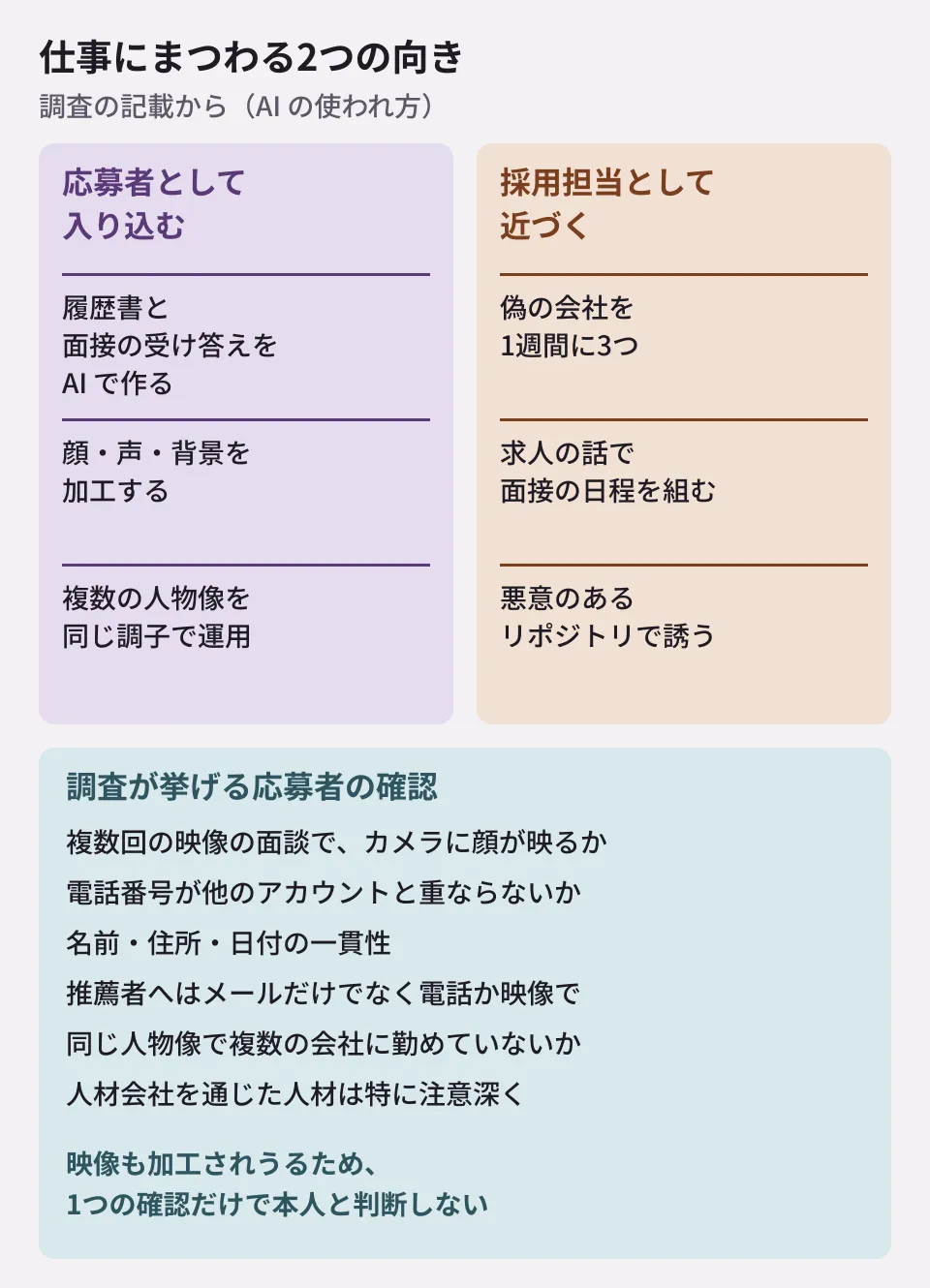
One is the tactic of getting in as an applicant. Jasper Sleet lands legitimate remote jobs under false identities. According to the research, it appears to have used workflows that create resumes with generative AI and AI agents, and over the past year the speed and scale of persona preparation and the fit with job postings have improved. It is also said to be investing in reusable tools that support its job-related activities. The research further says it operates multiple fake worker personas while keeping them consistent in tone with AI tools.
The other is the tactic of approaching as a recruiter. According to the research, from June 8 to 12, 2026, Jade Sleet posed as an AI-powered blockchain analytics company, made contact about a software engineer job, and scheduled an interview. In the same short period, it did the same through two other fake companies using similar infrastructure. The research says Sapphire Sleet, Jade Sleet, and Coral Sleet target users and organizations under the guise of recruiting or interviews, and sometimes use malicious repositories as lures.
In both tactics, AI is used for the following tasks (excerpted from the research's list).
- Tailored recruiter and investment lure messages
- Resumes, work histories, and natural interview answers
- Coding assignments, help with job tasks, and managing multiple personas
- Translation and tone adjustment
- Editing of profile photos, video, voice, and backgrounds
Applicant checks listed in the research
As one countermeasure, the research lists "Vetting potential employees." It covers the following.
- Look especially carefully at workers supplied through staffing companies: it says this is the easiest route for North Korean workers to get in
- Compare social media and professional accounts: check whether they closely resemble other people's accounts, and whether the contact phone number is also used on other accounts
- Check the consistency of resumes and background checks: confirm that names, addresses, and dates match. Contact references by phone or video call, not just by email
- Check whether the same persona is employed at multiple companies
- Confirm in multiple video calls that the person's face appears on camera: it treats being unable to participate because of camera or microphone problems as a warning sign
- Check for a digital footprint: a real phone number that is not internet telephony (VoIP), an address, and social media accounts
The research also notes that AI may be used to alter video and voice. A face on camera alone does not prove someone's identity, so it is reasonable to read item 5 on the assumption that it is used in combination with other checks.
Reviewing permissions given to external developers
From here on is the editorial team's own summary. In case someone slips past the hiring and contractor checks, you can also limit the damage on the side of the permissions you grant. Given that the research covers tampering with private repositories, here are the points that companies opening their development to outside parties should review.
- Limit repository permissions to each person's area of responsibility: Instead of all repositories in the GitHub organization, invite them only to the repositories they are responsible for, with the permissions they need (read or write)
- Stop direct changes to the default branch: If you configure it so that nothing enters the default branch without going through review, you will have more chances to notice planted changes
- Remove permissions when the contract ends: Decide on a procedure for removing repository, cloud and chat permissions on the day a contractor engagement ends or someone leaves the company. Keep a list of who can access what, and until when
- Keep secrets off developers' machines: Run things so that production cloud keys and API tokens are not stored in repositories or on personal devices
The tactic in which outside developers are lured by fake recruiting into running malicious repositories was covered in Malware disguised as attractive job offers. The idea of deciding by contract where code is kept when you outsource development is summarized in Is code location specified in your contract?. A separate incident in which ARTEX was used was covered in Abuse of ConnectWise integration apps.
Scope of verification
On October 30, 2026, we checked the Microsoft Security Blog research "Tracking AI adoption in North Korean threat actor tradecraft" (October 29, 2026) (document research). On November 6, 2026, we reopened the original and confirmed that the figures and dates in the text had not changed and that the page showed no update notice. The research does not indicate the impact on Japanese organizations or the number of cases, nor does it describe the route by which Coral Sleet got into the private repositories. The GitHub settings listed in the editorial section are general operational suggestions, and we have not verified the setting names or the plans that offer them against GitHub's latest documentation (docs.github.com).
For designing the permissions you grant to outside developers, or for taking inventory of repository and cloud permissions, please contact us through consultation on development, AI, and automation.