If you have built an integration that exports tasks to Google Tasks from an internal request system or project management tool, the November client library update may break your build. This affects code that uses Google's official client (@googleapis/tasks, googleapis) in TypeScript and passes hidden to tasks.insert, which creates tasks.
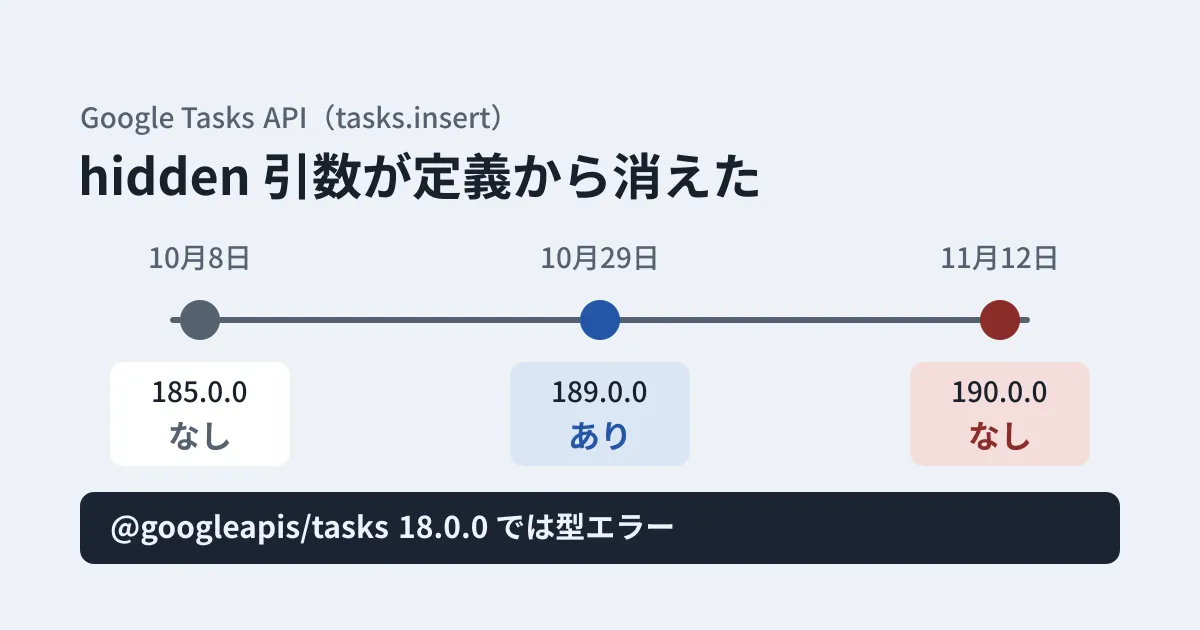
In the Tasks API definition (the Discovery document), the hidden parameter of tasks.insert was added in late October and disappeared in an early November revision. Because the official client is generated automatically from the definition, the new major version released on November 12 no longer includes this parameter in its types. This article covers how the definition changed, what we confirmed locally, how to fix affected code, and the description of moving recurring tasks, which changed at the same time.
How the definition changed
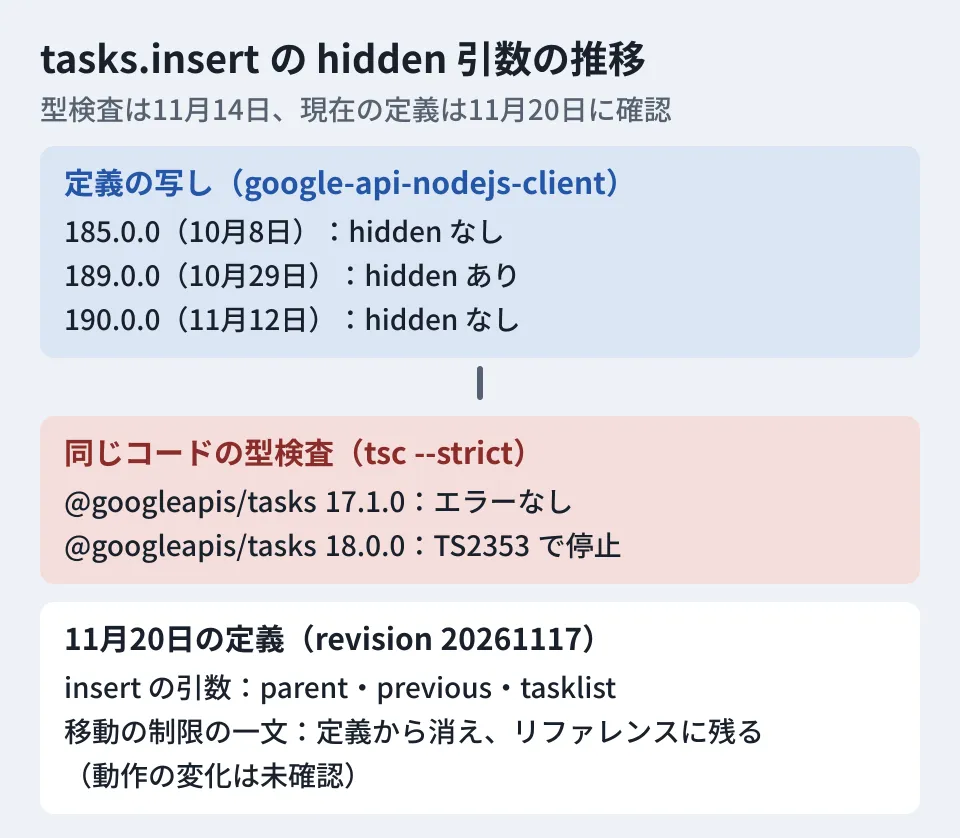
Google publishes each API's definition as a Discovery document, and the official client is generated from a copy of it. Comparing the copies in each googleapis/google-api-nodejs-client release with the current Tasks API definition retrieved on November 14 shows the following progression.
| Definition version (revision) | Where we checked | insert for hidden | Moving recurring tasks |
|---|---|---|---|
| 20251102 | Client 185.0.0 (October 8) | None | States they "cannot be moved between lists" |
| 20261025 | Client 189.0.0 (October 29) | Available | Same as above |
| 20261101 | Client 190.0.0 (November 12) | None | Same as above |
| 20261110 | Tasks API definition (retrieved November 14) | None | Statement removed |
| 20261117 | Tasks API definition (retrieved November 20) | None | Not stated |
The description of hidden in the 189.0.0 copy said, in effect, "Whether to create the task in the state of having been cleared from the list after completion. Only completed tasks can be created as hidden, and nesting or position cannot be specified." The 190.0.0 changelog notes "This release has breaking changes." for 12 APIs, including Tasks.
Google's developer reference (the tasks.insert page on developers.google.com) also listed only tasklist, parent and previous as parameters as of November 20, with no hidden. We have not been able to confirm whether hidden ever appeared in the reference. The latest entry in the Tasks API release notes is dated July 23, 2024, and we found no announcement of this addition or removal.
Note that hidden (Task.hidden) remains as a task field. Its description is "Whether the task was completed when the task list was last cleared. Read-only." What was removed is the parameter specified at creation time.
What we confirmed with the official client types
On November 14, 2026, we fetched @googleapis/tasks 17.1.0 (released October 30) and 18.0.0 (released November 12) from npm and type-checked the same code with TypeScript 5.9.3 (tsc --noEmit --strict). We did not call the API.
import { tasks_v1 } from '@googleapis/tasks';

const params: tasks_v1.Params$Resource$Tasks$Insert = {
  tasklist: '@default',
  hidden: true,
  requestBody: { title: '完了済みの記録', status: 'completed' },
};
The results were as follows.
@googleapis/tasks 17.1.0: エラーなし
@googleapis/tasks 18.0.0:
check.ts(5,3): error TS2353: Object literal may only specify known properties,
and 'hidden' does not exist in type 'Params$Resource$Tasks$Insert'.
In the 18.0.0 type definitions, the parameters of tasks.insert are only parent, previous and tasklist (plus the request body). Code that started using hidden around 17.1.0 will fail type checking after the update.
Affected code and how to fix it
Affected code is code that passes hidden to tasks.insert. When searching, check whether calls to tasks.insert( and hidden: appear in the same place. If you pass hidden as an optional argument when creating tasks with the Apps Script advanced service (Tasks), include that in your review as well (we have not checked the behavior in the advanced service).
The fix depends on your goal. Here are the editorial team's suggestions.
- If you only want to keep a record of completed tasks, remove
hidden. Creating withstatus: 'completed'produces a completed task. The Tasks API list (tasks.list) also returns completed tasks because the default forshowCompletedis True. If you do not want them returned, specifyshowCompleted: falseon the retrieving side. - If you want to hide tasks from view, check the impact of
tasks.clearbefore using it.clearis a method that "clears all completed tasks from the specified list," and cleared tasks become hidden. Because it works on a whole list, tasks that users completed themselves are also affected. Use it only when you can limit the scope, for example by keeping a separate list just for the integration. - Do not pin to an old version just to avoid type errors. We have not been able to confirm what happens if you keep sending a parameter that has been removed from the definition (whether it is ignored or causes an error). Pinning the client to 17.1.0 leaves your code able to keep sending the parameter.
With JavaScript (no type checking), the build will not break after the update. To confirm that behavior has not changed, try creating tasks and retrieving the list with a test account.
The description of moving recurring tasks
In the definitions retrieved on November 14 (revision 20261110) and November 20 (revision 20261117), the sentence "Recurrent tasks cannot currently be moved between lists." has disappeared from the description of destinationTasklist (the destination list) in tasks.move. Because @googleapis/tasks 18.0.0, released November 12, was generated from the revision 20261101 definition, the description in its type definitions still contains this sentence.
On the other hand, the tasks.move reference on developers.google.com still contained this sentence as of November 20. Because the definition and the reference disagree, we cannot conclude that the restriction has been lifted. The Tasks API release notes also have no entry on this point. If your move logic includes a branch that excludes recurring tasks, try actually moving one with a test account before removing it.
Meanwhile, the description of parent in the same tasks.move says "Assigned and repeating tasks cannot be set as parent tasks (have subtasks), or be moved under a parent task (become subtasks)." so recurring tasks still cannot be made parents or placed under another task. Also, Tasks API task fields have nothing that represents a recurrence setting, so you cannot create recurring tasks from the API.
How to track definition changes
In the official client's changelog, the Tasks entry for 190.0.0 is just one line, "update the API," and you cannot tell what changed without comparing definitions. For APIs your business integrations depend on, adding checks like the following on a regular basis helps you notice changes like this one early.
# 現在の定義の版と、tasks.insert の引数の一覧
curl -s 'https://tasks.googleapis.com/$discovery/rest?version=v1' \
  | jq '{revision, insert: (.resources.tasks.methods.insert.parameters | keys)}'
The result on November 14, 2026 was "revision": "20261110" and on November 20 it was "revision": "20261117"; in both cases the parameters were parent, previous and tasklist. Diff the output against the previous run, and if parameters have been added or removed or descriptions have changed, verify the affected processing. Also, if you have Renovate or Dependabot set up to pull in client major version updates automatically, assume that major versions of Google's clients may contain incompatible changes to API definitions, and make sure type checking and tests always pass before they are merged.
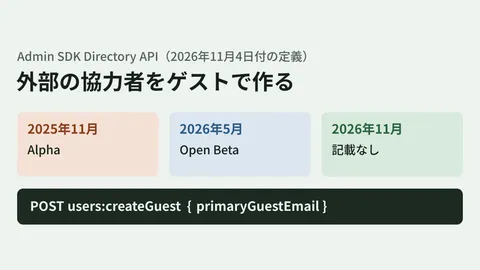
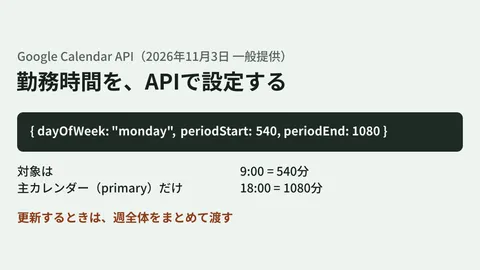
Other articles covering changes to Google Workspace API definitions include bulk-setting working hours with the Calendar API and creating guest users with the Admin SDK. Updates to the Apps Script development environment were covered in our clasp 3.4 article.
Scope of verification
On November 14, 2026, we reviewed the Tasks API Discovery document (https://tasks.googleapis.com/$discovery/rest?version=v1, revision 20261110), the definition copies (discovery/tasks-v1.json) and changelogs for googleapis/google-api-nodejs-client 185.0.0, 189.0.0 and 190.0.0 (desk research). We also fetched
@googleapis/tasks17.1.0 and 18.0.0 from npm and type-checked the same TypeScript code (TypeScript 5.9.3, Node.js 22.23.4). We did not check Tasks API calls, the behavior whenhiddenis sent, or moving recurring tasks. On November 20, we reviewed the Discovery document (revision 20261117), the Tasks API reference on developers.google.com (tasks.insert,tasks.move,tasks.clear) and release notes, and the Google Workspace Updates blog. We have not been able to confirm whetherhiddenever appeared in the reference.
GleamHub's free IT and Google Workspace consultation covers maintaining processes that connect Google Workspace with internal systems and identifying the impact of API changes. Please reach out via our contact form.
References
- Google Tasks API — Discovery document (v1)
- googleapis/google-api-nodejs-client — CHANGELOG(190.0.0、2026-11-12)
- googleapis/google-api-nodejs-client — discovery/tasks-v1.json(googleapis-v189.0.0)
- googleapis/google-api-nodejs-client — discovery/tasks-v1.json(googleapis-v190.0.0)
- npm — @googleapis/tasks
- Google Tasks API — Method: tasks.insert
- Google Tasks API — Method: tasks.move
- Google Tasks API release notes