Directus is software that lets you work with the contents of an SQL database through an API and an admin interface, and it is sometimes used as a headless CMS to hold website articles or product data. The admin interface has a “Shares” feature that lets you show specific articles or data, via a link, to people who are not logged in.
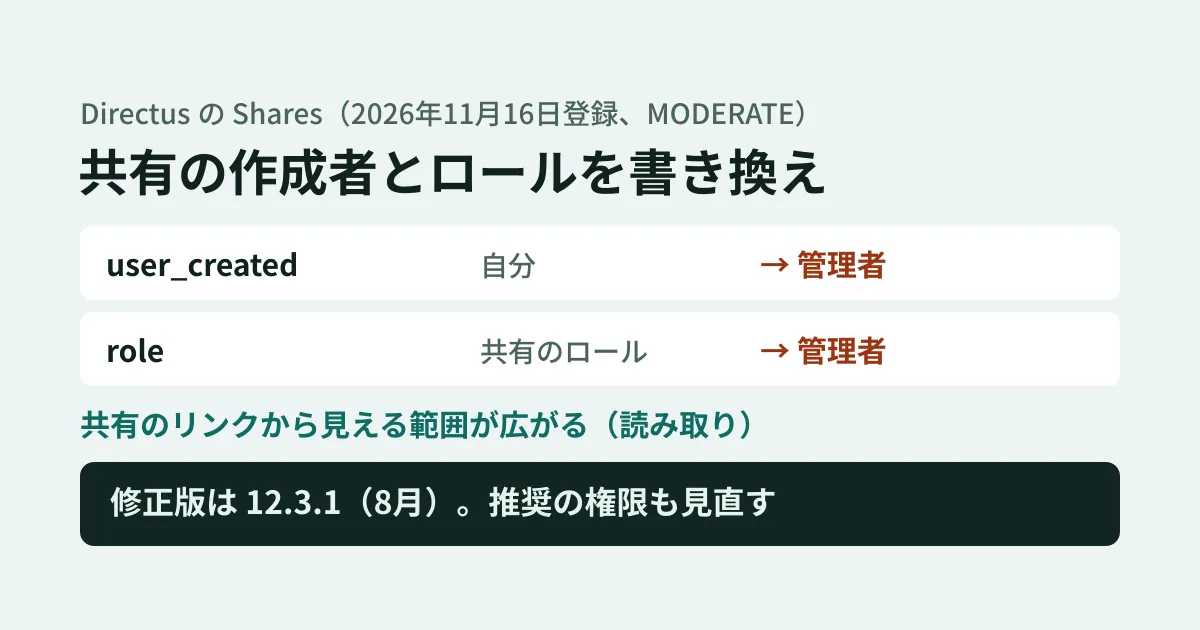
On November 16, 2026, an advisory about this sharing feature (GHSA-7h45-q5jx-7r87, CVE-2026-129239, severity MODERATE) was registered in the GitHub Advisory Database. By rewriting the “creator” and “role” of a share they created to an administrator, a regular user can widen what is visible through that share's link beyond the permissions of themselves and of the share's role. In the directus/directus repository, it had been published as a security advisory on September 2.
The fixed version, 12.3.1, was released on August 25, but the advisory describes the entry point of the problem as the “recommended permissions template.” The settings created when this template was applied are likely to remain in the database (see below), so we recommend also checking your permission settings after upgrading.
What happens
Let us walk through the advisory's explanation step by step.
- The recommended permissions allowed updates to
directus_shares(the list of shares) only for “rows the user created.” However, all fields could be updated, including the creator (user_created), the role (role), the shared item (item) and the collection (collection). - Whether an update was allowed was decided based on the “row before rewriting,” and the row after rewriting was not checked. When a new share is created, the creator is fixed to the user and the system also checks whether the user may share that item, but neither of these was done on update.
- When a share link is viewed, Directus determines permissions from both the share's creator and its role, and applies administrator scope when both are administrators. If both the creator and the role are rewritten to administrator, related data across the entire schema becomes readable from the shared item.
The advisory states that the direct impact is on reads (confidentiality), that this issue alone has no impact on writes or availability, and that it does not by itself yield an administrator token. It also explains that this bypasses the mitigation for the previously fixed CVE-2025-24353 (the mechanism that checks both the creator and the role).
The advisory lists the following three preconditions for being affected.
- A non-administrator user has update permission on
directus_shares. The basic app permissions only allow reading one's own shares, but update permission is included in the recommended permissions template for enabling the sharing feature - There are items the user is allowed to share
- The user knows the IDs of an administrator user and role. In the reported example, they could be read with normal read permissions through the relations of a shareable item
What the fix changes, and what remains after upgrading
The fix commit (5869c06, included in 12.3.1) changes the following two things.
- On the API side: Attempting to rewrite
user_createdwhen updating a share returns an error (“You can’t change the “user_created” value manually”). When rewritingitemorcollection, it checks whether the user may share the new target - On the recommended permissions side: The fields allowed for updates on
directus_sharesare narrowed from all fields (*) toname,collection,item,role,password,date_start,date_end,max_usesandtimes_used
Because of the API-side change, rewriting the creator no longer works in 12.3.1 and later. The recommended permissions, however, are a “template.” When you choose to use the recommended permissions, the admin interface creates their contents as permission rows in the database. The fix commit does not include any processing that rewrites rows already created, so in environments where the template was already applied, the update fields are likely to remain set to all fields even after upgrading Directus (we have not verified this in a real environment). After upgrading to 12.3.1 or later, checking for roles whose update permission still covers all fields helps prevent unintended field updates.
| Release line | Affected versions | Fixed version | Latest as of November 20 |
|---|---|---|---|
| 12.x | Before 12.3.1 | 12.3.1 (August 25) | 12.7.0 (November 18) |
| 11.x and earlier | All (the advisory's range is “0 or later, below 12.3.1”) | No fixed version listed for 11.x | — |
If you are using 11.x or earlier, you need to plan for this, including a migration to 12.x.
The repository's security advisory lists the affected versions as “below 12.2.0.” However, the fixed version there is also 12.3.1, and 12.3.1 is the first release that includes the fix commit. The GitHub Advisory Database range is also “below 12.3.1,” so if you are using 12.2.x or 12.3.0, it is safer to upgrade to 12.3.1 or later as well.
Order of checks (editorial suggestion)
From here on are the editorial team's suggestions.
1. Check the version. Check the version from the Directus package you run (npm ls directus) or the Docker image tag, and upgrade if it is earlier than 12.3.1. The release notes for the latest version, 12.7.0, list changes such as how environment variables are read under “Potential Breaking Changes,” so read them first if you are upgrading that far.
2. Review the update permissions for shares. In the permission settings, check whether any non-administrator role has “update” permission on directus_shares. If so, check whether all fields are updatable, and either narrow them to the recommended fields after the fix described above, or remove the update permission if recreating shares is enough for your operations.
3. Check existing shares. In the list of shares, look for shares whose creator or role is an administrator but that no administrator remembers creating. Delete shares you do not need, and create shares with an expiration (date_end) or a usage limit (max_uses) to keep links from lingering.
4. Review IDs readable through relations. As noted in the third precondition, if administrator user and role IDs can be read through the relations of shared items, they become material for this kind of attack. Check whether relations to users or roles can be followed from the collections you publish or share.
We outlined how the admin interface and content API remain entry points in a headless CMS in our article on headless CMS entry points. We also covered how to think about the architecture in our article on migrating to a headless CMS and our article on Astro and microCMS.
Scope of verification
On November 17, 2026, we checked the GitHub Advisory Database advisory (data from github/advisory-database), the directus/directus repository (fix commit 5869c06, and the recommended permission definitions in tags v12.3.1 and v12.6.1), and the publication dates on the npm registry (document research). On November 20, we rechecked the GitHub Advisory Database, the repository's security advisory, the npm registry (the 12.7.0 release), and the recommended permission definitions and admin interface code in v12.7.0. We have not reproduced the issue by running Directus or checked the operations in the admin interface. We have not actually checked the permission settings screen.
GleamHub can help with building and maintaining CMS-based sites and reviewing permission design through our development, AI and automation consultations. The approach depends on your setup, so please reach out via our contact form.
References
- GitHub Advisory Database — GHSA-7h45-q5jx-7r87(Directus: Share update allows reassigning user_created and role)
- directus/directus — Prevent user created change on share updates(5869c06、#28145)
- directus/directus — Security advisory GHSA-7h45-q5jx-7r87 (repository, published September 2)
- directus/directus — v12.3.1
- directus/directus — v12.7.0
- directus — npm