
At Cloud Next 2026, Google released its official Agent Skills repository (github.com/google/skills). This is a mechanism for loading specialized knowledge required by AI agents on demand, structurally solving the "context bloat" issue caused by overusing MCP.
Notably, this Skills format is originally a standard developed by Anthropic. Serving as a concrete example of collaboration aligned with the recent Google-Anthropic 4 trillion yen investment deal, it can be utilized across all major agent harnesses including Claude Code, Codex, Gemini CLI, and Antigravity.
In this article, we break down the mechanics of Skills, repository contents, installation steps, ADK integration, and how SMB development teams can leverage them.
What are Agent Skills? — Markdown documents optimized for agents
Agent Skills are "concise document formats designed for agents to master specific technologies and tasks." Markdown-based, they can incorporate reference files, code snippets, and other assets.
Differences from MCP and how to choose between them
| Dimension | MCP(Model Context Protocol) | Agent Skills |
|---|---|---|
| Role | Real-time data and API access | Static knowledge, patterns, and best practices |
| Loading | Persistent while connected (ongoing context consumption) | Loaded only when needed (on-demand) |
| Format | Server / protocol | Markdown files |
| Token cost | High (persistent overhead accumulates) | Low (consumed only when used) |
Connecting numerous complex MCP servers consumes tens of thousands of tokens right at startup, squeezing the capacity the model can allocate for actual processing. Skills resolve this problem through an architecture designed to "pull in knowledge only when necessary."
As discussed in our Implementation Guide for In-House MCP Servers, MCP is powerful but carries operational overhead. It is easiest to think of Skills as a complementary mechanism designed to lighten that load.
Why Google adopted the Anthropic-originated format
Skills is a format that Anthropic originally published for Claude Code and opened as a community standard. Behind Google's decision to adopt it directly and publish a repository lie the following factors:
- Ecosystem collaboration strategy: Google invested up to 4 trillion yen in Anthropic in April 2026, aligning steps in technology standards as well
- Cross-vendor compatibility: Having a single format usable across Claude Code, Codex, Gemini CLI, OpenCode, and Antigravity eliminates lock-in concerns on the user side
- Developer aggregation: Attracting AI agent developers across the board with the message that "skill assets remain valuable regardless of which agent you use"
This move can be seen as emblematic of the phase transition from an "individual tool war" to "standard format competition." Running alongside Anthropic-led products like Claude Design, layers across the AI agent market are standardizing at a rapid pace.
Inside the repository — 13 pre-built skills
The official Google repository initially includes Skills in the following categories:
Google Cloud product skills
| Skill | Anticipated use case |
|---|---|
| AlloyDB | PostgreSQL-compatible high-performance DB operations and optimization |
| BigQuery | Data warehouse operations and SQL optimization |
| Cloud Run | Container deployment and scaling |
| Cloud SQL | Managed DB operations |
| Firebase | App development, authentication, and Realtime DB |
| Gemini API | Generative AI integration |
| GKE(Google Kubernetes Engine) | Container orchestration |
Well-Architected Framework skills
| Skill | Details |
|---|---|
| Security | Security best practices |
| Reliability | Reliability and SLO design |
| Cost Optimization | Cost optimization patterns |
Recipe skills
| Skill | Details |
|---|---|
| Onboarding | Google Cloud project initial setup |
| Authentication | IAM and service account management |
| Network observability | VPC logging and trace configuration |
With these 13 pre-built Skills, asking an agent to "write a query in BigQuery," for example, will dynamically load the BigQuery Skill to return an answer reflecting the latest 2026 best practices, SQL syntax, and cost optimization guidelines.
Which agents can use it? — Cross-vendor compatibility
The biggest highlight is that it is not tied to a specific agent. Installation is also completed with a single command.
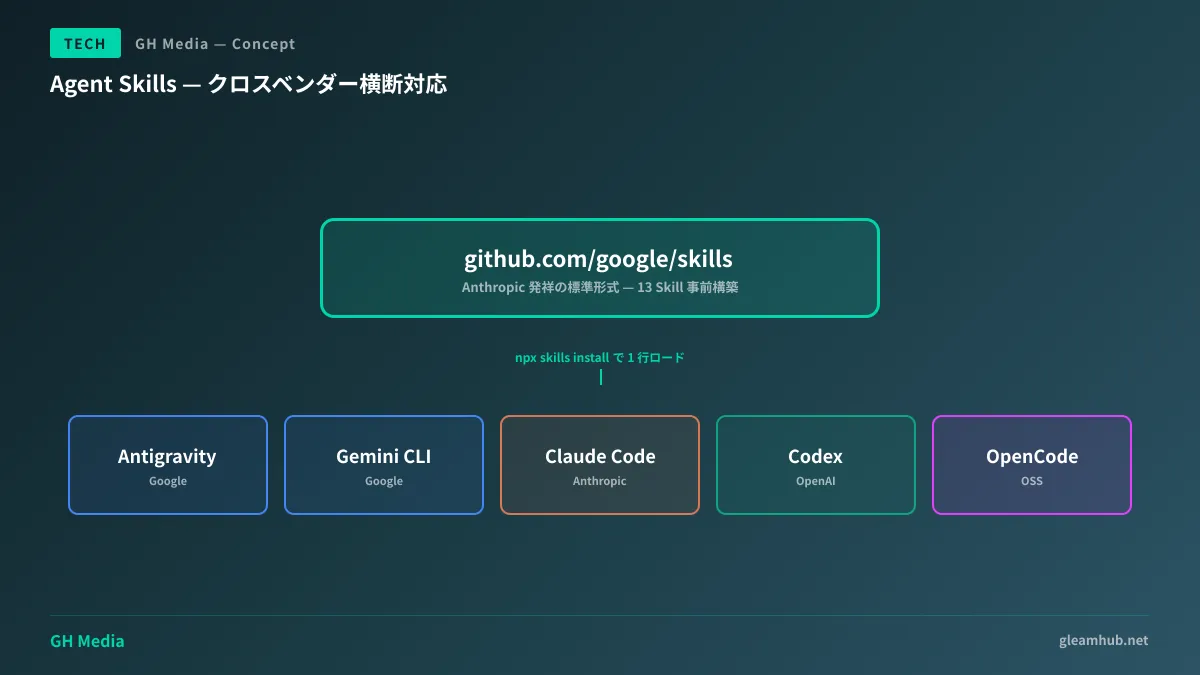
Installation Steps
# Google 公式 Skills リポジトリを丸ごとインストール
npx skills install github.com/google/skills

# 個別 Skill だけインストール(例:ADK 関連のみ)
npx skills add google/adk-docs -y -g
Verified agents
| Agent | Status |
|---|---|
| Antigravity(Google) | ✅ Native support |
| Gemini CLI(Google) | ✅ Native support |
| Claude Code(Anthropic) | ✅ Originator of the Skills format |
| Codex(OpenAI) | ✅ Compatible |
| OpenCode(OSS) | ✅ Compatible |
| Other third parties | ✅ Supported if Skills specification is implemented |
This holds particularly significant value for SMBs like GleamHub that position Claude Code at the core of their implementation workflows, because the Skill assets Google is cultivating can be used as-is in local Claude Code environments.
Integration with ADK — Dynamic loading via SkillToolset
Google's Agent Development Kit (ADK) provides an API called SkillToolset, which can be used to achieve behavior where an agent loads Skills only when needed. In Python pseudocode, it looks something like this:
from google.adk import SkillToolset

# Skill リポジトリを参照する Toolset を生成
skills = SkillToolset(repo="google/skills")

# エージェントの実行時に必要な Skill を動的にロード
agent.add_toolset(skills)
result = agent.run("BigQuery でユーザー別売上を集計して")
# → Agent が "BigQuery Skill" を自動的に読み込んで回答
The relationship is structured as "Skill = knowledge recipe" and "Toolset = index for automatically looking up recipe collections." Because there is no need to dump all knowledge into the context window every time, both token costs and response latency improve.
Developer use cases — In SMB and custom development environments
1. Client projects adopting Google Cloud
When a client's infrastructure runs on GCP, npx skills install github.com/google/skills lets the agent learn the latest best practices for BigQuery, GKE, and Cloud Run in one shot. It feels like Skills creates "drawers of knowledge" on the engineer's behalf, without requiring individual engineers to read through official documentation.
2. Authoring and internally sharing proprietary skills
Beyond the Skills published by Google and Anthropic, it is also possible to package company-specific domain knowledge into Skills. For example:
acme-corp-coding-style.md— Internal coding standardsacme-deploy-procedure.md— Internal deployment proceduresacme-postmortem-template.md— Incident postmortem format
Place these in an internal private repository and load them into every engineer's environment via npx skills install. This directly translates into team design where "tacit knowledge does not dilute as headcount grows."
3. Ready-to-use knowledge for AI agent builders
When designing managed agents like Claude Managed Agents, incorporating Skills enables instant bootstrapping of "specialized expert agents." For instance, roles like a "dedicated BigQuery agent" or "dedicated security review agent" can be defined simply by their set of Skills.
Summary — A new chapter in standardization and what it means for developers
To summarize this release in three lines:
- Google fully adopted the Anthropic-originated Skills format and released 13 official Skills
- Solves the MCP context bloat problem via on-demand loading
- Usable across all agents including Claude Code, Gemini CLI, and Codex
From an SMB development team perspective:
- Reduced setup overhead: GCP practices reflected in agents with a single command
- Zero agent switching cost: Skill assets remain usable even when migrating from Claude Code to Gemini CLI
- Structuring internal knowledge: The flow of tacit knowledge → Markdown documentation → shared Skills across the team becomes the standard
The center of gravity in the AI agent ecosystem is shifting from "the merits of individual tools" to "asset value on standardized formats." Taking the time now to organize in-house Skills looks likely to be a move that determines development productivity three years down the line.


