Even though a project management tracker was moved to a spreadsheet, ultimately no one except the person who made it opens it. This is a common symptom. The root cause lies not in operational rules, but in the interface itself. Once the columns exceed around 30, it turns into a sheet where anyone other than the person in charge cannot tell where to look. Even just updating a status requires scrolling horizontally to hunt for the target cell.
Until now, there were only two options to solve this: endure it as a spreadsheet, or rebuild it from scratch as an internal business system. Sheets canvas, which has been rolling out gradually since August 10, 2026, inserts a third option right between the two.
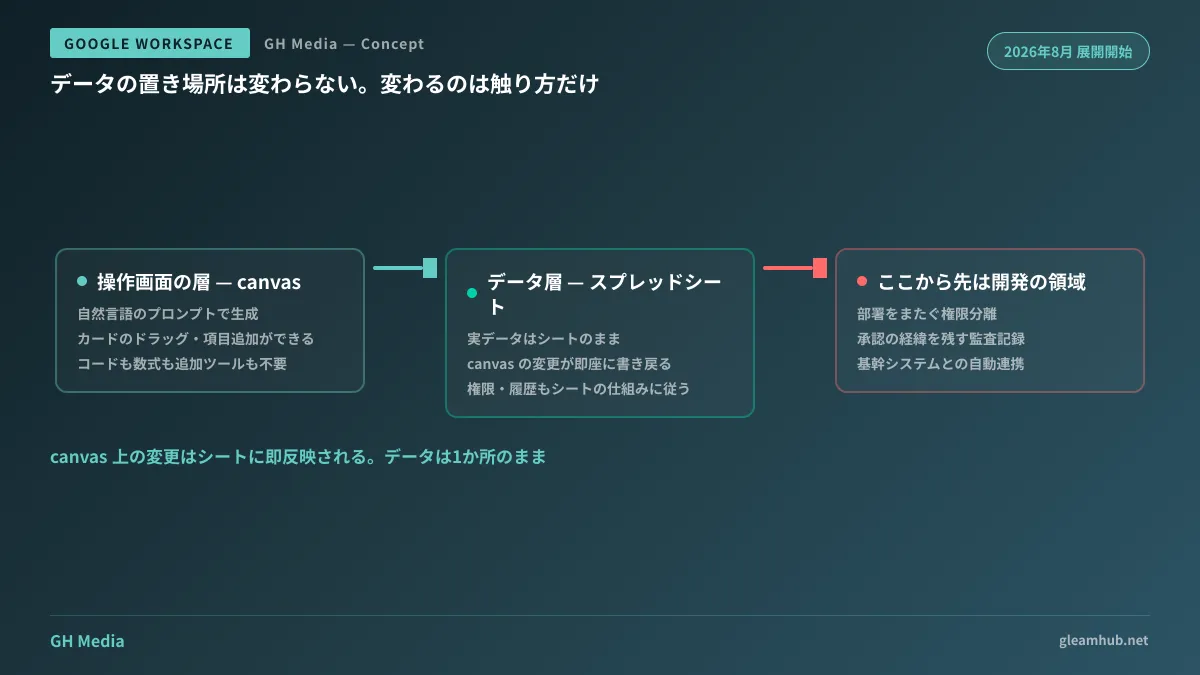
However, this does not mean that custom development will no longer be necessary. Rather, it makes it clearer than before where the territory of custom development begins.
Overlaying another interface on top of the sheet
Sheets canvas is a feature that uses Gemini to overlay an interactive operation interface directly over spreadsheet data. By providing instructions in natural language prompts, visualizations and workflows come together without writing any code, formulas, or using third-party tools.
What is important is that this is not a read-only dashboard. When you drag task cards or add new items on canvas, those changes are immediately reflected in the original sheet. The structure ensures that the table and the app are looking at the exact same data.
In other words, where the data resides remains unchanged in Google Sheets. All that changes is how you interact with it. This distinction becomes critical in later decisions.
Whether you can try it in-house right now
Because rollout conditions are subdivided in detail, checking whether it is available in your organization first will prevent your deliberations from going in circles.
| Condition | Details |
|---|---|
| Eligible plans | Google AI Pro / Ultra, Business and Enterprise Standard/Plus, Google AI Pro for Education add-on |
| Rollout timing | Gradually starting August 10, 2026 for Rapid Release, and August 31, 2026 for Scheduled Release |
| Language | English only at initial release |
| Prerequisite settings | "Smart features and personalization" must be turned on on the user side |
The last row is what tends to get overlooked. In organizations where this setting is disabled in the Admin console, canvas will not appear even if license requirements are met. When AI features have been shut off across the board, even if that decision itself is reasonable, failing to inventory what has been turned off will leave you in a state where features that should be usable remain unavailable. We organized the relationship between this setting and Gemini features in Gemini plan selection for Google Workspace.
Additionally, there are per-user usage limits for creating and editing. While not noticeable during trial usage, if you design processes around incorporating it into company-wide routine operations, this limit will become an operational bottleneck.
Tasks where canvas suffices and tasks where it falls short
Because it is so easy to "just build it," failing to draw the line beforehand will cause trouble later. In practical terms, rather than evaluating feature availability, decisions are best made by what the business workflow requires.
Canvas suffices when all of the following conditions are met:
- Data ownership is confined to a single department. Multiple departments do not need to interact with the same data under different permission levels.
- Operations do not halt if records are lost. There is no strict requirement to audit who changed what and when after the fact.
- It is not connected to other systems. Automated integrations with core enterprise systems or accounting software are unnecessary.
- It only needs to be used while the creator remains at the company. It is suitable for limited-duration management that does not require formal handovers.
Conversely, if even one of these conditions is not met, canvas can serve as an entry point, but it cannot be the final destination.
The second condition in particular is frequently underestimated. While Google Sheets retains version edit histories, it is fundamentally distinct from records indicating whose approval brought about this state, which enterprise systems provide. In workflows like order management or invoicing where audit trails are required later, this becomes the primary issue.
The same applies to the third condition regarding integrations; as long as operations rely on manually exporting and importing CSVs, prettying up the interface will not reduce manual transcription work. The criteria covered in When to switch from Excel operations to system development apply directly to drawing this line.
Where the ability to "just build it" comes back to haunt you
As the scope of what can be built in-house with no-code expands, what actually proliferates are small mechanisms whose full picture no one understands.
This is exactly what happened when AppSheet spread, and it is not a new phenomenon. A staff member builds something for their own tasks, and the moment they transfer, it continues running without anyone able to fix it. Only when it breaks do people realize it was part of an essential business process.
In the case of canvas, because the foundation is a spreadsheet, it is even more prone to this condition. Because everything is self-contained within a single file, there is no mechanism to count how many exist across the company. They multiply without ever appearing on an IT asset management registry.
A practical countermeasure is to decide the permissible scope for using canvas in advance. Rather than banning it, draw a clear line stating, "consult the IT team if conditions exceed this threshold." The four conditions from the previous section can serve directly as a prototype for internal rules.
We cover how to identify when no-code setups reach their limits in Realistic scopes for building business apps with AppSheet, and deciding when to transition to custom development after hitting SaaS constraints in Limits of kintone and custom development.
What to do next
First, pick one spreadsheet in your company that is currently the least opened. One with many columns where updates depend heavily on a specific person fits the bill. Whether canvas can improve it can be judged in several dozen minutes simply by overlaying it.
Then, check whether that data satisfies the four conditions mentioned above. If it meets them, in-house development is sufficient. If any condition is violated, use canvas as a temporary stopgap while documenting the reasons for violation as system architecture issues. That will define your future development scope.
At GleamHub, our free IT and Google Workspace consultations can help you distinguish which of your business operations can be satisfied in-house and where development is necessary. Because conclusions depend on data structures and dependencies on existing systems, please consult us individually. Reach out through Contact Us.
Sources
- Use Sheets canvas to visualize data in custom, interactive mini-apps — Google Workspace Updates
- Bring your spreadsheet data to life with Sheets canvas — Google Blog
- Create a Sheets canvas — Google Docs Editors Help
- Google launches Sheets canvas for Gemini mini-apps — TestingCatalog
- Google Sheets gets Gemini-powered Canvas for interactive data — Android Authority