When companies begin planning a website renewal, there is one question we always confirm first: "Do you know which server your current site is hosted on?"
It is surprisingly common that they cannot answer. Five years ago, an agency said, "We'll handle the server," and that was that. Invoices arrive each month labeled simply as "maintenance fees." No one knows the login credentials for the domain management portal.
As long as the site runs smoothly, this state causes no immediate problems. Trouble starts when you want to switch agencies, or when that agency goes out of business. In either situation, the challenge becomes whether administrative authority can be transferred.
The three meanings behind "we will provide the server"
First, let us review the available options. In practice, hosting locations for corporate websites fall broadly into three categories:
| Hosting type | Best suited for | Key points for clients |
|---|---|---|
| Shared hosting | Sites where pages are assembled server-side, such as WordPress | Contracts often end up under the agency's name. Check whether PHP version upgrades are included in maintenance. |
| Static hosting | Sites serving pre-rendered HTML | Fast rendering and lightweight operations, but requires a separate publishing mechanism. Clarify who handles deployments. |
| Cloud (GCP, AWS, etc.) | Sites with member portals or external system integrations | Pay-as-you-go pricing makes costs less predictable. Verify whether billing accounts can be registered directly to your company. |
It is not a matter of which option is superior, but of matching the architecture to the website's technical requirements. Static hosting is also delivered via cloud platforms. These categories are not mutually exclusive; choose based on necessary publishing functionality, operational workflows, and budget ceilings. Conversely, if your site requires contacting an agency for every update, continuous iterative site improvements will grind to a halt.
In recent years, European hosting providers emphasizing data residency have emerged, reflecting a growing movement to specify physical server locations as an explicit choice. While this is rarely a strict requirement for domestic small and medium-sized businesses, having forms that handle client data makes knowing where your data resides a valid operational concern.
Four roadblocks encountered during migrations
Migrating a website is often more troublesome than choosing where to host it. Technical hurdles are fewer than expected; delays almost always occur at four predictable points.
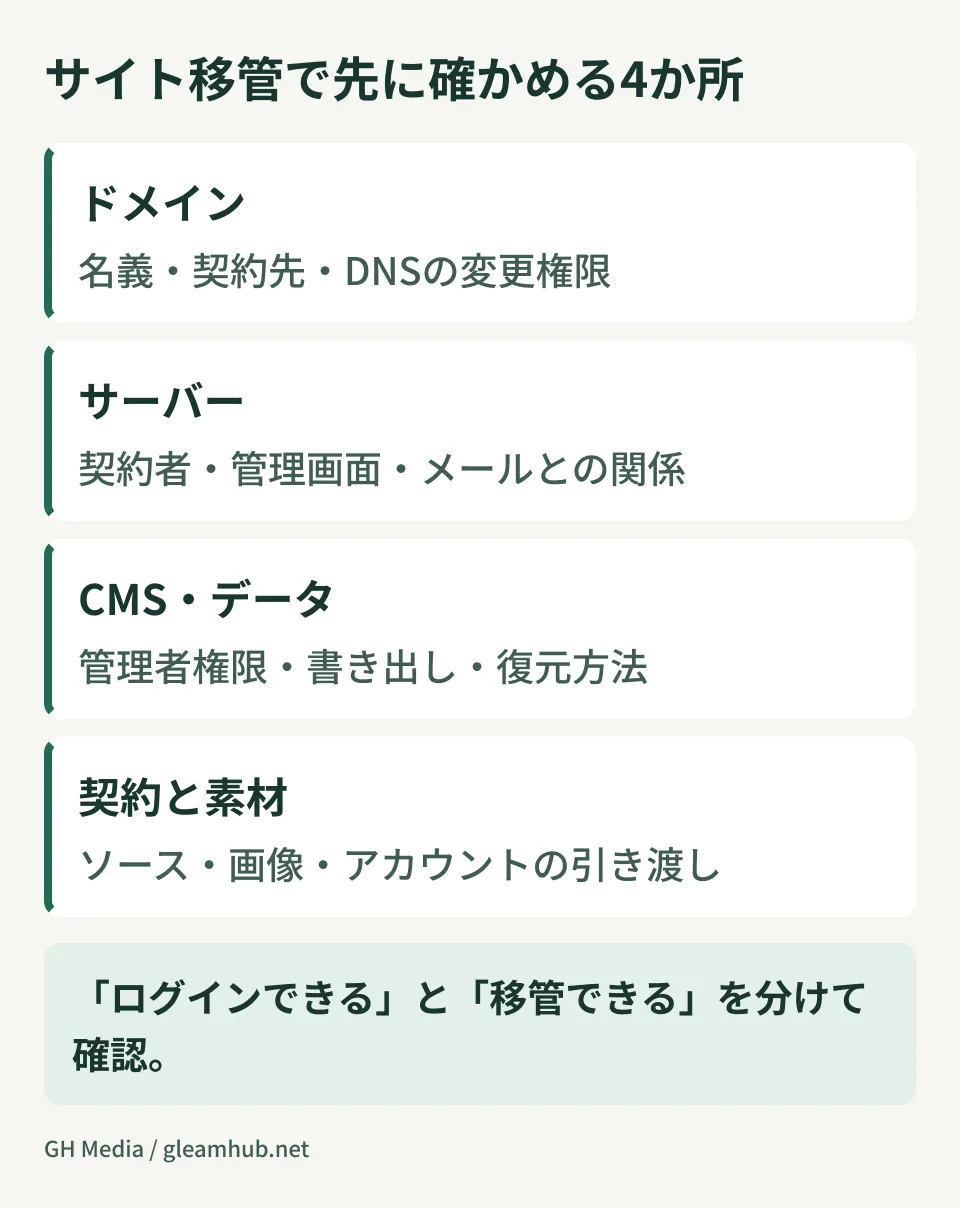
1. Domain ownership
Is the registrant for example.co.jp set to your company? If registered under an agency's name, their cooperation is essential for any transfer. While relationships are cordial, this is not an issue, but transfers during disputes take considerable time. Verify the registrant/contractor separately from the administrator who manages the portal. Simply having login access does not confirm that your company is the legal registrant.
2. DNS management location
Even if you own the domain, if DNS configuration privileges—which determine which server traffic routes to—reside elsewhere, your company cannot control switchover timing. Even with the site prepared on a new server, it cannot go live until someone updates the DNS records.
3. Email
This is the single most frequently overlooked aspect. In many cases, custom domain emails like info@example.co.jp operate on the same shared server as the website. If you proceed assuming you are only moving the website, dropping MX records or canceling the server subscription will take down company email. If you only update web-specific A or CNAME records appropriately, moving email at the same time is unnecessary. Always confirm where email is running before drafting a migration plan.
4. Deployment procedures
Who deploys the new site, and how? If the architecture only allows uploads from an agency's local environment, your ability to update disappears the moment you end that relationship. Ensure that source code repositories and deployment access remain with your company. This shares the same root issue as who retains approval authority over website updates.
Questions to ask when placing an order
When commissioning new development or taking over an existing site, clarifying these four points at the quotation stage preserves your options years down the line:
- Can the domain registrant be set to our company? (If already registered under another party, can it be transferred, and what is the process?)
- Can server and DNS contracts be under our company's name? If not, what is the reason?
- Where will custom domain emails operate? Can they be separated from the website?
- Will our company receive the site's source code? Can the site be published using only what is handed over?
Asking these four questions reveals a great deal from the vendor's response. Agencies that can explain domain ownership with specific procedures have handled handovers before. Agencies that brush it off with "we can handle that later" are likely building systems without handovers in mind. The goal of these questions is not just gathering information, but discovering which type of vendor you are dealing with.
Some agencies answer "yes" to all four immediately, while others insist "it only runs in our environment." The latter is not inherently bad, but costs must be compared on that basis. Even if production fees seem lower, an untransferable setup means the rebuild required at your next redesign represents deferred expenses.
While benchmark pricing is outlined in our guide to website development costs, be sure to align these four conditions across vendors before comparing prices.
Servers can be changed later; ownership is hard to undo
Where a site is hosted can always be changed later. If the site is built cleanly, migration itself is not a prolonged endeavor.
Conversely, resolving domain ownership and email dependencies becomes exponentially harder the longer it is left unattended. What should be secured first is not the hosting tier, but legal ownership and administrative authority. As long as your company holds these keys, hosting decisions can be made calmly whenever needed.
What to do next
Check which registrar holds your company's domain and when it expires. Verify the registrant name, renewal date, and contact information through the registrar's admin portal and contract records. Public WHOIS/RDAP records offer helpful context, but privacy protection or proxy registrations mean a displayed name alone does not prove third-party ownership.
Additionally, list who within your company has login credentials to domain and server management consoles. Having only a single person with access carries virtually the same risk as leaving it with an outside vendor. If that single person leaves or transfers, the number of authorized individuals instantly drops to zero.
GleamHub provides consultations on website redesigns, hosting architecture reviews, and legacy site handovers through our website development and renewal consulting. Because next steps depend on your current architecture and domain status, please reach out via Contact Us.