"Our distributor notified us that support for our on-premises package edition of Cybozu ends next year. Honestly, we don't know whether to extend it or switch to something else." We recently received this consultation from a general affairs manager at a manufacturing company of about thirty employees. The longer a tool has been in place, the heavier the decision to replace it feels. Furthermore, once you think beyond picking a destination to how you will bring over accumulated emails, calendar events, and bulletin board posts, it is easy to hesitate. That hesitation is completely understandable.
Behind this dilemma lies a concrete timeline: Cybozu Office on-premises (package edition) sales end at the end of September 2026, with support ending one year later at the end of September 2027. This forces many companies to face a three-way choice: migrate to Cybozu's cloud edition, or switch to Microsoft 365 or Google Workspace. Focusing on Google Workspace migrations, this article covers decision-making criteria and practical cautions for email and data migration. Our goal is to break down that vague feeling of "this seems daunting" into an actionable checklist of items to verify.
How to Decide Whether to Switch in the First Place
First and foremost, do not approach the discussion assuming a migration is mandatory. If maintaining the status quo causes no issues, there is no need to force a transition. The evaluation criterion is straightforward: can your company accept the risk of continuing to run the software after support ends? Unsupported products receive no patches when vulnerabilities are discovered, making them potential gateways for data breaches. If that risk is unacceptable, evaluating your options now—while you can still dictate the timeline yourself—is the prudent course.
Structuring your criteria for selecting a destination makes the decision much clearer:
| What You Prioritize | Best-Fit Option | Details |
|---|---|---|
| Keeping existing workflows as unchanged as possible | Cybozu Cloud Edition | Minimal learning curve for end users |
| Workflows centered on Excel, Word, and PowerPoint | Microsoft 365 | Native compatibility with Office products |
| AI utilization, Gmail, and low operational overhead | Google Workspace | Browser-based workflows and simple administration |
Google Workspace is best suited for organizations seeking browser-based management free from vendor lock-in to specific installed software. Whether Microsoft 365 or Google Workspace is a better fit depends on how heavily your existing workflows rely on Office files. We cover the distinctions in detail in our comparison between Google Workspace and Microsoft 365, which we encourage you to review if you are currently in the vendor selection phase.
Email Migration Is the Biggest Hurdle: Register First, Switch Later
Email requires the most vigilance during any migration. The golden rule here is to register all email addresses used in the legacy environment on Google Workspace as users or groups before switching DNS MX records (the settings that determine email routing). If you reverse this order, incoming messages arriving right after the cutover will bounce as undeliverable, causing missed communications with clients and partners.
To migrate historical emails themselves, utilize the migration tools provided by Google. For moves from Microsoft 365 (Exchange), administrators can use a dedicated utility (Google Workspace Migration for Microsoft Exchange) to transfer emails, calendars, and contacts centrally without burdening individual staff. Furthermore, in May 2026, Google launched a beta feature that automatically imports user profile information from Microsoft 365 into Google Workspace (initially starting with smaller batches). Because these tools evolve continuously, verifying what is currently available for your specific migration source against official documentation before starting is the safest approach.
How to Handle Cybozu-Specific Bulletin Boards and Custom Apps
While migrations from Microsoft 365 enjoy relatively well-established toolchains, migrating from Cybozu presents greater challenges when dealing with non-email data. Cybozu environments typically accumulate bulletin board posts, schedules, and custom-built applications (such as inventory management or daily reports), none of which can simply be funneled directly into equivalent Google Workspace features.
A realistic roadmap requires categorizing data by its nature. Put calendars and contacts through standard migration pipelines. For bulletin boards and files, selectively move only what is genuinely needed into Google Drive or Google Sites, consciously choosing not to migrate legacy archives. For custom applications built inside Cybozu, individually design their replacements within Google Workspace—a choice closer to redevelopment than simple data transfer. Aiming to transfer everything as-is causes both man-hours and costs to balloon, so using the migration as an opportunity to audit and retire unused assets ends up being the most cost-effective path.
Treating Post-Migration Setup as Seriously as the Transfer Itself
Even if data is transferred successfully, rolling out the platform company-wide without thorough initial configuration invites a different set of problems: overly permissive shared drive permissions where everyone can view everything, having only a single administrator, or ambiguous external sharing policies. Migration projects often fixate entirely on moving data, but securing how the new environment is used is an integral part of the migration itself.
Specifically, configuring permissions tailored to organizational hierarchy, appointing multiple administrators, and establishing baseline external sharing policies must all be completed prior to organization-wide rollout. The foundational settings you should configure during deployment are compiled in our complete guide to Google Workspace deployment. Additionally, reviewing unneeded licenses during a migration frequently reduces costs, a perspective we discuss in our article on license cost optimization.
First, Lock Down the Migration Source and Data Scope
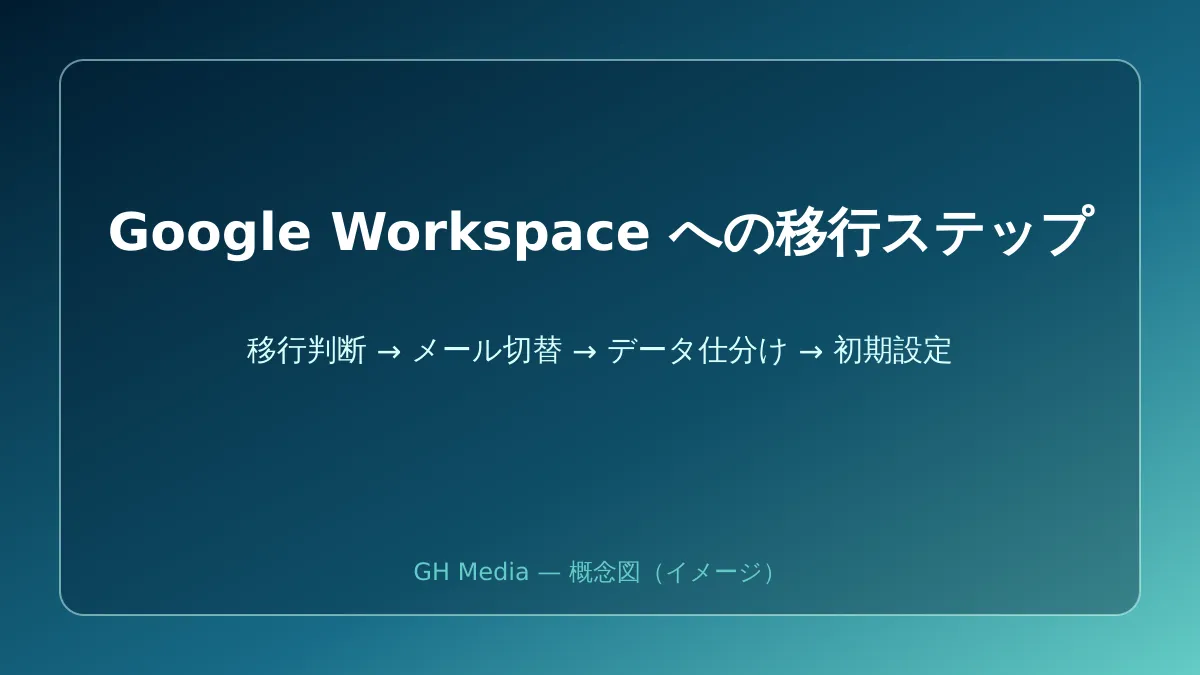
Groupware migration is not as monolithic as it might seem. Broken down, it consists of four distinct phases: deciding whether to switch, safely cutting over email, categorizing non-email data, and completing post-migration configuration. The first task is to confirm your migration source (whether Cybozu or Microsoft 365) and define up front what data to bring along and what to discard. Once this scope is settled, you can determine the required migration tools and accurately estimate project effort.
Resisting the urge to over-expand scope and focusing strictly on the data your business actively uses today is the single most effective way for SMBs to achieve a smooth migration.
If you are unsure which platform fits your organization, how to replace custom Cybozu applications, or how to schedule an email cutover without downtime, please reach out via GleamHub's free IT and Google Workspace consultation. From auditing your source environment to defining migration scope and planning cutover day procedures, we work alongside you tailored to your company's infrastructure.
Sources
- Migrate from Microsoft to Google Workspace | Google Workspace Learning Center
- Perform a Google Workspace Migration to Microsoft 365 or Office 365 | Microsoft Learn
- Key Considerations for Transitioning and Migrating Ahead of Cybozu Package Edition End of Support | rakumo
- Automated User Import Feature from Microsoft 365 to Google Workspace (May 2026 Release) | Dontokoi! Google Workspace