"Do we have to replace our meeting room equipment again?" Whenever hardware strategy changes are reported, this is the immediate reaction. For a company that deployed dedicated Meet devices across three conference rooms just a few years ago, it is a natural concern.
In September 2026, Google announced that it will transition Meet conference room hardware from ChromeOS to an Android (AOSP) base. While headlines sound like a call to replace hardware immediately, the same announcement explicitly stated that full updates and security patches will continue through September 2030 for select existing ChromeOS models. Before scrambling to secure budget, verify which camp your company falls into.
What is changing and what is staying the same
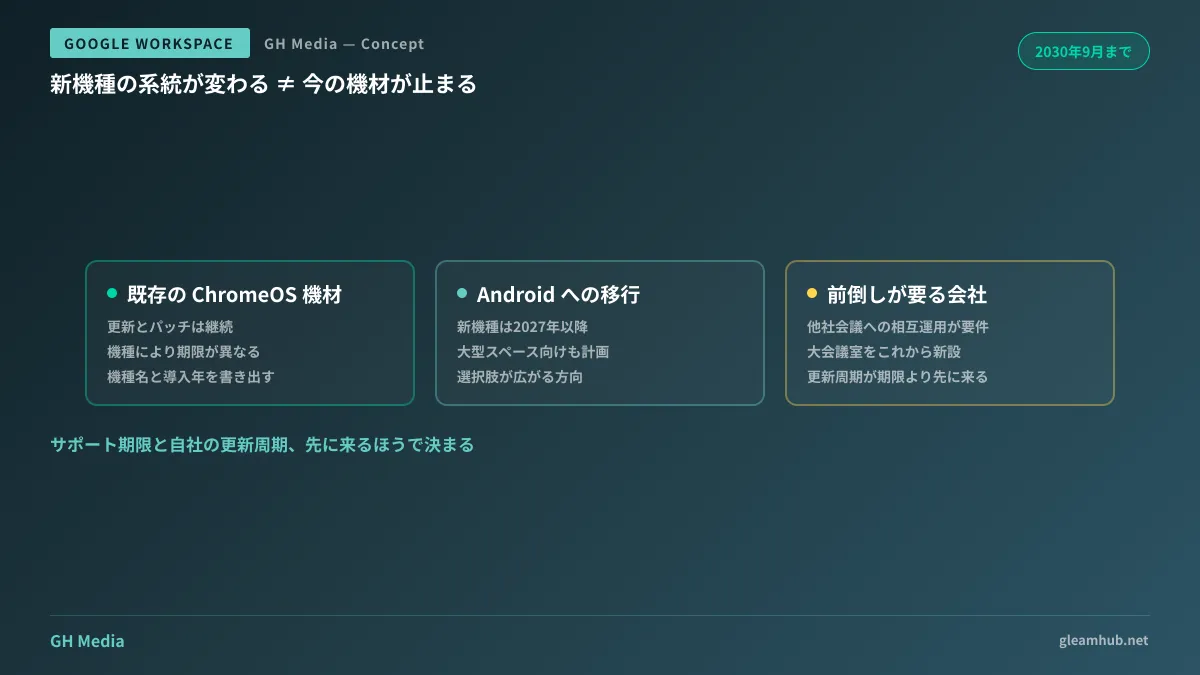
What is changing is the platform for upcoming new hardware. Partners such as Logitech, Neat, and HP Poly will roll out Android-based models starting in 2027. Google cited faster feature delivery, a broader selection of form factors like all-in-one bars, and easier interoperability with third-party services as reasons for the shift.
What is not changing is how currently running ChromeOS devices are treated. Updates, security patches, and stability fixes will continue to be delivered as before. "The platform for new models is shifting" and "existing hardware will stop working" are entirely different matters, and only the former was announced.
You can evaluate your situation using these three scenarios:
| Company Scenario | Recommended Action |
|---|---|
| ChromeOS equipment installed a few years ago with no complaints | Confirm support end date and keep in place |
| Currently planning new or expanded conference rooms | Factor the release timing of Android-based models into the plan |
| No dedicated room hardware; operating with laptops | First determine whether dedicated hardware is even necessary |
A surprising number of companies fall into the third row. The decision of whether to introduce dedicated hardware in the first place is detailed in How Far Can Laptops and TVs Take You?
How to check if your current equipment is affected
The September 2030 deadline is not applied uniformly to all ChromeOS hardware. While relatively recent models will receive full support until that deadline, older generation equipment may have earlier end dates.
Here is the verification procedure:
- List installed model names and quantities from the Google Meet hardware inventory in the admin console
- Check each model's Auto Update Policy expiration date via manufacturer or Google support documentation
- Compare those dates against your internal hardware refresh cycle
Skipping the third step leads to inconsistent decisions. Unless you predetermine your company's hardware replacement cycle, debates over "it's still usable" versus "it's already obsolete" will reset every time. Equipment reaching its refresh cycle before the support deadline should be replaced regardless of this announcement.
What can and cannot be concluded from the announcement
Announcements of this kind easily become distorted as they circulate internally. In actual consultations, the following three points are frequently conflated:
"Existing equipment will become unusable in 2027" is incorrect. 2027 marks the arrival of new Android-based models, not the end of life for existing devices.
"Moving to Android means third-party conferencing services can be freely installed" is also not supported by the announcement. Interoperability is provided within certified hardware and supported service pairings, not an open door to install arbitrary apps.
"New features will arrive on existing hardware at the same pace" is not guaranteed either. While continued updates and security patches are guaranteed, the announcement does not state that new features will roll out simultaneously to old and new hardware. That remains to be seen based on actual rollout.
For internal communication, keeping it to two sentences is most accurate: "Current equipment remains secure and usable through its support deadline. The new hardware lineage will begin rolling out in 2027."
Valid reasons to accelerate replacement timelines
While keeping existing gear is generally best, moving up replacement timelines can make sense under certain conditions.
One scenario is the requirement to join third-party meetings directly from conference rooms. Interoperability between Meet and Microsoft Teams targets room hardware, and compatibility varies by model. Because which organizations can benefit depends on hardware generation, companies whose partners primarily use Teams may want to prioritize upgrades.
Another scenario is outfitting new large spaces. Because Android-based hardware designed for large meeting spaces is planned for 2027 and beyond, companies building large conference rooms today should consider whether shifting timelines provides strategic value.
Conversely, companies with few rooms, primarily internal meetings, and no complaints about current equipment have zero reason to accelerate replacements. In that case, the only action needed is adding the support deadline to the calendar.
What to do next
Compile an inventory of installed model names and deployment years for each conference room. This information is typically maintained in general affairs asset ledgers, or can be found on rear device labels.
Add a column for each model's support deadline to that inventory. If the support deadline falls after your internal refresh cycle, there is no need to act on this announcement. Only hardware whose support expires before your refresh cycle needs to be submitted for subsequent budget reviews.
GleamHub offers free IT and Google Workspace consultations covering conference room architecture, handling existing hardware, and reviewing Google Workspace admin settings. Because optimal setups depend on room counts and usage, please reach out via Inquiries.
Sources
- Transitioning Google Meet room hardware to focus on Android (AOSP), ongoing ChromeOS support unchanged and up to September 2030 — Google Workspace Updates
- Google Meet hardware dropping ChromeOS for Android — 9to5Google
- Google Meet Hardware Is Ditching ChromeOS in Favor of Android — Android Headlines